1400 words (10 minutes reading time) by Carole Parkinson
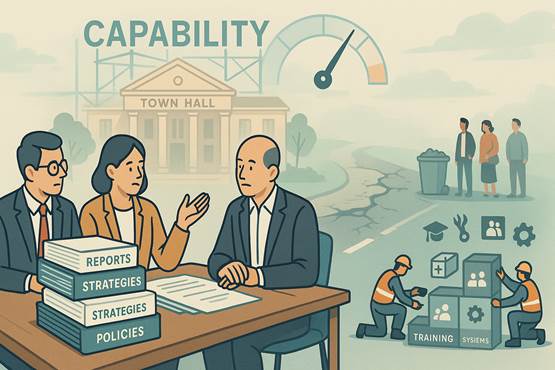
In the previous piece on the capability trap, Colin Weatherby showed how councils get stuck in a cycle of “do more with less” that slowly erodes their ability to deliver safe, reliable services. This piece zooms out. It asks a broader question: what has happened to capability across the local government sector, and why have we barely noticed its drift?
We talk a lot in local government about money, policies, structures and compliance. We almost never talk about capability. Yet capability – especially the ability to implement – is critical for governments.
From the capability trap to sector drift
My argument is blunt. Victorian councils have not really understood the role of capability. Because we don’t name it, measure it or protect it, we’ve quietly allowed some of our most important capabilities to erode – including the basic ability to implement projects and services at scale and on time.
Weatherby explains what this looks like inside a single council service: years of “do more with less” that undermine preventative work, training and supervision until the capability to deliver collapses. The same pattern is visible across the sector if you look carefully.
Local government doesn’t have a shared understanding of capability. We don’t recognise it or place it on risk or asset registers. We don’t report on it to councillors. We rarely ask, “What capabilities are we creating, maintaining or expending this year?” As a result, vital capabilities can be lost while performance still looks fine – until working harder no longer closes the performance gap.
There was an interesting article in the New York Times on 9 November 2025 (“Mamdani Isn’t the Future of the Democrats. This Guy Is.” by Binyamin Appelbaum) about the Democrats and the tussle between centrist and progressive candidates. Appelbaum says Governor Josh Shapiro is popular because he has shown that government can work and “get shit done”. When a highway collapsed, he reopened it in just 12 days. That is capability in action: not another plan, but a road people can drive on again.
Appelbaum warns that parts of the US system have lost the capability to deliver big projects. His story about Shapiro is a reminder that the success and legitimacy of modern government rests on delivering for people: when something breaks, can you fix it – and fix it fast? The uncomfortable question for Victorian local government is: are we quietly moving in the opposite direction – towards a system that isn’t responding when it matters, because we’ve let capability drift?
In the state capability literature, developed countries aren’t defined by having clever policies, programs or projects; they’re defined by being able to implement reliably. Roads get built. Waste gets collected. Permits get processed.
What developed systems can do that we’re losing
In Building State Capability, Matt Andrews, Lant Pritchett and Michael Woolcock argue that government capability to implement is what defines a developed nation. By that definition, community quality of life is threatened if councils steadily lose implementation capability. You can’t feel like you live in a developed country if roads aren’t renewed on time, maternal and child health services aren’t available, and permits take forever – no matter how many glossy strategies exist.
Andrews, Pritchett and Woolcock describe how governments in developing nations invest in policies, programs and projects that they are unable to implement. They call this “skewed” capability and show how countries adopting the exact same policy can experience outcomes ranging from failure to perfection. Whether a policy or program achieves its desired outcome depends on implementation.
How councils have quietly lost key capabilities
Over the last decade, many councils have quietly lost key capabilities as a direct consequence of “work harder” responses to rate caps and budget pressure:
- The ability to deliver capital works programs as promised – after year upon year of underspends and deferred projects and using those underspends simply to manage cashflow.
- The ability to manage complex contracts in-house, after outsourcing and restructures stripped out experienced staff who knew how to specify, supervise and renegotiate.
- The ability to solve messy, cross-service problems, because knowledge and authority have been fragmented into silos and projects.
None of this happened in a single decision. It happened because capability was never treated as an asset to be developed and maintained. It was a legacy of decades of slow or no change and it was simply “there” – until it wasn’t.
When councils lose the capability to implement – to turn plans, policies and budgets into outcomes – they are, in a very real sense, drifting away from the performance their communities expect.
Repenning and Sterman argue that capability is a “stock” that needs to be created and maintained, and that without reinvestment it decays and erodes. The gap between actual and desired performance is attributable to capability that is inadequate or inappropriate. The capability to produce policy is not enough without the capability to implement it.
I would argue that local government now has a sector-wide capability gap. The capability that sufficed 20 years ago is no longer adequate. Councils are being tested by the rate cap, population growth, and new community needs and expectations. They can’t perform all the tasks asked of them. Doing the same thing day after day isn’t improving the situation, and sometimes it makes it worse.
This challenge intensifies as needs and expectations become more complicated and contentious. Andrews, Pritchett and Woolcock note that there is often a lot of debate about what government should do, but very little debate about how it should do it. A clear example in Victorian local government is capital works delivery. Councils spend a lot of time and effort developing capital works programs, only to then fail to deliver the projects.
Other capabilities under pressure include governance, asset and contract management, and customer service – anywhere that knowledge, reliability and coordination really matter to the community.
Why importing solutions isn’t enough
Many councils acknowledge the gap between actual and desired performance. They want to improve. Few understand the importance of capability, or how their current behaviour may be damaging it. Councils that want to improve capability often ask consultants to help. This can be good, or it can make the situation worse.
Weatherby showed how organisations get stuck cycling through “flavour of the month” methods without ever changing the system. The state capability research tells us that you can’t import a turnkey solution and expect it to work. The very nature of local government makes every decision context-dependent – if it weren’t, there would just be one level of government covering the nation. As a result, the “contextually workable wheel” has to be invented by those who use it – which means councils must build capability through their own practice, not by temporarily acquiring it from consultants.
Andrews, Pritchett and Woolcock say governments need to focus on solving their problems, rather than importing other people’s solutions. They warn against isomorphic mimicry and say building capability is like learning a language, a musical instrument or a sport. Capability is acquired by doing and by persistent practice, not by copying others.
Putting capability on the agenda
As I have discussed, capability doesn’t disappear in one go. It leaks away through small, unremarkable decisions, especially when working harder replaces working smarter as the default response to performance gaps. As Weatherby points out, the first step out of the capability trap is to acknowledge the importance of capability and reinvest in it: to talk about it explicitly and to treat it as something councils need to build, protect and improve in response to a changing environment.
Until local government puts capability on the agenda, we will go on confusing “having more plans” with “being able to implement” – and wondering why we can’t make ends meet and, more importantly, why we can’t meet community needs and expectations.
Some questions to ask yourself
For councillors, CEOs and directors, that means asking some different questions:
- For every major decision: “What capabilities are we building, maintaining or eroding here?”
- For every budget cut: “Whose time, know-how or preventative work is this silently eating?”
- For every new plan or policy: “Do we actually have – or are we investing in – the capability to implement this?”
These questions don’t replace debates about money, policy or structure – but they help ensure that the sector stops trading away the very capability it needs to deliver on any of them.
References
Matt Andrews, Lant Pritchett and Michael Woolcock, Building State Capability, Oxford University Press, 2017.
Binyamin Appelbaum, Mamdani Isn’t the Future of the Democrats. This Guy Is., New York Times, 9 November, 2025.





 Local Government Utopia