291 – Capability drift and the need to recognise and build sector capabilities

1400 words (10 minutes reading time) by Carole Parkinson
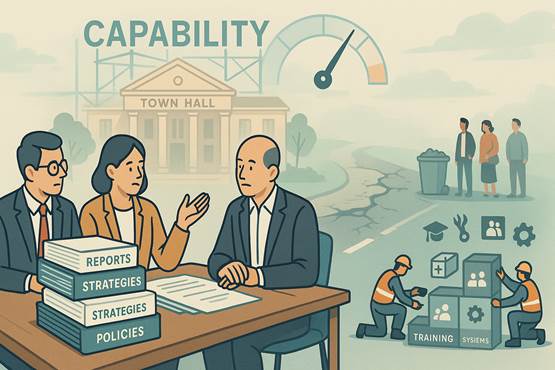
In the previous piece on the capability trap, Colin Weatherby showed how councils get stuck in a cycle of “do more with less” that slowly erodes their ability to deliver safe, reliable services. This piece zooms out. It asks a broader question: what has happened to capability across the local government sector, and why have we barely noticed its drift?

We talk a lot in local government about money, policies, structures and compliance. We almost never talk about capability. Yet capability – especially the ability to implement – is critical for governments.

From the capability trap to sector drift

My argument is blunt. Victorian councils have not really understood the role of capability. Because we don’t name it, measure it or protect it, we’ve quietly allowed some of our most important capabilities to erode – including the basic ability to implement projects and services at scale and on time.

Weatherby explains what this looks like inside a single council service: years of “do more with less” that undermine preventative work, training and supervision until the capability to deliver collapses. The same pattern is visible across the sector if you look carefully.

Local government doesn’t have a shared understanding of capability. We don’t recognise it or place it on risk or asset registers. We don’t report on it to councillors. We rarely ask, “What capabilities are we creating, maintaining or expending this year?” As a result, vital capabilities can be lost while performance still looks fine – until working harder no longer closes the performance gap.

There was an interesting article in the New York Times on 9 November 2025 (“Mamdani Isn’t the Future of the Democrats. This Guy Is.” by Binyamin Appelbaum) about the Democrats and the tussle between centrist and progressive candidates. Appelbaum says Governor Josh Shapiro is popular because he has shown that government can work and “get shit done”. When a highway collapsed, he reopened it in just 12 days. That is capability in action: not another plan, but a road people can drive on again.

Continue reading


286 – Abundance, Regulation and Council Costs

2000 words (18 minutes reading time) by Lancing Farrell

I might be drawing a long bow, but I think the Abundance agenda presents a fundamental challenge for those councils trying to find a way forward that is financially sustainable in a rate capped environment. It opens the door to reviewing regulatory and other service design to make savings and support economic growth.

Let me start at the beginning.

On 19 June 2025, in an article about a speech by Jim Chalmers, the Australian Treasurer, he was quoted as saying that left-leaning governments (as we currently have in Australia) are “strangling their own good intentions with bureaucracy”. He is asking regulators across the nation to identify regulations that can be axed or simplified to reduce compliance costs and increase the pace of economic growth. It is part of delivering a supply-side solution to the nation’s housing and energy problems by removing government-imposed impediments to production of goods and services.

Continue reading

282 – An elegy for local government

350 words (3 minutes reading time) by Colin Weatherby

Professor Joseph Drew has produced his annual analysis of local government expenditure in NSW. He has also looked at the reasons for the latest large rate increases being sought by councils. Professor Drew gives his usual clear and calm description of the findings.

I think his videos have become an elegy for local government.

Continue reading

272 – What is the big deal about the Wigan Deal?

1200 words (13 minutes reading time) by Lancing Farrell

In his post on the Victorian local government enquiry, Colin Weatherby mentioned the Wigan Deal as an example of how councils can avoid the politics of sacrifice – i.e. being forced to give up what you have today – and instead move to the politics of transition – i.e. finding better ways in the future. It seems like a no brainer to me and I am sure every elected representative would agree that this would be better politics. Unfortunately, they are not necessarily getting to make the decision – or, if they are, they are being given limited options by their bureaucracy about the decision they can make.

Strategic versus operational decisions

As an aside, this has been a point of contention in Victoria where the Local Government Act restricts councillors to making ‘strategic decisions’, while the CEO and staff make ‘operational decisions’. The definition of each type of decision seems to be quite flexible. For anyone wanting to see how this plays out, watch the Mornington peninsula Shire Council meeting on the 28 May 2024 at the 4 hour and 25 minute mark. Fascinating.

In contrast, the Wigan Deal was created and implemented with the commitment and direction of both elected representatives and the organisational leaders.

Continue reading

270 – Local government and Financial Sustainability Strategies

2850 words (30 minutes reading time) by Colin Weatherby

Councils across Australia have recently started developing financial sustainability strategies. This sounds like a good idea, but is it?  Are the goals in these strategies realistic and achievable? Do they seriously address fundamental issues affecting sustainability or are they just another distraction? The latest fad?

To kick this post off, let’s look at 3 councils, Logan Council in Queensland, Central Coast Council in New South Wales, and Yarra City Council in Victoria.

It is a long post but worth the effort!

Financial sustainability and corporate planning

Given the parlous condition of council finances and the existential threat from rate capping in NSW and Victoria, it is interesting to see where the financial sustainability strategy fits into organisational planning for councils.

Continue reading