295 – Seven Practical Stories in a Free E-Book

Every so often, along comes a free AND useful publication.

Purpose, Public Value, and Service Design in Local Government – Seven stories from Nova Ratio Publica by Stephen Thorpe is a good example. Drawing on 30 years of leadership experience in local government in Victoria, Australia, the e-book provides seven easy to understand public service stories to help you improve your work.

Thorpe explains how he has overcome some big challenges. Inside the e-book you’ll find practical ways to think and act differently, including:

  • Managing for value to move a conversation from operational gripes to strategic leverage.
  • Aligning public value, legitimacy, and operational capability so good intentions can be delivered.
  • Designing operations for the visible signals that tell people a place is being cared for (especially when resources are tight).
  • Service blueprinting to map services end-to-end, anticipate fail points, and build recovery so services are safe-to-fail at go-live.
  • Accommodating variety by designing a menu of service options that fit different household circumstances.
  • Understanding system capability to understand what a system can actually produce, and why setting targets outside capability will damage capability.
  • Purpose-led improvement in statutory services by focussing on the applicant experience drivers so that statutory measures become a consequence, not the method.

Inspired by Mark Moore, W. Edwards Deming, John Seddon, and other systemic thinkers, Thorpe has thought deeply about the challenges that he and others experienced at work. He has then looked far and wide for theories to explain what he was observing to help him learn and improve.

Continue reading

294 – If the Vendor Won’t Bet on Savings, Why are you?

700 words (3 minutes reading time) by Tim Whistler

‘The IT Wager’ by Tim Whistler (with the assistance of ChatGPT)

Carole Parkinson has put together a compelling and well researched post on how Councils can avoid gambling on IT investments – or at least how the risks in the bet can be understood.

I asked some experienced IT managers what they thought and they said the post was useful but didn’t go far enough.

I asked them why.

Why the IT bet feels safer than a service bet

The first point made was that the post should have explored why CEOs prefer to gamble on an IT bet than a service review and improvement bet. It was suggested that perhaps they didn’t understand how to make the service review and improvement bet. Or it was simply easier to bet on an IT product from a big vendor. It is a way for the CEO to outsource risk. They pass on the responsibility for organisational service improvement to a Big 4 consultancy and the software vendor.

One suggested that CEOs don’t have a choice because they are caught up in the race to digitise simply because their councils and communities expect them to do it. It is the new service standard. Non one wants to be left behind. Whilst this may be true, I have never seen a business case with a justification of ‘they are doing it, so we should too!’.

Why business cases mislead

Continue reading

293 – IT investment: Dangerous Enthusiasm or Due Diligence? Use evidence to decide.

2200 words (20 minutes reading time) by Carole Parkinson

Podcast option:

Credit: ChatGPT

In a nutshell…

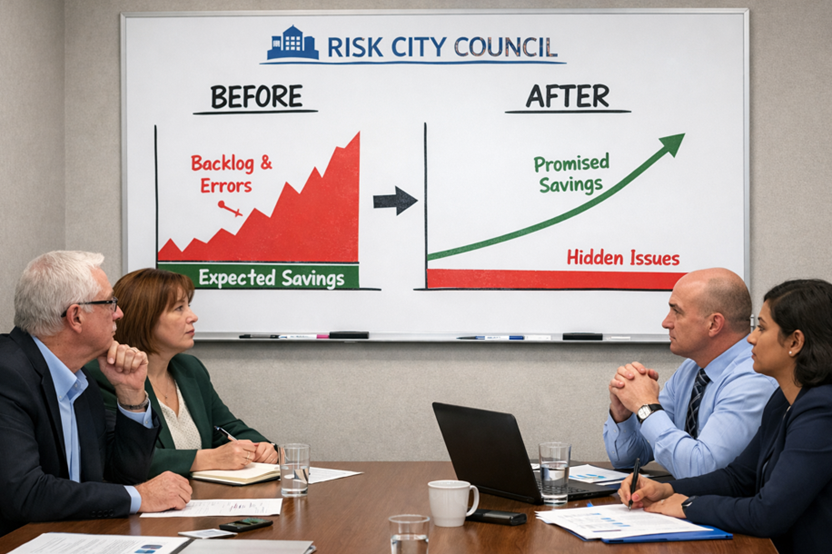
This post explores the risks and pitfalls associated with large-scale IT investments in local government. It argues that councils often rely on technology and automation to fix financial deficits or service inefficiencies without first optimising their underlying processes. Drawing on expert theories, the post suggests that these ambitious projects frequently over-promise and under-deliver by ignoring the complexities of human-technical systems. To avoid failure, Parkinson recommends that leaders adopt a skeptical mindset, demand evidence-based service studies, and implement incremental project stages. Ultimately, Parkinson emphasizes that improving service design from a resident’s perspective is more effective than simply digitising outdated methods.

Introduction

“I voted for the IT project because the business case promised the budget would balance by year four. But no one told us what we’d do if the savings didn’t arrive. In the end, we automated our inefficient services instead of fixing them. It has now cost us more money than we have saved!

We should have demanded a service study to improve services first, limited the project scope, put a ‘kill-switch’ in place, and made sure the CEO had an effective early warning system in place for failure.”  

Councillor

The lesson?

Big IT doesn’t fix services; it just automates them. You can make governance improvements to reduce the odds of an expensive disappointment.

Why councils are betting on IT

Continue reading

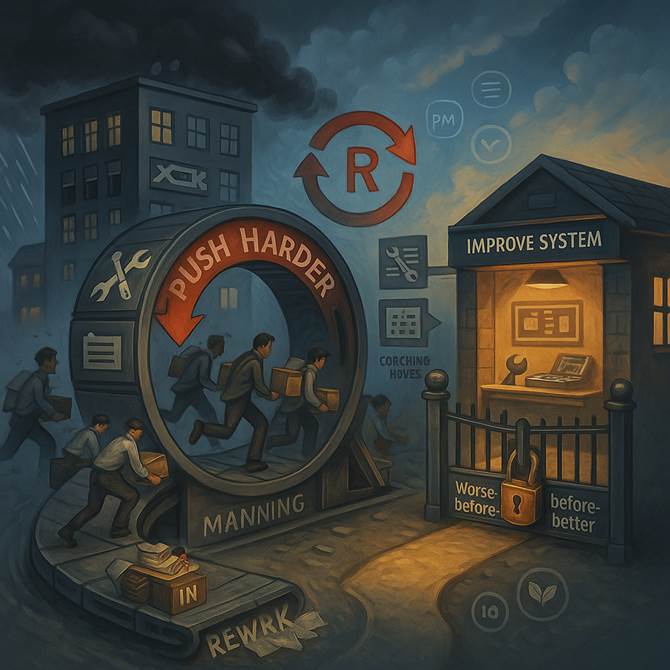
290 – The Capability Trap: How Budget Cuts Damage Councils Long Before Anyone Notices.

3100 words (15 minutes reading time) by Colin Weatherby

Podcast option:

Credit: ChatGPT

Summary

  • Councils under rate caps are being pushed into a capability trap: cutting investment in how work is done, while demanding the same (or more) output.
  • Doing more with less works for a while, then it quietly destroys the ability to deliver safe, reliable services.
  • Escaping the trap means shifting from “work harder” to “work smarter” – investing in process capability, not just pushing people to do more.
  • This piece explains the trap in plain language and offers advice to avoid it.

Introduction

After ten years of “doing more with less”, many council roads managers describe their world like this:

“Today, I barely recognise our roads program. Every budget cycle we cop another efficiency dividend, another round of ‘temporary’ cuts to inspections, reseals, heavy patches and drainage repairs. On paper the program still looks coherent thanks to some clever rephasing and optimistic assumptions, but out on the network the cracks are literal.

We’ve gone from renewing assets at the right time to stretching them well past their use-by date. Crews that used to do planned maintenance now spend most of their time chasing potholes and complaints. We’ve sweated the plant so hard that breakdowns are normal, and cut training and supervision to the point where we’re relying on a few old hands to hold everything together.

What hurts most is knowing this was avoidable. Every ‘saving’ we booked was borrowed against the future condition of the network. We’ve lost capability in quiet ways – trainees we didn’t take on, engineers who left and weren’t replaced, inspectors who no longer have time to inspect, relationships with contractors hollowed out by always taking the lowest price.

The community still expects the same level of service, but we’re no longer set up to deliver it. We’ve traded investment in capability for short-term budget wins, and now the bill is arriving as risk, backlog and a network that’s deteriorating faster than we can look after it.”

This isn’t a story about lazy workers or bad managers. It’s what it looks like when a council slides into what Repenning and Sterman call the capability trap – without realising it.

Continue reading

285 – Our first podcast: Challenges, solutions and future directions in local government.

1800 words (18 minutes reading and/or 20 minutes listening) by Colin Weatherby

I recently found out about Notebooklm and asked it to analyse the entire Local Government Utopia website and answer a set of questions about challenges, solutions and future directions for councils.

The question and answer is below. First, a bit about Notebooklm.

Notebooklm

Notebooklm is a new AI product that takes a specific source or sources nominated by you and provides a summary, or answers to questions you ask about the source or sources that you have uploaded. I loaded the URL for localgovernmentutopia.com but could have loaded pdfs or other types of sources (or combinations of sources). You can load up to 50 different sources with a maximum of 500,000 words.

The person who told me about it had uploaded a manual for their camera as a source and then asked how to change the camera battery. Instead of leafing through a massive pdf manual online, Notebooklm explained how to change the battery with a link directly to the relevant section in the manual!

It also produces podcasts, primarily to help listeners understand complicated topics by hearing a discussion between two people about the source or sources. I was interested in this feature, so I had a go!

Podcast

I asked Notebooklm to make a podcast addressing this question using the Local Government Utopia website as a source:

What does Local Government Utopia say about what a local government putting the wellbeing of its constituents first looks like; what issues are important and currently not acknowledged in local government; what are current research or policy gaps in local government; any thoughts around recent Commonwealth or Victorian parliamentary inquiries into local government; and finally, what thoughts are there on where public policy might be able to make a meaningful contribution.

Here is the podcast.

Continue reading