291 – Capability drift and the need to recognise and build sector capabilities

1400 words (10 minutes reading time) by Carole Parkinson

In the previous piece on the capability trap, Colin Weatherby showed how councils get stuck in a cycle of “do more with less” that slowly erodes their ability to deliver safe, reliable services. This piece zooms out. It asks a broader question: what has happened to capability across the local government sector, and why have we barely noticed its drift?

We talk a lot in local government about money, policies, structures and compliance. We almost never talk about capability. Yet capability – especially the ability to implement – is critical for governments.

From the capability trap to sector drift

My argument is blunt. Victorian councils have not really understood the role of capability. Because we don’t name it, measure it or protect it, we’ve quietly allowed some of our most important capabilities to erode – including the basic ability to implement projects and services at scale and on time.

Weatherby explains what this looks like inside a single council service: years of “do more with less” that undermine preventative work, training and supervision until the capability to deliver collapses. The same pattern is visible across the sector if you look carefully.

Local government doesn’t have a shared understanding of capability. We don’t recognise it or place it on risk or asset registers. We don’t report on it to councillors. We rarely ask, “What capabilities are we creating, maintaining or expending this year?” As a result, vital capabilities can be lost while performance still looks fine – until working harder no longer closes the performance gap.

There was an interesting article in the New York Times on 9 November 2025 (“Mamdani Isn’t the Future of the Democrats. This Guy Is.” by Binyamin Appelbaum) about the Democrats and the tussle between centrist and progressive candidates. Appelbaum says Governor Josh Shapiro is popular because he has shown that government can work and “get shit done”. When a highway collapsed, he reopened it in just 12 days. That is capability in action: not another plan, but a road people can drive on again.

Continue reading
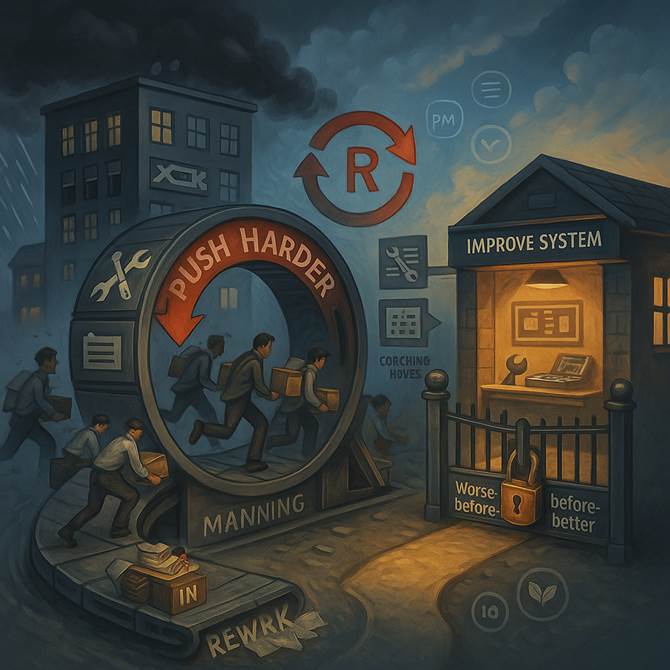
290 – The Capability Trap: How Budget Cuts Damage Councils Long Before Anyone Notices.

3100 words (15 minutes reading time) by Colin Weatherby

Podcast option:

Credit: ChatGPT

Summary

  • Councils under rate caps are being pushed into a capability trap: cutting investment in how work is done, while demanding the same (or more) output.
  • Doing more with less works for a while, then it quietly destroys the ability to deliver safe, reliable services.
  • Escaping the trap means shifting from “work harder” to “work smarter” – investing in process capability, not just pushing people to do more.
  • This piece explains the trap in plain language and offers advice to avoid it.

Introduction

After ten years of “doing more with less”, many council roads managers describe their world like this:

“Today, I barely recognise our roads program. Every budget cycle we cop another efficiency dividend, another round of ‘temporary’ cuts to inspections, reseals, heavy patches and drainage repairs. On paper the program still looks coherent thanks to some clever rephasing and optimistic assumptions, but out on the network the cracks are literal.

We’ve gone from renewing assets at the right time to stretching them well past their use-by date. Crews that used to do planned maintenance now spend most of their time chasing potholes and complaints. We’ve sweated the plant so hard that breakdowns are normal, and cut training and supervision to the point where we’re relying on a few old hands to hold everything together.

What hurts most is knowing this was avoidable. Every ‘saving’ we booked was borrowed against the future condition of the network. We’ve lost capability in quiet ways – trainees we didn’t take on, engineers who left and weren’t replaced, inspectors who no longer have time to inspect, relationships with contractors hollowed out by always taking the lowest price.

The community still expects the same level of service, but we’re no longer set up to deliver it. We’ve traded investment in capability for short-term budget wins, and now the bill is arriving as risk, backlog and a network that’s deteriorating faster than we can look after it.”

This isn’t a story about lazy workers or bad managers. It’s what it looks like when a council slides into what Repenning and Sterman call the capability trap – without realising it.

Continue reading