294 – If the Vendor Won’t Bet on Savings, Why are you?

700 words (3 minutes reading time) by Tim Whistler

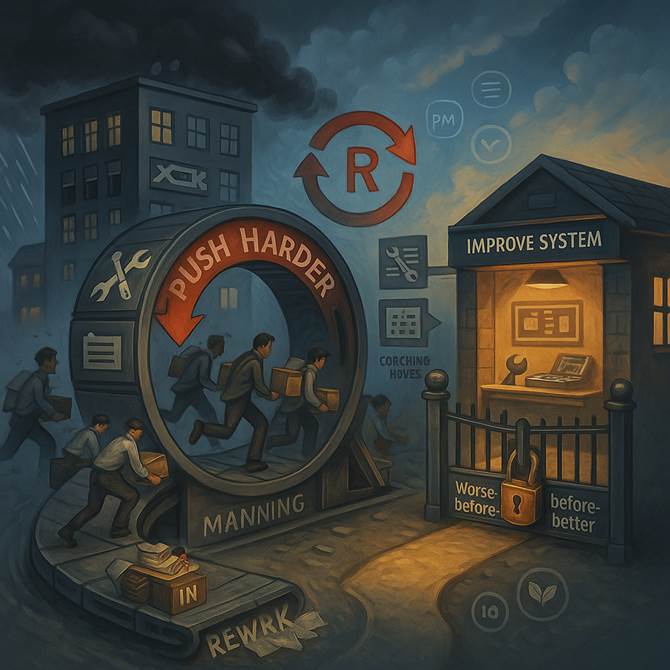
‘The IT Wager’ by Tim Whistler (with the assistance of ChatGPT)

Carole Parkinson has put together a compelling and well researched post on how Councils can avoid gambling on IT investments – or at least how the risks in the bet can be understood.

I asked some experienced IT managers what they thought and they said the post was useful but didn’t go far enough.

I asked them why.

Why the IT bet feels safer than a service bet

The first point made was that the post should have explored why CEOs prefer to gamble on an IT bet than a service review and improvement bet. It was suggested that perhaps they didn’t understand how to make the service review and improvement bet. Or it was simply easier to bet on an IT product from a big vendor. It is a way for the CEO to outsource risk. They pass on the responsibility for organisational service improvement to a Big 4 consultancy and the software vendor.

One suggested that CEOs don’t have a choice because they are caught up in the race to digitise simply because their councils and communities expect them to do it. It is the new service standard. Non one wants to be left behind. Whilst this may be true, I have never seen a business case with a justification of ‘they are doing it, so we should too!’.

Why business cases mislead

Continue reading
293 – IT investment: Dangerous Enthusiasm or Due Diligence? Use evidence to decide.

2200 words (20 minutes reading time) by Carole Parkinson

Podcast option:

Credit: ChatGPT

In a nutshell…

This post explores the risks and pitfalls associated with large-scale IT investments in local government. It argues that councils often rely on technology and automation to fix financial deficits or service inefficiencies without first optimising their underlying processes. Drawing on expert theories, the post suggests that these ambitious projects frequently over-promise and under-deliver by ignoring the complexities of human-technical systems. To avoid failure, Parkinson recommends that leaders adopt a skeptical mindset, demand evidence-based service studies, and implement incremental project stages. Ultimately, Parkinson emphasizes that improving service design from a resident’s perspective is more effective than simply digitising outdated methods.

Introduction

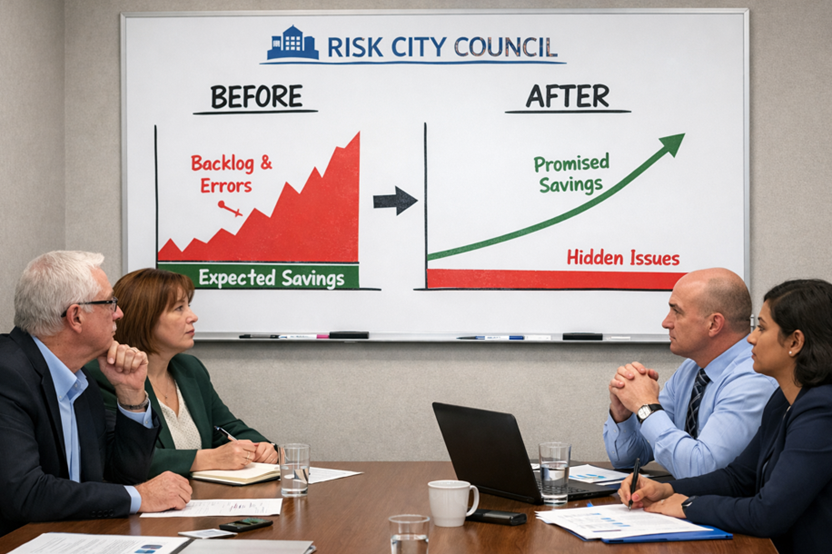
“I voted for the IT project because the business case promised the budget would balance by year four. But no one told us what we’d do if the savings didn’t arrive. In the end, we automated our inefficient services instead of fixing them. It has now cost us more money than we have saved!

We should have demanded a service study to improve services first, limited the project scope, put a ‘kill-switch’ in place, and made sure the CEO had an effective early warning system in place for failure.”  

Councillor

The lesson?

Big IT doesn’t fix services; it just automates them. You can make governance improvements to reduce the odds of an expensive disappointment.

Why councils are betting on IT

Continue reading

291 – Capability drift and the need to recognise and build sector capabilities

1400 words (10 minutes reading time) by Carole Parkinson

In the previous piece on the capability trap, Colin Weatherby showed how councils get stuck in a cycle of “do more with less” that slowly erodes their ability to deliver safe, reliable services. This piece zooms out. It asks a broader question: what has happened to capability across the local government sector, and why have we barely noticed its drift?

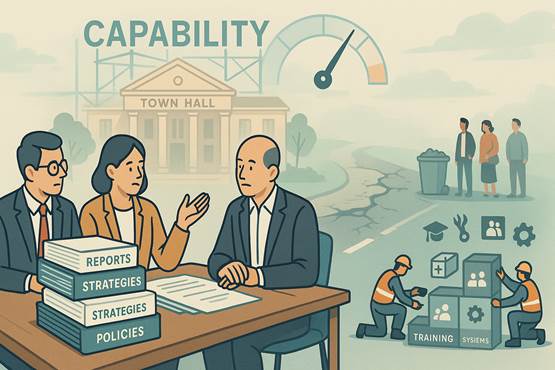
We talk a lot in local government about money, policies, structures and compliance. We almost never talk about capability. Yet capability – especially the ability to implement – is critical for governments.

From the capability trap to sector drift

My argument is blunt. Victorian councils have not really understood the role of capability. Because we don’t name it, measure it or protect it, we’ve quietly allowed some of our most important capabilities to erode – including the basic ability to implement projects and services at scale and on time.

Weatherby explains what this looks like inside a single council service: years of “do more with less” that undermine preventative work, training and supervision until the capability to deliver collapses. The same pattern is visible across the sector if you look carefully.

Local government doesn’t have a shared understanding of capability. We don’t recognise it or place it on risk or asset registers. We don’t report on it to councillors. We rarely ask, “What capabilities are we creating, maintaining or expending this year?” As a result, vital capabilities can be lost while performance still looks fine – until working harder no longer closes the performance gap.

There was an interesting article in the New York Times on 9 November 2025 (“Mamdani Isn’t the Future of the Democrats. This Guy Is.” by Binyamin Appelbaum) about the Democrats and the tussle between centrist and progressive candidates. Appelbaum says Governor Josh Shapiro is popular because he has shown that government can work and “get shit done”. When a highway collapsed, he reopened it in just 12 days. That is capability in action: not another plan, but a road people can drive on again.

Continue reading

290 – The Capability Trap: How Budget Cuts Damage Councils Long Before Anyone Notices.

3100 words (15 minutes reading time) by Colin Weatherby

Podcast option:

Credit: ChatGPT

Summary

  • Councils under rate caps are being pushed into a capability trap: cutting investment in how work is done, while demanding the same (or more) output.
  • Doing more with less works for a while, then it quietly destroys the ability to deliver safe, reliable services.
  • Escaping the trap means shifting from “work harder” to “work smarter” – investing in process capability, not just pushing people to do more.
  • This piece explains the trap in plain language and offers advice to avoid it.

Introduction

After ten years of “doing more with less”, many council roads managers describe their world like this:

“Today, I barely recognise our roads program. Every budget cycle we cop another efficiency dividend, another round of ‘temporary’ cuts to inspections, reseals, heavy patches and drainage repairs. On paper the program still looks coherent thanks to some clever rephasing and optimistic assumptions, but out on the network the cracks are literal.

We’ve gone from renewing assets at the right time to stretching them well past their use-by date. Crews that used to do planned maintenance now spend most of their time chasing potholes and complaints. We’ve sweated the plant so hard that breakdowns are normal, and cut training and supervision to the point where we’re relying on a few old hands to hold everything together.

What hurts most is knowing this was avoidable. Every ‘saving’ we booked was borrowed against the future condition of the network. We’ve lost capability in quiet ways – trainees we didn’t take on, engineers who left and weren’t replaced, inspectors who no longer have time to inspect, relationships with contractors hollowed out by always taking the lowest price.

The community still expects the same level of service, but we’re no longer set up to deliver it. We’ve traded investment in capability for short-term budget wins, and now the bill is arriving as risk, backlog and a network that’s deteriorating faster than we can look after it.”

This isn’t a story about lazy workers or bad managers. It’s what it looks like when a council slides into what Repenning and Sterman call the capability trap – without realising it.

Continue reading

289 – Fire fighter or architect? It is your choice.

580 words (6 minutes reading time) by Lancing Farrell

I recently completed a training course in the work of W. Edwards Deming. At the end of the course, one of the participants said they felt as though they now had the knowledge to become an architect in their work and cease being a fire fighter.

It made me think about how it is that leaders become fire fighters. It is a common complaint from executives in local government who are being exhausted on a treadmill of frantic and stressful activity.

I recently saw this piece on LinkedIn by Simon Dodds, a Health Care Engineer at SAASoft Ltd. I have reproduced it in full because it eloquently describes from a health care perspective, the same series of events that shifts managers and directors on the council treadmill from walking speed to sprinting. Here it is.

Continue reading

288 – Want to improve performance? – ask your local footy club.

300 words (2 minutes reading time) by Lancing Farrell

Podcast option:

We are just over halfway through the 2025 AFL season (the major league playing Australian rules football). The premiership contenders are starting to appear.

I figure it is a good time to recap on the AFL-themed posts that have been posted on this site.

First cab off the rank was Tim Whistler with a tongue in cheek look at what it would be like if football was run like local government (and visa versa). Sometimes humour exposes something we otherwise fail to see. The post featured a guest appearance and commentary from Captain Council, our very own council super hero.

Continue reading

286 – Abundance, Regulation and Council Costs

2000 words (18 minutes reading time) by Lancing Farrell

I might be drawing a long bow, but I think the Abundance agenda presents a fundamental challenge for those councils trying to find a way forward that is financially sustainable in a rate capped environment. It opens the door to reviewing regulatory and other service design to make savings and support economic growth.

Let me start at the beginning.

On 19 June 2025, in an article about a speech by Jim Chalmers, the Australian Treasurer, he was quoted as saying that left-leaning governments (as we currently have in Australia) are “strangling their own good intentions with bureaucracy”. He is asking regulators across the nation to identify regulations that can be axed or simplified to reduce compliance costs and increase the pace of economic growth. It is part of delivering a supply-side solution to the nation’s housing and energy problems by removing government-imposed impediments to production of goods and services.

Continue reading

285 – Our first podcast: Challenges, solutions and future directions in local government.

1800 words (18 minutes reading and/or 20 minutes listening) by Colin Weatherby

I recently found out about Notebooklm and asked it to analyse the entire Local Government Utopia website and answer a set of questions about challenges, solutions and future directions for councils.

The question and answer is below. First, a bit about Notebooklm.

Notebooklm

Notebooklm is a new AI product that takes a specific source or sources nominated by you and provides a summary, or answers to questions you ask about the source or sources that you have uploaded. I loaded the URL for localgovernmentutopia.com but could have loaded pdfs or other types of sources (or combinations of sources). You can load up to 50 different sources with a maximum of 500,000 words.

The person who told me about it had uploaded a manual for their camera as a source and then asked how to change the camera battery. Instead of leafing through a massive pdf manual online, Notebooklm explained how to change the battery with a link directly to the relevant section in the manual!

It also produces podcasts, primarily to help listeners understand complicated topics by hearing a discussion between two people about the source or sources. I was interested in this feature, so I had a go!

Podcast

I asked Notebooklm to make a podcast addressing this question using the Local Government Utopia website as a source:

What does Local Government Utopia say about what a local government putting the wellbeing of its constituents first looks like; what issues are important and currently not acknowledged in local government; what are current research or policy gaps in local government; any thoughts around recent Commonwealth or Victorian parliamentary inquiries into local government; and finally, what thoughts are there on where public policy might be able to make a meaningful contribution.

Here is the podcast.

Continue reading

284 – The Public Service Chain Reaction.

1700 words (18 minutes reading time) by Carole Parkinson

The Deming chain reaction

Tim Whistler cuts straight to the chase. In the case of his latest piece, I think he could do with a little nuancing of what he is proposing. His description of the disruption to ensue if councils can’t manage their finances with a rate cap is probably accurate, but also, avoidable.

I have been talking to executives at councils and it is true that they are grappling with defining and agreeing on what they need to do. Everyone involved in leadership seems to be pulling in a different direction – Finance wants direct funding cuts to balance budgets now; Directors want efficiency drives to fit services into budgets as soon as possible; Councillors want to cut services they think the State should provide and avoid electoral backlash when they stand for re-election in 2028. It is a vicious cycle.

I have a more immediate approach, which neatly fits with Whistler’s focus on infrastructure as the big service, allocating capital first, and, most importantly, reducing expenditure where you should, not just where you think you can.

Continue reading

283 – Celebrating 10 years

Lancing Farrell

117 – ‘Captain Council’. A local government superhero, posted on June 15, 2015

Local Government Utopia is 10 years old.

Yes! Our birthday was in January this year. We have been too busy writing to reflect on what 10 years of commentary on local government might contain. I have looked at the very first post and what we set out to do. I think we have been true to our aim.

See what you think…

Continue reading