176 – In-vehicle GPS – Part 2: How every council can have it.

Posted by Lancing Farrell                                                                              550 words

hurdles

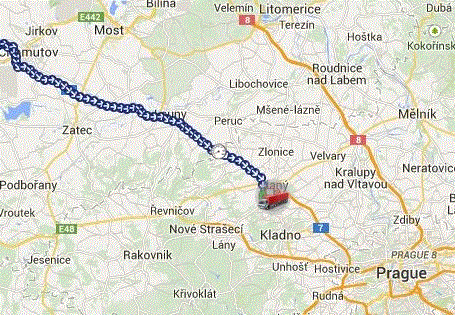
In part one I discussed the features and benefits of in-vehicle GPS. Because councils deliver services at locations dispersed across a large geographic area and vehicle ownership is expensive and utilization is often low, in-vehicle GPS has the potential to provide significant benefits. It links the planning undertaken in asset maintenance systems to in-field work planning and delivery to ensure that resources are used efficiently to complete the planned work. The key barrier has been how to get in-vehicle GPS installed in all vehicles.

I think the trick to implementing in-vehicle GPS is the strategy and policy sitting behind it. Here are some tips. Continue reading
175 – In-vehicle GPS – Part 1: Why every council should have it.

Posted by Lancing Farrell                                                                                              1100 words

in vehicle gps

I remember looking at in-vehicle monitoring devices in the 1990’s. The technology was basic and there was no 4G network. Since then councils have flirted with in-vehicle GPS. As far as I know, no council in Victoria has installed it throughout their vehicle fleet. This is partially explained by the industrial relations implications (see the next post) but I think it is really explained by the lack of focus on customer service and productivity that pervades the sector. Rate capping will change that.  Most councils wouldn’t even be aware of the potential benefits from the technology. Hence this post.

So, what are the features and benefits of in-vehicle GPS that councils should be thinking about? Continue reading

174 – The Executive: filters and traffic controllers or drivers?

Posted by Whistler                                                          760 words

filter

There have been a number of posts about the Executive over the past 6 months (see What can a culture survey, an organisational self assessment, and your Executive’s risk appetite tell you?; Risk farming or good governance? How some executives avoid accountability; The Executive. What exactly is their role?;Does your Executive suffer from altitude sickness?; and The deep web and local government recruitment. ). Each has explored a different dimension of the Executive in local government – their comfort with risk, their role, how they support service delivery and make decisions, and how they are appointed.

This may be the last post on the topic (it now seems to have been a bit of a collective whinge) and it looks at what they really do or can do given the way councils operate.

One way of looking at the Executive from an organisational viewpoint is as a filter. Continue reading

173 – A series: Managers as designers in local government. Part 4.

Posted by Lancing Farrell                                                                                              1000 words

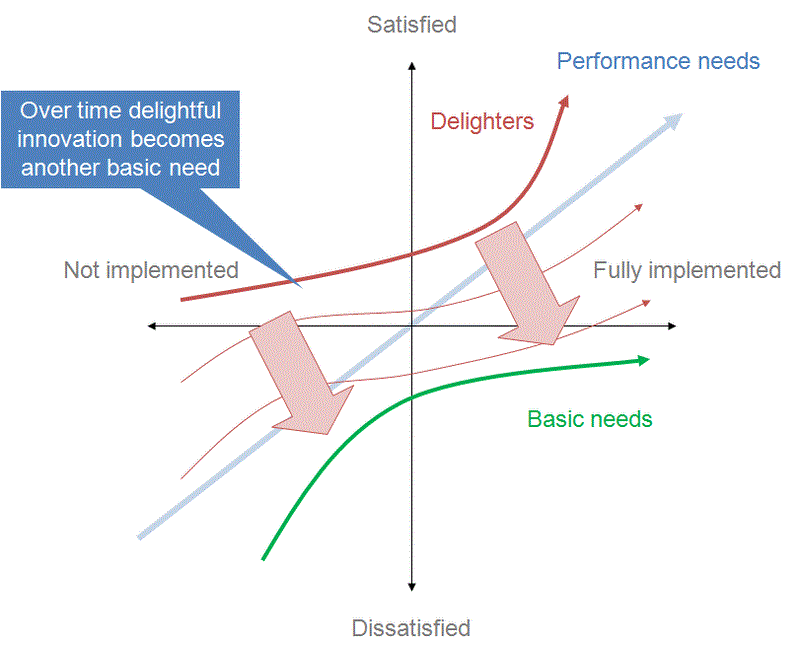
Kano model Wikipedia

Kano’s model

This is the last post in this series. It looks at how design can be used for new services and their implementation in local government.

Roger Martin and Tim Brown provide a related but different view of design in organisations. They see it as helping stakeholders and organisations work better together as a system. This is a systems-thinking approach as much as it involves design-thinking.

They describe the evolution of use of design in organisations as the ‘classic path of intellectual process’ as each design process is more sophisticated than the one before it because it was enabled by learning from that preceding stage. As designers have become more skilled in applying design to shape user experiences of products, they have turned to ‘user interfaces’ and other experiences. Continue reading

172 – Fear transmission. What happens when managers’ contracts start to not be renewed?

Posted by Colin Weatherby                                                         630 words

reject

I was talking to a colleague who has worked at a couple of councils where managers have not had their contracts renewed. She was describing the impact it had on other managers. I was interested in why it is happening, how it has happened and exactly what impact it has had.  Since that discussion I have heard of many more managers who have not had their contracts renewed.  It is almost as if the revolutionisation process has reached a new layer of the organisation.

The first manager was not re-appointed almost a year out from the expiration of their contract. Continue reading

171 – A series: Managers as designers in local government. Part 3.

Posted by Lancing Farrell                                                                              500 words

design and thinking

This is the third post in a series of four. It addresses some of the challenges to design-thinking.  Jon Kolko has identified several.

His first challenge is accepting that you will be dealing with more ambiguity.

“It is difficult if not impossible to understand how much value will be delivered through a better experience or to calculate the return on investment in creativity.”

He says that ambiguity doesn’t fit well with organisations that value ‘repeatable, predictable operational efficiency’. This will be an issue for councils seeking to use design-thinking. For councils, there is an expectation that value will be created through efficient use of resources without any waste. The strong risk aversion of local government reinforces elimination of uncertainty, or at least pretending it has been eliminated. Embracing a culture or experimentation, customer value creation and risk taking will be very challenging. Continue reading

170 – ‘The Utopia of Rules – On Technology, Stupidity, and the Secret Joys of Bureaucracy’ by David Graeber.

Posted by Whistler                                                                          620 words

Utopia of Rules cover

Every so often I come across an interesting book that challenges orthodox thinking. This is one of those books. Published earlier this year to a mixed reception, as a bureaucrat I found it rewarding reading. It was also reassuring – maybe we aren’t the half-wit brethren of private sector management. Perhaps the private sector is a poor emulator of public sector bureaucracy?

There are too many interesting and thought-provoking passages in the various essays making up the book to mention them all. I have reproduced some favourites below.

“The rise of the modern corporation, in the late nineteenth century, was largely seen as a matter of applying modern, bureaucratic techniques to the private sector – and these techniques were assumed to be required, when operating on a large scale, because they were more efficient than the networks of personal or informal connections that had dominated the world of small family firms.” (p.11)

This is an intriguing thought when you consider Peter F. Drucker’s observation that by the 1970’s public sector organisations were unsuccessfully copying private sector business management ideas. Continue reading

169 – A series: Managers as designers in local government. Part 2.

Posted by Lancing Farrell                                                                              800 words

rapid prototyping

This is the second post in a series of four. It discusses the second and third principles of design-thinking.

Models can be used to examine complex problems. In this context, the ‘model’ is an artefact of the design process that is used to ‘explore, define and communicate’. Typically this will include diagrams and sketches instead of (or in addition to) the spreadsheets and specifications usually used to analyse and resolve problems. According to Kolko, they ‘add a fluid dimensions to the exploration of complexity, allowing for non-linear thought when tackling non-linear problems”.

There are a number of local government services that routinely use models or design artefacts in their work. Continue reading

168 – A series: Managers as designers in local government. Part 1.

Posted by Lancing Farrell                                                                              800 words

empathy hand holding

This is the first in a series of four posts on managers as designers in local government. It might seem like an esoteric topic and hardly relevant, however, every day managers make design decisions, often in ignorance. There is now a body of work on how managers can use design-thinking to improve the customer experience and organisational decision making. I challenge you to say it is irrelevant to your council.

Some years ago I read a book called ‘Managers as Designers in the Public Services’ by David Wastell (Professor of Information Systems at Nottingham University Business School). It made a lasting impression on me. Continue reading

167 – High performance: ‘Why I Like People with Unconventional Résumés. Claudio Fernández-Aráoz.

Posted by Colin Weatherby                                                                         500 words

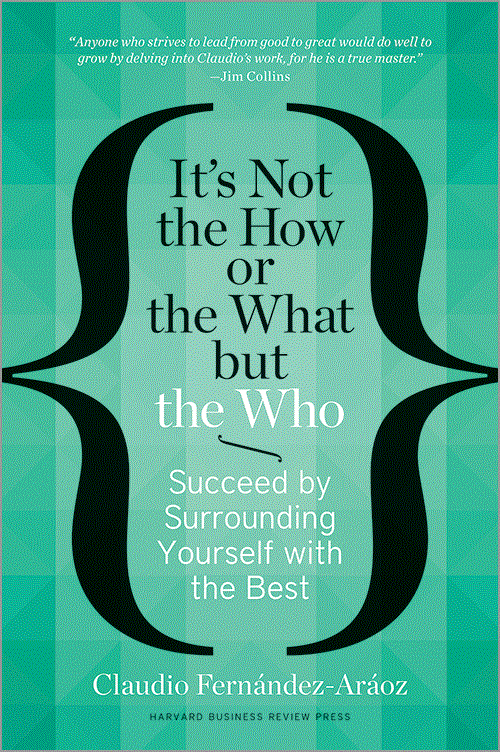
its not the what or the how cover

This is the title of a chapter in Fernández-Aroáz’s book ‘It’s not the How or the What but the Who’. It is also the title of a blog he posted for HBR.org . In it he discusses the unconventional candidate with exceptional potential. I was surprised at his honesty in discussing his personal ‘epiphany’ when he realized that, as a recruiter, he had been advocating a recruitment strategy that his own company did not follow.

Fernández-Aráoz starts the chapter by discussing his HBR.org blog post and the response it prompted. Many of the respondents described their frustration at recruiters who didn’t appreciate, understand, or even consider their track record. For many people who have pursued executive roles in local government this is not news.

Many councils or almost all recruiters play it safe. Continue reading