121 – Squire to the giants. Who are the giants in common?

Posted by Colin Weatherby                                                                                                 830 words
squire

I recently found a new and interesting blog called ‘Squire to the Giants’. Much like thinkpurpose.com this blog site is aimed at people who have an interest in improving their organisation through systems thinking. A recent post talks about the ‘giants’ that have influenced the Squire’s thinking. I am familiar with some of the ‘giants’ and have others of my own.

The Squire lists the following giants:

Regular readers of this blog will be familiar with the work of Peter Scholtes  and John Seddon. Both have influenced the thinking of writers. The biographical pieces written by the Squire  are worth a look.

I have decided to produce a blog on one of my giants.


mark h moore picProfessor Mark H. Moore

First some background. Mark H. Moore is the Hauser Professor of Nonprofit Organisations and director of the Hauser Centre for Nonprofit Organisations, at the John F. Kennedy School of Government at Harvard University.

His research interests include public management and leadership, civil society and community mobilization, and criminal justice policy and management. Continue reading
114 – Classic paper: ‘Forget your people – real leaders act on the system’. John Seddon.

Posted by Colin Weatherby                                                                         2200 words

john seddon

John Seddon won the first Harvard Business Review/ McKinsey Management Innovation Prize for ‘Reinventing Leadership’ in 2010 for this paper. The prize was awarded for:

“ … the best story (a real-world case study of management innovation) or hack (a bold idea for tackling a critical management challenge) around … redefining the work of leadership, increasing trust (reducing fear), and taking the work out of work.”

As the title suggests it is a provocative paper. In his usual way, Seddon provides challenging ideas supported by practical evidence.

The context for the story is Owen Buckwell, the head of housing at Portsmouth City Council in England. Over 40,000 people rely on him for warm, safe and comfortable homes. Each year he is responsible for dealing with 17,000 blocked toilets and 100,000 dripping taps in the 17,000 council houses.

Owen has been managing housing for 6 years. Seddon describes him as a curious man who likes to get to the bottom of things.

What does Owen do?

113 – Improving service operations. Finish with service redesign.

Posted by Colin Weatherby                                                                         1300 words

service redesign board

The first post on improving service operations covered service action planning. Both posts have followed a discussion about service improvement with a colleague in which he described a process he has been using with operational staff to work out how their work can be improved. This post discusses redesigning services when that has been an action identified in the service action plan.

If the need to redesign services has been identified in the service action plan there is a good chance that all team members are on board and prepared to discuss some big changes. This is really a prerequisite for significant change in local government, otherwise there is a risk that you are just ‘revolutionising’ people and will have no long term effect.

Stage 2 – Service redesign.

The first step is to separate the services with different demands, operations typology and performance objectives (this has been the subject of an earlier post). Then related services are grouped together. The last step is to redesign services to integrate similar services and plan implementation of the new service. This includes risk analysis of key aspects of the service and planning the new supervisory role required to make the service design work. Continue reading

111 – High performance: ‘The Best and the Rest’. Claudio Fernández-Aráoz.

Posted by Colin Weatherby                                                                         560 words

star

This is the title of a chapter in Fernández-Aroáz’s book ‘It’s not the How or the What but the Who’. It discusses the difference between a typical worker and a highly productive worker. I was surprised at the differences in performance between the best and the rest.

Fernández-Aráoz says that a ‘star’ worker in simple jobs, for example an assembly line, and a ‘typical’ worker is about 40%. The distribution of performance follows a normal distribution, or bell curve. The distance between the best and the rest grows quickly with increasing complexity of work. He cites a top life insurance salesperson as being 240% more productive than an average salesperson, and star software developers outperforming others by 1,200%. Continue reading

110 – Improving service operations. Start with a service action plan.

Posted by Colin Weatherby                                                                         1250 words

service brainstorming

I was recently discussing service improvement with a colleague. He described to me a two-stage process he has been using with operational staff in his team to determine how their work can be improved generally, and then how to re-design services if required.

It is an intensely practical two-stage approach to working with teams collaboratively to understand work and improve operations to get better customer outcomes.

The first stage involves bounded brainstorming by the whole work group, their Team Leader and the Manager to respond to the question – how can we do our work better? It is not intended to question whether or not services should be delivered, just how they can be improved. The process is intended to be inclusive and to quickly lead to action. The output is a service action plan.

The second stage involves redesigning services if this has been identified the way to make improvement. The redesign process is led by the Team Leaders and Manager using some simple reengineering and operations management tools. The output is a new service design.

Stage 1 – The service action plan Continue reading

109 – How can you influence a council decision? Some tips.

Posted by Posted by Colin Weatherby                                                                  670 words

sprinfield monorail

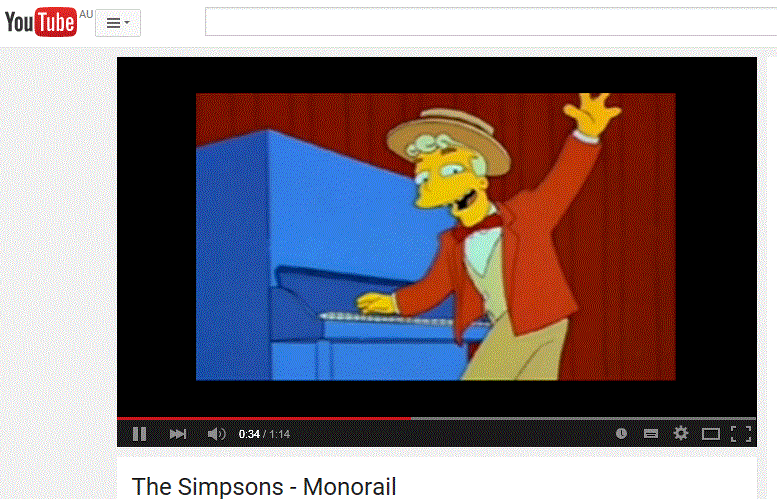
Hear the song.

 A friend recently asked me for advice on influencing a council decision regarding a park near his home. His council had plans to demolish an old community building in a park and allow a nearby disused tennis facility to be converted into bowling greens by the club based at the park. He disagreed with the plan and wanted to see the building retained and the old tennis courts turned into open parkland.

After thinking about it overnight I proposed the following ten actions Continue reading

108 – Melbourne City Council: Organisational Capability Review, May 2015.

Posted by Colin Weatherby                                                                         1300 words

Melbourne capability review model

The public release of this critical report has been something of a surprise. Commissioned in March 2015 and released in May, the report prepared by Jude Munro, Dr Bronte Adams and Steve Parker has looked at three key capabilities; leadership, strategy and delivery. Each has been rated on a four point scale for several elements. Out of the ten attributes rated, six were seen as a ’development area’ and one as a ‘serious concern’. The remaining three were seen as ‘well placed’ and none were seen as ‘strong’ (p.14). So what does this mean?

melbourne assessment criteria ratingsThe report states that this is the first time that this review model has been applied to local government in Australia. Its intention is to provide a forward looking, whole of organisation review that assesses an organisation’s ability to meet future objectives and challenges.


“This review provides the opportunity and impetus to take a very good organisation and make it even better.” Ben Rimmer, CEO

Continue reading

96 – A corporate services productivity initiative. Are you sure?

Posted by Colin Weatherby                                                                         360 words

lawn mower

How long is it since your corporate services team decided to make some improvements to their productivity? Maybe they had to take a budget cut o show some leadership when their Group Manager was asking everyone else to make cuts. Maybe they genuinely think they have produced the same or more value at less cost. Sometimes they aren’t seeking to improve productivity, they are simply complying with the recommendations of yet another internal audit and the opportunity has come up for what seems like greater efficiency. After all, isn’t being more efficient hard to argue with?

Whichever way it happens, the flow on effects are always the same. Someone downstream gets to do more work. Continue reading

94 – ‘An interview with Wanksy, Penis Doodler and Pothole Avenger’, The Atlantic CITYLAB, 1 May 2015.

Posted by Colin Weatherby                                                                                         430 words

Wanksy image

Image from CITYLAB.

The sub title to this article says it all – ‘How an English construction worker is fighting for better road infrastructure by scribbling on the streets like a third-grader’. What is it that reduces people to this behavior? Why do they feel compelled to break the rules to get something done? There have been various articles on guerilla gardening, depaving and other aspects of DIY urbanism, but this is the first ‘guerilla maintenance’ article I have seen.

According to the article, Wanksy is a surveyor and professional artist who became fed up with the numerous potholes in his hometown, so he started drawing penises around them. And it seems to be working Continue reading