600 words (4 minutes reading time) by Tim Whistler
When reading local government plans, you could be forgiven for thinking that The Secret(2006) was a management manual: “ask, believe, and receive”. It is hard to see how some councils think they will make a difference from the way they plan.
To be fair, I agree that councils usually aren’t intentionally stupid or reckless. They’re juggling rate caps, grant uncertainty, ageing assets, and a community that wants more of everything. They are under pressure, and when it comes to their long-term plan, the temptation is to plug the spreadsheet gaps with “efficiency dividends” and “future asset sales” and hope it all works out.
But that doesn’t make it strategic. I call it Plan–Do–Hope.
Council plans
When I look at the 10-year plans that councils are releasing, I wonder how much connection they have to the reality most ratepayers experience.
I can’t imagine those same ratepayers copying the council by hoping that their income will go up next year because someone will give them more money; wishing that their expenses will go down without making lifestyle changes; and then acting on those assumptions by spending more money now (even if they have to borrow it).
I was reading my local council’s plan and in the next 10 years it has $1 million a year of savings budgeted from an “efficiency dividend”, but no information about what the efficiencies will be or how they might affect services. All the plan says is that they will be based on “decisions made strategically through the annual budget process”.
If your council plan has an “efficiency dividend”, I challenge you to point to one service where they have made changes so you get the same service and they use less resources. If you can’t find one, it’s not about efficiency. It’s just wishful thinking with a number attached.
My council goes further. They are also planning to sell $32 million of unspecified assets, with half of the proceeds to go towards capital works and the other half to cover operating expenses. Talk about selling the farm to buy hay!
“The Shire holds $3.7 billion in assets, including ageing stock that requires increasing maintenance, renewal, or in some cases closure. Asset utilisation analysis is required to better align infrastructure with community demand.”
That’s not analysis. It’s more wishful thinking, this time dressed up as strategy.
The council seems to think they can sell assets that they say people don’t use, and that they will be able to do it without objection. That thinking looks safe on a spreadsheet, but anyone with experience of asset sales knows it’s explosive once real people and real places are involved. In the past, these lists have included the old swimming pool, or a small out-of-the-way branch library, or a block of land zoned residential and used as a park but considered “surplus” in the open space plan.
I challenge councillors to imagine they are fronting a public meeting and listing, one by one, the $32 million of “surplus” assets you plan to sell in the next decade. Would you still be comfortable with that line in the plan?
These financial plans expose the real gap between what communities want their councils to do, and what councils think they should be doing. Councils talk about “community outcomes” and “customers first”, but then make decisions from the top, rather than really listening to the community.
What would Check–Plan–Do look like instead?
Check: Start with real demand. What are people actually asking for? Where are you failing them now?
Plan: Decide what to stop, start or change so that people continue to get the services they need and expect. Then cost that honestly.
Do: Try changes on a small scale, learn from them, and only then (when you know how to do it and that it works) put it into the 10-year plan.
If your 10-year plan doesn’t start from real demand and doesn’t explain what will change in the way services work for people, it is Plan–Do–Hope.
Going a step further, if you’re a councillor, I challenge you to ask yourself: would you be happy if your own household budget was planned the way you’re planning the budget for your community?
3100 words (15 minutes reading time) by Colin Weatherby
Podcast option:
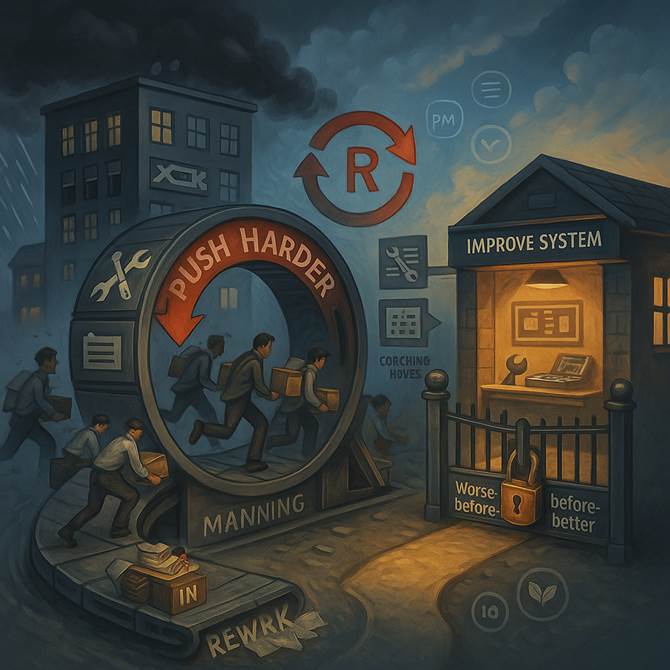
Credit: ChatGPT
Summary
Councils under rate caps are being pushed into a capability trap: cutting investment in how work is done, while demanding the same (or more) output.
Doing more with less works for a while, then it quietly destroys the ability to deliver safe, reliable services.
Escaping the trap means shifting from “work harder” to “work smarter” – investing in process capability, not just pushing people to do more.
This piece explains the trap in plain language and offers advice to avoid it.
Introduction
After ten years of “doing more with less”, many council roads managers describe their world like this:
“Today, I barely recognise our roads program. Every budget cycle we cop another efficiency dividend, another round of ‘temporary’ cuts to inspections, reseals, heavy patches and drainage repairs. On paper the program still looks coherent thanks to some clever rephasing and optimistic assumptions, but out on the network the cracks are literal.
We’ve gone from renewing assets at the right time to stretching them well past their use-by date. Crews that used to do planned maintenance now spend most of their time chasing potholes and complaints. We’ve sweated the plant so hard that breakdowns are normal, and cut training and supervision to the point where we’re relying on a few old hands to hold everything together.
What hurts most is knowing this was avoidable. Every ‘saving’ we booked was borrowed against the future condition of the network. We’ve lost capability in quiet ways – trainees we didn’t take on, engineers who left and weren’t replaced, inspectors who no longer have time to inspect, relationships with contractors hollowed out by always taking the lowest price.
The community still expects the same level of service, but we’re no longer set up to deliver it. We’ve traded investment in capability for short-term budget wins, and now the bill is arriving as risk, backlog and a network that’s deteriorating faster than we can look after it.”
This isn’t a story about lazy workers or bad managers. It’s what it looks like when a council slides into what Repenning and Sterman call the capability trap – without realising it.
Unfortunately, this is an all-too-common council story. Problems are clear to the workers, but their managers are hard at work on the organisational treadmill.
Why is service improvement so difficult?
Repenning and Sterman have studied organisational improvement efforts to understand why they are not sustained. Their research (grounded in more than a dozen case studies across industries and multiple formal simulations) suggests:
Identifying and learning about improvement methods is not the main barrier to improvement.
Implementing improvement methods presents the biggest challenge.
They say that the inability of organisations to get the full benefits of improvements has little to do with the method selected. It has much more to do with “how any improvement method interacts with the physical, economic, social and psychological structures in which the implementation takes place”- it is a systemic problem, not a people problem.
Their research provides useful insights for those contemplating service improvement in local government.
The capability trap
Repenning and Sterman describe the capability trap as the situation that arises when:
Managers think that the gap between desired and actual performance is attributable to the effort level of workers.
Managers put pressure on workers to do more or better work.
This continues until the limits of working harder are reached and damaging workarounds occur.
The alternative is to see the performance gap as the result of the inevitable decay in capability resulting from lack of investment in creating and maintaining capability. Rather than blaming workers and putting pressure on them to do more work, the other choice is to spend time improving the capability of the process workers are using. This avoids the capability trap, but for reasons I will explain, it is also frequently avoided by organisations.
As Repenning and Sterman point out, once you see this structure, you’ll notice it everywhere – in IT projects, asset maintenance, and even your own exercise or learning habits.
Figure 1 – Capability as a ‘stock’ requiring investment to prevent erosion (Repenning and Sterman, 2001).
Before going any further, it is worth noting that Repenning and Sterman view capability as a ‘stock’ that is created and accumulates, and then decays in a dynamic system. They say capability has a lifecycle, and without ongoing investment, especially if the organisation’s services are changing, it will erode.
How does this affect councils?
Rate capped councils are vulnerable to the capability trap described by Repenning and Sterman because:
Demand is increasing through population growth.
Performance gaps are becoming more apparent as community needs and expectations change.
Councils can’t increase rates to get more resources.
In many rate-capped councils, the dominant belief is:
“If we can’t raise more revenue, the only thing left to do is cut costs and push workers harder.”
Repenning and Sterman say that in the absence of extra resources, reducing the gap between desired performance and actual performance requires council managers to make one of two choices:
Put pressure on workers to put in more hours and work harder to increase their output (i.e. produce more with the same resources) – the ‘work harder’ balancing loop (B1).
Put effort into improving process capability to increase output from each hour worked – the ‘work smarter’ balancing loop (B2).
Figure 2 – The work harder and work smarter balancing loops (Repenning and Sterman, 2001)
How does working harder compare with working smarter?
Working smarter gives you more capable processes that deliver more in the same amount of time. The following comparison shows the effect of an increase of 25% in time spent working versus the same increase in process capability when the performance required is collect 1000 bins a day.
More time working
A kerbside waste collection truck can collect 100 bins each hour worked and a working day is 8 hours with a maximum of 10 hours with overtime. This allows 800 bins to be collected in the working day and a further 100 bins in each of the additional 2 hours that can be worked as overtime (i.e. max 1000 bins total). Ten hours of labour is required for every 1000 bins collected.
More capable process
If the process is improved so that 125 bins can be collected each hour, in an 8-hour day 1000 bins can be collected. If overtime is worked, each hour would result in another 125 bins being collected for a maximum of 1250 bins. Eight hours of labour is required for every 1000 bins collected.
You might ask how councils put their workers under pressure to do more work. It is not always obvious. A common way is to arbitrarily cut budgets and require workers to continue delivering the same service with less resources. This is sometimes dressed up as getting ‘back to black’, or as an annual efficiency dividend applied to all budgets. It also happens when recruitment freezes stop staff replacement, or there are vacancy holds to delay recruitment.
Why is working harder so popular with managers?
Leaders like the immediate and unambiguous increase in output that comes from working harder:
The cause and effect are close in time.
It feels responsible under budget pressure.
It produces numbers that look good on a dashboard – for a while.
None of this means managers are stupid or uncaring. Under rate caps, they are rational actors in a bad system:
The budget rules punish visible overspending, not the invisible erosion of capability.
Short-term results are rewarded, while long-term risk is someone else’s problem.
Doing more with less is welcomed by councillors and the community.
The capability trap is a systemic problem that smart, committed people fall into. The risk in using pressure to do work (B1) to overcome performance problems is that the reinvestment loop (R1) will lock it in as the permanent way of working. If this happens, the natural limits to finding more time to do the work will eventually be reached. Paid overtime will reach the limits of budgets or the EA. Unpaid overtime will reach the limits of tolerance of workers and their families.
Repenning and Sterman say workers are unlikely to let their supervisor know when they are unable to work any harder and they will start finding more of their work time to produce outputs by missing breaks, avoiding training sessions or meetings, deferring vehicle servicing and repairs, keeping incomplete work records, and not following all the steps in a procedure. They will cut corners, game the system to achieve targets, and spend less time learning and improving. Workarounds will become the norm as the shortcut loop (B3) kicks in.
Figure 3 – The reinvestment reinforcing loop and the shortcuts balancing loop (Repenning and Sterman, 2001).
In councils, the workers are no different. A common response to pressure to do more with less is to reduce time-intensive preventative programs and wait for reactive service requests. For example, it takes less time to patch the potholes reported by road users than to inspect and maintain all roads to avoid potholing. It has the added benefit that it is cheaper in the short-term and gives you something to measure (remember the title of Repenning and Sterman’s paper is ‘Nobody Ever Gets Credit for Fixing Problems That Never Happened’).
This approach gives several years of benefit before failing roads pothole so badly that they have to be renewed. A worse problem is if workers stop creating safety when they trade-off time, cost, quality, and safety to get more work done. It is easy for both psycho-social and physical injuries to increase when workers are under put under pressure to do more work without extra resources or better processes.
How do you get caught in the capability trap?
The capability trap emerges when managers:
Choose the ‘work harder balancing loop’ (B1).
It is made permanent by the ‘reinvestment loop’ (R1).
Then the ‘shortcut balancing loop’ (B3) takes effect when the limits of working harder are reached.
Getting out of the capability trap is difficult for managers because they seldom realise they are in it and the feedback they are getting reinforces their behaviour. After all, there was a performance gap, they applied pressure, and more output was produced.
When the limits are reached and there is no further improvement in performance, Repenning and Sterman say the managers blame lazy workers, difficult unions, faulty equipment, fickle customers – all factors beyond their control. It is easy for managers in councils to blame insufficient resources, unrealistic community expectations and poor culture for performance gaps.
When they do, it reflects a common mindset, which is reinforced by their experience in working harder. Psychologists call this fundamental attribution error: assuming performance is mainly about individual effort instead of the system. Then experience adds self-confirming attribution error: because pushing harder worked in the short term, we “learn” that pressure is the answer – even when it will eventually make things worse.
For many council managers, it is the only way of working they have ever known, and many leaders have been very successful working in this way. After all, if you move on every few years the damage from the working harder balancing loop is unlikely to be evident.
How do you get out of the capability trap?
Repenning and Sterman start running out of definite advice at this point. They explain why it is hard to get out of the capability trap, and what needs to happen, but have few examples of how companies have managed to do it.
Organisations that have become dependent on firefighting and working harder to solve performance problems caused by low process capability, are in a difficult situation. Their performance is low, work pressure is intense, and making time for improvement quickly overloads workers. This leads to a short-term drop in output and performance.
Observing that performance is not immediately improving, as they are accustomed to seeing by working harder, managers think the improvement method is not working and they abandon it and look for an alternative. This leads to ‘flavour of the month’ programs. I once started a new job as a manager and was asked by the office coordinator what new method of improvement I had in mind. I had never had that question before. Her cynicism was obvious.
After working at the council for over 20 years, she was able to show me the ‘FISH! A Proven Way to Boost Morale and Improve Results’ book, two Australian Business Excellence Framework booklets (two different CEOs), the ‘Who moved my Cheese’ book, and a handout from the ‘Colloquium’ training provided by the Australian School of Applied Management. No doubt all methods could improve services but none had been sustained.
Repenning and Sterman suggest that experiences teach managers the wrong lessons, and new mental models are needed to remove barriers to implementing improvement and then sustaining it. They give examples of normative processes using models to allow all stakeholders to see and understand inter-relationships. My experience has been that this sounds easier than it is in practice. For it to work, leaders must be open to new ways of thinking and curious to learn about different ways on managing.
Shifting a leader from a successful career seeing performance problems as the result of workers needing more pressure to do work, and then successfully applying more pressure and getting improved performance is challenging. Often, they have moved jobs before the erosion of capability becomes obvious. When they do move on, often to another council where the erosion of capability is starting to show, they still blame people – the previous leader didn’t do something that they should have done!
Some suggestions from Repenning and Sterman
Repenning and Sterman say:
Working harder creates the ‘better-before-worse’ paradox because improvement is immediate.
However, eventually working harder erodes capability and reduces performance.
In comparison, working smarter leads to ‘worse-before-better’ because there is a delay between time spent on improvement and increased capability.
However, eventually working smarter increases capability and performance.
The delay from working smarter is a deterrent.
They go on to say that performance = effort x capability and show the difference between working harder and working smarter in the following diagram.
Figure 4 – Simulations of the working harder and working smarter strategies (Repenning and Sterman, 2001).
Based on these comparisons, it is hard to see how any leader could think working harder is the best solution to their problems. There is obviously something else needed to convince leaders to take practical steps to avoid or escape it. They need an argument to overcome the rewards from instant gratification.
Repenning and Sterman give two examples of organisations that have broken out of the capability trap and sustained improvement. Both feature the same experienced manager, Winston Ledet, who worked for Du Pont before moving to British Petroleum. He used the same method at both organisation.
Both organisations had been cutting costs, which resulted in reduced preventative maintenance with flow on impacts to operations through increased breakdowns, reduced uptime, and higher costs. It also impacted on sales when reliability to supply went down. Ledet developed a model to understand what was happening and determine the changes were needed.
The model was developed by Du Pont staff with help from an experienced modeler. It became a ‘laboratory’ to design and test new ideas. It showed how performance would deteriorate then improve. The challenge was now how to implement it across a company with thousands of workers. They had an added complication – Ledet and his team realised that their understanding had changed as a result of their involvement in creating the model. For implementation to be successful, they needed to facilitate a similar normative learning experience for workers in their plants.
To do this, they turned the model into an interactive role-playing game, which was embedded into a 2-day workshop called a ‘learning laboratory’. This workshop was run at all their plants, sometimes multiple times, to support implementation. Ledet repeated this process later at British Petroleum.
Both organisations continued to be challenged by the need to reinvest gains from improved capability. Locking in gains through downsizing or budget cuts is an ongoing risk and needs senior management commitment to working smarter for it to be avoided. Repenning and Sterman say the Du Pont and British Petroleum examples show the power of a shift in mental models.
Ledet and his colleagues did two things worth copying in councils:
They made the system visible – using a model that showed how cuts to preventative work would reliably produce breakdowns, higher costs and lost sales later.
They let people “fly” the system safely – turning the model into a game so thousands of workers could experiment and see, for themselves, why working smarter beat working harder.
The interactive game developed by Winston Ledet (and still going after 40,000 participants) demonstrates a way that councils could use to reduce risks from learning in the real system, enable everyone to learn about the system, and for them to see it from each other’s perspective to encourage systems thinking. These are all valuable outcomes.
My question is whether it is enough to avoid the capability trap.
Conclusion
At this point, I must thank two colleagues who gave me the benefit of their thoughts about the paper. Neither did that with the knowledge that I might use their comments in a post, so they will remain anonymous.
The first gave me insights based on their work in helping organisations move beyond command-and-control management. They saw this paper as a cautionary tale but not a solution. In a nutshell, they said if leaders still think they are responsible for implementing improvement, and that this can be done without studying demand and understanding customer purpose, then they won’t ever work smart enough to get out of the capability trap and stay out of it.
The second looked at the paper through the lens of W. Edwards Deming’s work. They saw the search for ‘instant pudding’ and the focus on the short-term as leading people into the capability trap and keeping them there. They thought that the paper highlighted how lack of understanding of the system led to poor decision making.
In conclusion, I agree with them both. It is alarming to see so many councils simply cutting budgets and asking workers to do more without understanding the work as a system. Many councils seem to be running headlong into the capability trap.
Escaping is not about heroics. It calls for a different kind of courage:
The courage to admit that “do more with less” is degrading your organisation.
The courage to protect time and money for improvement when budgets are tight.
The courage to be remembered as the leader who left behind a more capable council, not just a balanced budget.
If you’re willing to entertain that possibility, the first step is simple: stop asking only “How can we squeeze more out of this year’s budget?” and start asking “What will this decision do to our capability five years from now?”
Winston J. Ledet, Engaging the Entire Organisation – The Key to Reliability, The Oil and Gas Journal, Vol. 97, Issue 21, 1999. More information is available here.
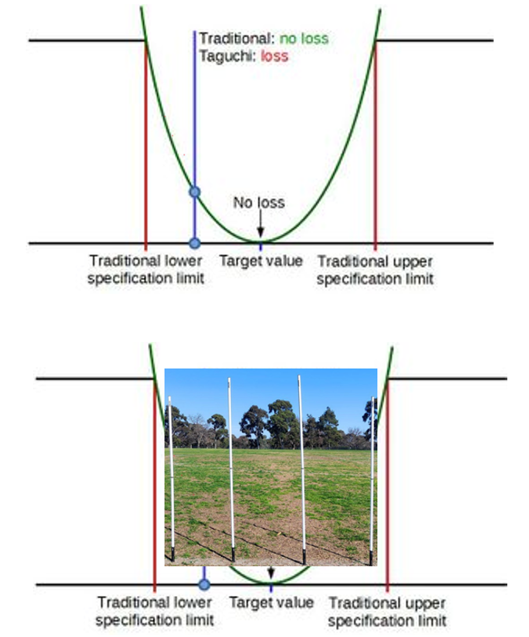
Lancing has highlighted a key problem with many council services. I used to call it the ‘lowest common denominator effect’ (i.e. performance gets reduced to the lowest level tolerated) but I think the Taguchi Loss Function makes the point in a way that helps you to fix the problem.
Imagine that the diagram Lancing used to show the target value that a customer or citizen wants as fitting between two ‘goal posts’, to instead show a set of Australian Rules football goals. For those non-Australians, I have helped you imagine that with the diagram below.
If you aren’t aren’t familiar with Australian Rules football, when the ball is kicked between the two centre posts it is a goal and scores 6 points. If it is kicked between a centre post and the post either side, it is called a behind and scores 1 point. If the ball is kicked outside all the goal posts it is out of bounds on the full and there is no score and the opposition gets to kick the ball back into play.
2000 words (18 minutes reading time) by Lancing Farrell
I might be drawing a long bow, but I think the Abundance agenda presents a fundamental challenge for those councils trying to find a way forward that is financially sustainable in a rate capped environment. It opens the door to reviewing regulatory and other service design to make savings and support economic growth.
Let me start at the beginning.
On 19 June 2025, in an article about a speech by Jim Chalmers, the Australian Treasurer, he was quoted as saying that left-leaning governments (as we currently have in Australia) are “strangling their own good intentions with bureaucracy”. He is asking regulators across the nation to identify regulations that can be axed or simplified to reduce compliance costs and increase the pace of economic growth. It is part of delivering a supply-side solution to the nation’s housing and energy problems by removing government-imposed impediments to production of goods and services.
1800 words (18 minutes reading and/or 20 minutes listening) by Colin Weatherby
I recently found out about Notebooklm and asked it to analyse the entire Local Government Utopia website and answer a set of questions about challenges, solutions and future directions for councils.
The question and answer is below. First, a bit about Notebooklm.
Notebooklm
Notebooklm is a new AI product that takes a specific source or sources nominated by you and provides a summary, or answers to questions you ask about the source or sources that you have uploaded. I loaded the URL for localgovernmentutopia.com but could have loaded pdfs or other types of sources (or combinations of sources). You can load up to 50 different sources with a maximum of 500,000 words.
The person who told me about it had uploaded a manual for their camera as a source and then asked how to change the camera battery. Instead of leafing through a massive pdf manual online, Notebooklm explained how to change the battery with a link directly to the relevant section in the manual!
It also produces podcasts, primarily to help listeners understand complicated topics by hearing a discussion between two people about the source or sources. I was interested in this feature, so I had a go!
Podcast
I asked Notebooklm to make a podcast addressing this question using the Local Government Utopia website as a source:
“What does Local Government Utopia say about what a local government putting the wellbeing of its constituents first looks like; what issues are important and currently not acknowledged in local government; what are current research or policy gaps in local government; any thoughts around recent Commonwealth or Victorian parliamentary inquiries into local government; and finally, what thoughts are there on where public policy might be able to make a meaningful contribution.“
1700 words (18 minutes reading time) by Carole Parkinson
The Deming chain reaction
Tim Whistler cuts straight to the chase. In the case of his latest piece, I think he could do with a little nuancing of what he is proposing. His description of the disruption to ensue if councils can’t manage their finances with a rate cap is probably accurate, but also, avoidable.
I have been talking to executives at councils and it is true that they are grappling with defining and agreeing on what they need to do. Everyone involved in leadership seems to be pulling in a different direction – Finance wants direct funding cuts to balance budgets now; Directors want efficiency drives to fit services into budgets as soon as possible; Councillors want to cut services they think the State should provide and avoid electoral backlash when they stand for re-election in 2028. It is a vicious cycle.
I have a more immediate approach, which neatly fits with Whistler’s focus on infrastructure as the big service, allocating capital first, and, most importantly, reducing expenditure where you should, not just where you think you can.
800 words (8 minutes reading time) by Tim Whistler
Whilst Lancing Farrell has penned an interesting , and no doubt useful, piece on reframing, I think it doesn’t go nearly far enough. Councils are going to remain on a downward trajectory to crisis while they fail to make major changes in the way they think and act.
I have a much shorter list of changes that councils could make and should make. If they don’t, I fear that there will be massive financial failure and the sacking of councils and their CEOs, mainly because they are unable to make decisions where there are no winners, followed by the imposition of State control through the appointment of administrators and forced amalgamations.
2000 words (20 minutes reading time) by Lancing Farrell
Introduction
Is the challenge that councils face insufficient revenue to cover costs? Or is it that they are providing services outside their remit? Or is it waste and inefficiency in their operations? Is it all of the above? And, if it is, where do you start to address it?
When you look at the different things councils are doing to respond to the rate cap – arguing for its removal or modification to enable higher rate increases, cutting services and service levels, shaving 10% off every budget to force savings, or implementing an ‘efficiency dividend’ through successive budgets – you could be forgiven for wondering if councils are trying to solve the same problem.
Having a common view of the problem to be solved is a start to genuine and effective action across the sector.
I have been thinking about a simple re-framing of the problem councils need to solve in a rate capped environment.
1200 words (12 minutes reading) by Colin Weatherby
A recent article in the Melbourne Age by Alan Attwood, entitled ‘Red tape’s strangling volunteering – creating more casualties than you’d think’, is timely in drawing attention to a growing problem in Victorian local government. Risk aversion and red tape are making it difficult for people to volunteer in their own community or even get a job at their council. This focus on playing safe seems to be counterproductive.
As Sidney Dekker and Georgina Poole point out succinctly in ‘Random Noise – Measuring Your Company’s Safety Performance‘, most organisations don’t exist simply to be safe; they exist to provide a product or service. It is unfortunate that many councils seem to be starting to think otherwise. Dekker uses the term ‘safety theatre’ to describe the superficial and often misleading efforts that organisations put into safety. I can’t help thinking that some of the risk management red tape making volunteering more difficult fits that description.
1300 words (14 minutes reading time) by Lancing Farrell
I have been doing some diverse reading recently, some of it inspired by world events. Serendipitously, it has led me to an insight that I thought I would share.
Why we’re Polarized
The first book is Ezra Klein’s international bestseller ‘Why we’re Polarized’. He says the book is an examination of the American political system and that it is unlike most books on American politics, which he says tend to focus on the individuals.
“Let me be clear from the beginning: This is not a book about people. This is a book about systems.”
Ezra Klein, ‘Why we’re Polarized’
Klein is an American and says two decades of reporting on American politics has shown that it has predictable cycles and patterns that repeat. He sets out to explain the failure of the political system, which he says occurs despite it being ‘full of rational actors making rational decisions given the incentives they face’. He describes it as a collection of functional parts that combine into a dysfunctional whole.