294 – If the Vendor Won’t Bet on Savings, Why are you?

700 words (3 minutes reading time) by Tim Whistler

‘The IT Wager’ by Tim Whistler (with the assistance of ChatGPT)

Carole Parkinson has put together a compelling and well researched post on how Councils can avoid gambling on IT investments – or at least how the risks in the bet can be understood.

I asked some experienced IT managers what they thought and they said the post was useful but didn’t go far enough.

I asked them why.

Why the IT bet feels safer than a service bet

The first point made was that the post should have explored why CEOs prefer to gamble on an IT bet than a service review and improvement bet. It was suggested that perhaps they didn’t understand how to make the service review and improvement bet. Or it was simply easier to bet on an IT product from a big vendor. It is a way for the CEO to outsource risk. They pass on the responsibility for organisational service improvement to a Big 4 consultancy and the software vendor.

One suggested that CEOs don’t have a choice because they are caught up in the race to digitise simply because their councils and communities expect them to do it. It is the new service standard. Non one wants to be left behind. Whilst this may be true, I have never seen a business case with a justification of ‘they are doing it, so we should too!’.

Why business cases mislead

Continue reading

289 – Fire fighter or architect? It is your choice.

580 words (6 minutes reading time) by Lancing Farrell

I recently completed a training course in the work of W. Edwards Deming. At the end of the course, one of the participants said they felt as though they now had the knowledge to become an architect in their work and cease being a fire fighter.

It made me think about how it is that leaders become fire fighters. It is a common complaint from executives in local government who are being exhausted on a treadmill of frantic and stressful activity.

I recently saw this piece on LinkedIn by Simon Dodds, a Health Care Engineer at SAASoft Ltd. I have reproduced it in full because it eloquently describes from a health care perspective, the same series of events that shifts managers and directors on the council treadmill from walking speed to sprinting. Here it is.

Continue reading

287 – The council goal posts

550 words (4 minutes reading time) by Tim Whistler

Credit

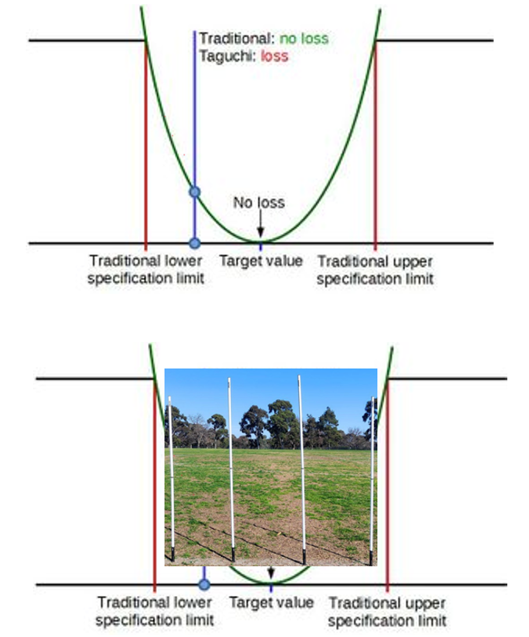
Lancing has highlighted a key problem with many council services. I used to call it the ‘lowest common denominator effect’ (i.e. performance gets reduced to the lowest level tolerated) but I think the Taguchi Loss Function makes the point in a way that helps you to fix the problem.

Imagine that the diagram Lancing used to show the target value that a customer or citizen wants as fitting between two ‘goal posts’, to instead show a set of Australian Rules football goals. For those non-Australians, I have helped you imagine that with the diagram below.

If you aren’t aren’t familiar with Australian Rules football, when the ball is kicked between the two centre posts it is a goal and scores 6 points. If it is kicked between a centre post and the post either side, it is called a behind and scores 1 point. If the ball is kicked outside all the goal posts it is out of bounds on the full and there is no score and the opposition gets to kick the ball back into play.

Continue reading