
Subscribe to continue reading
Subscribe to get access to the rest of this post and other subscriber-only content.
Subscribe to get access to the rest of this post and other subscriber-only content.
400 words (5 minutes reading time) by Colin Weatherby

I have been experimenting with Microsoft’s ‘everyday AI companion’, called Copilot. I asked it to analyse the podcast ‘What on earth is a paradigm shift?’ by the Centre for Public Impact. I am not trying to second guess the great work by Lancing Farrell, simply to show how some new technology works!
This is what it came back with:
The podcast ‘What on earth is a paradigm shift?’ by the Centre for Public Impact (CPI), is a conversation between Adrian Brown and Professor Toby Lowe, who are both part of the CPI team. They discuss the concept of paradigms and how they apply to public service and systems change.
Here is a brief summary of the podcast:
Continue reading850 words (9 minutes reading time) by Lancing Farrell

The need for a new paradigm in local government in Victoria has been mentioned in a few posts recently (see 241 – Rate capping – the final words (from our future), 253 – Minds Change: My Journey to Transform Local Government Performance, and 261 – Reinventing Local Government). Model collapse, as described by Carole Parkinson and Tim Whistler, signals the end of an existing paradigm. This raises critical questions about the current paradigm in local government and the need for change. A recent podcast in the Reimagining Government series by the Centre for Public Impact, ‘What on earth is a paradigm shift?’, discusses paradigms and provides insights and practical tips for those wanting to bring about transformative change.
The podcast features host Adrian Brown and Professor Toby Lowe from the Centre for Public Impact, Henk-Jan Dekker from the International Centre for Environmental Research and Development, and Jessica Studdert from think tank ‘New Local’. Drawing on the work of Thomas Kuhn and Margaret Masterman, a paradigm was defined as a ‘grand explanatory narrative for how a part of the world works’. It operates on metaphysical, sociological, and exemplar levels, shaping perceptions of what exists and what should be valued. Understanding how paradigms work is crucial for those seeking systemic change in local government.
Continue reading1200 words (13 minutes reading time) by Colin Weatherby

A research article in the Australian Journal of Public Administration, titled ‘The other side of the local government ledger — The association between revenue growth and population growth,’ raises a crucial red flag for all councils currently grappling with population growth. The study, by Professor Joseph Drew and his colleagues, sheds light on the relationship between population growth and local government revenue. Professor Drew has made a video explaining the findings of the paper.
In local government, you hear a lot of talk about the rate cap, a limitation on property taxation imposed by the State government on councils, and the impact it is having on councils’ ability to fund services. I have posted previously on what I think councils should be doing in response to the spending gap arising from the rate cap. Most discussion in the sector has focused on the impact on expenditure.
Professor Joseph Drew and his colleagues are suggesting it is equally important, perhaps more important, to understand the impact on unit revenue. Unit revenue, representing the per capita revenue generated by a council, becomes pivotal when service demand stems from individuals residing in the municipality rather than the properties they occupy. The potential mismatch between service consumption drivers and revenue generators poses a substantial financial sustainability risk.
Continue reading600 words (7 minutes reading time) by Lancing Farrell

I recently acquired a ‘new’ copy of the 1992 book ‘Reinventing Government – How the Entrepreneurial Spirit is Transforming the Public Sector‘ by David Osborne and Ted Gaebler, a work that wielded significant influence globally in its time.
The impact of Osborne and Gaebler on world leaders can be discerned through the timing of policy changes, public declarations, and the alignment of advocated principles with the reform initiatives undertaken by these leaders. Some explicitly referenced the book in speeches, policy documents, or interviews, revealing its profound effect on their perspectives. In other instances, reforms closely mirroring the book’s principles suggest a potential influence. The book’s impact must be viewed within the broader context of prevailing ideas and reforms during that period.
Continue reading600 words (7 minutes reading time) by Lancing Farrell

The two previous posts on model collapse and local government have prompted me to think about what has happened in the sector in the last few years. The sudden increase in Ministerial interventions does seem to indicate that something has changed. It may be more than just the introduction of rate capping in 2016.
I started asking colleagues what they think is happening. Unsurprisingly, several had views on what has happened, although no one was definitive. Everyone has anecdotal information from their council. I will have a go at describing the views told to me.
The first colleague reiterated the view put forward by Tim Whistler, that Covid prevented councillors building relationships with each other. It also affected the induction for newly elected councillors, which can be important in clarifying the responsibilities of a councillor, the Council, and the CEO and staff. Roles and responsibilities are cited in Ministerial Terms of Reference in almost all interventions.
Continue reading700 words (8 minutes reading time) by Tim Whistler

In the world of artificial intelligence (AI), the concept of model collapse is a well-recognised challenge. Now it is potentially reaching into my everyday life if my Spotify-generated daylist starts to select songs from a previous daylist! Yet, my concern isn’t confined to personal playlists, and it should be echoing through the corridors of local government and raising questions about what performance measurement actually tells us.
Carole Parkinson’s question at the end of her footnote resonates with me: How can we detect model collapse in local government? It may well be a moot question, and model collapse is simply an explanation of the current situation, as one of Carole’s colleagues suggested. This should become apparent if ChatGPT’s methods to identify model collapse in AI are accurate. Five seem particularly relevant for the local government context:
Continue reading700 words (8 minutes reading time) by Carole Parkinson

In many aspects of human endeavor, the belief that successive generations inherently improve holds true. Take sports, for example, where each Olympics sees records shattered by athletes who are better selected, trained, and conditioned than their predecessors. This continuous improvement is driven by a powerful incentive for each generation to surpass the achievements of the previous one.
However, this upward trajectory doesn’t always apply. In the realm of artificial intelligence (AI), there’s a phenomenon known as model collapse. Without diverse human-generated training data, AI systems risk malfunctioning if inundated with AI-generated content. The first generation of AI benefits from drawing on decades of human ingenuity, but as subsequent generations draw from their own created information, the pool of new ideas dwindles, resulting in a homogenised output.
Continue reading800 Words (9 minutes reading time) by Colin Weatherby
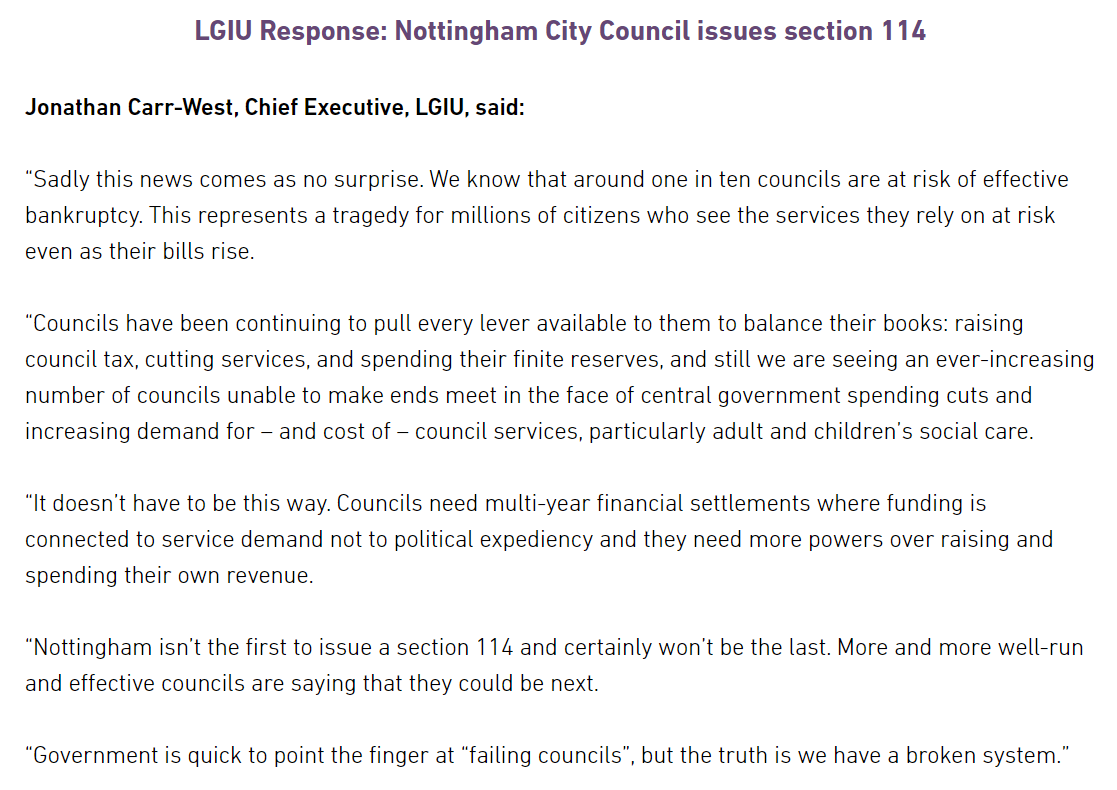
I was reading the latest Local Government Information Unit (LGIU) newsletter from the UK and the news item in the image above caught my attention. Although the cause of the problem is central government cutting funding to councils, not imposition of a rate cap, it has the same effect on council finances and reinforces the view I expressed in my posts about the effects of the rate cap (‘Il comune povero- ‘The poor municipality’ and ‘Rate Capping – the final words (from our future))’. Councils in Victorian can respond by trying to improve current services and increase revenue, find efficiencies and reduce waste in operations, and they will still be unable to meet community needs and expectations within their available resources.
In Victoria, councils cannot issue a section 114, which in the UK means that all spending, apart from on protecting vulnerable people and providing statutory services, will be suspended. Instead, the Victorian government sends in Monitors to oversee council decisions, and then, if the council doesn’t respond as the State requires, they can dismiss the council and appoint Administrators to run the council. In the past, this has resulted in decisions being made by the unelected Administrators to sell community assets, cut services and make whatever changes they think are necessary to get the council back in the black. This tends not to meet community needs and expectations either.
Continue reading580 words (7 minutes reading time) by Lancing Farrell

In a thought-provoking post titled ‘OECD Solutions,’ Colin Weatherby examined decision-making by those suffering from OECD, shedding light on the prevalence of single-loop learning over its more nuanced counterpart, double-loop learning. The implications of this choice, as Weatherby suggests, go beyond the surface, hinting at a deliberate oversight of systemic causes.

 Local Government Utopia