72 – Revolutionising local government. How long is it since you were last revolutionised?

Posted by Whistler                                                                          600 words

merry go round

I was talking to an experienced consultant who works with numerous councils recently and she commented about some of the councils currently undergoing ‘revolutionisation’. New CEO’s, in two cases new to the sector, were busily implementing their kitbag of management ideas. They seem to hit the ground running with a program of change. What are some of the features of revolutionisation and how effective is it?

I will start with effectiveness first. It depends on the measure. I can think of a few. Is it delivering on a promise to the councillors who appointed them to shake things up and create change? Is it is improving the performance of the organisation in meeting community needs sustainably in the longer term?

If it is the former, I would think they are mostly successful. Continue reading

71 – ‘Melbourne People’s Panel makes bold decisions where politicians fear to tread’, The Age, 1 April 2015.

Posted by Colin Weatherby                                                                         550 words

Peoples panel

“The public is smart if given the time and information necessary to work through an issue. And this has been demonstrated by a people’s “jury” which has delivered its verdict in a bold experiment in democracy by the Melbourne Town Hall.

The results should give hope to people despairing that Australia has lost its reform mojo, as it provides a new way for government to get hard but necessary things done.”

I read this article by Nicholas Reece, a Principal Fellow at Melbourne University, with some interest. Involving the community in budgeting is not new. Continue reading

70 – What does ‘meeting expectations’ really mean? A performance appraisal story.

Posted by Whistler                                                                     375 words

apple on teachers desk

Image from http://bellasvitas.blogspot.com.au

I have been reading Lancing Farrell’s posts on performance appraisal with interest. I am sure everyone has a performance appraisal story to tell. A colleague was telling me about her performance appraisal in which she ‘met expectations’. What does that really mean?

Her performance review outcomes possible were on a five point scale – does not meet, partially meets, meets, exceeds, or significantly exceeds expectations. For each outcome there was a definition. The definition for ‘meets expectations’ gives you an idea about the rest. Continue reading

65 – Service suppliers to local government. What do they do differently and why?

Posted by Parkinson                                                                                       350 words

integrated systems

It has always intrigued me that the major suppliers of services to local government operate quite differently. What are some of the differences and why?

The first difference that is obvious is the investment in enterprise management systems. Some are better developed and more integrated than others but all have a third party accredited quality (ISO 9001), safety (AS4801), and environment (ISO 1400) systems. They will also have a corporate operations manual and a management manual setting out company policy and requirements. Continue reading

64 – Ambition, culture and performance. A tale of middle management in local government.

Posted by Whistler                                                                                          750 words

cathedral

I was recently involved in a discussion where the metaphor of the three stonemasons came up. The person telling the story described the response of the three stonemasons to the question ‘what are you doing?’ You may know it.

The first stonemason said ‘I am making a stone’. The second said ‘I am making a wall’. The third said ‘I am making a cathedral’.

The purpose in telling the story was to illustrate the various motivations of people at work in local government and that, hopefully, we are all here to make a cathedral and we know it. Well, I started thinking about how many of the workers cleaning the same public toilets every day, or mowing the same parks, or emptying the same bins, think they are making a cathedral. The chances are that they are just diligently making a stone. Whether it is used to make a cathedral or not is probably not important to them and never will be.

Then my thinking moved on to thinking about myself and the other middle managers I deal with. Surely we are all making cathedrals? Continue reading

63 – ‘The more experienced the managers, the more they trust simple intuition’. Or do they?

Posted by Colin Weatherby                                                                         700 words

intuition

Some time ago I posted on an idea from Richard Farson’s book, Management of the Absurd – Paradoxes in Leadership. This post has been inspired by another chapter in that book.

Farson says that the one quality that top executives say separates them from their less successful colleagues is their intuition. Their ‘immediate visceral reactions’ to people and events are usually accurate, which makes their judgements valuable. Farson defines intuition as the ‘accumulation of many learning experiences that have sensitised them, making them able to read situations quickly’. It is a quality that allows top management to make fast decisions that are effective. However, when top management starts to lack confidence, they start to apply formal processes to make decisions. They replace their immediate visceral reaction with complicated analytical thinking. Continue reading

62 – “The way to make it in local government is to forget ambition and pigeon hole yourself before someone else does”.

Posted by S. Dogood                                                               1000 words

pigeon hole

This was the advice I received during a discussion with a colleague this week.  Pigeon hole yourself he advised and local government becomes a good place to work.  In some ways he is right.  The discussion started me thinking about why that is the case and how it could be different.

The ambitious face a number of challenges.  First and foremost they can’t be threatening to the Executive.  Secondly, they need to be realistic about their skills and value.  Lastly, regardless of their own role breadth or experience, they run the recruitment gamut as there is always a hierarchy of preferred candidates for any role.  Hiring traditionally take the following hierarchy seeking to recruit someone who Continue reading

59 – Decision hats for middle management. Some suggestions.

Posted by Whistler                                                                          570 words

I recently posted on hats that councillors could wear when making decisions in their different capacities, or when making different types of decision. The hats would provide a cue to other councillors and onlookers. I received some comments from readers and since then I conducted an informal poll of colleagues to determine what head gear they think could be worn when they make decisions. Again, the idea is to signal intention to others.

Managers mostly operate in the one capacity but they make many different types of decisions. Here are some thoughts on hats that could go with them. Continue reading

57 – Some types of thinking observed in local government.

Posted by Whistler                                                                          580 words

ant on leaf

Image from http://caracaschronicles.com

Convenient thinking. I think this is a preferred way of thinking for many people. It is the easiest. What is the quickest way to deal with this matter? Is there someone else who should be doing it? What is likely to have the least impact on me? Once you start asking these questions, you are well on the way to some convenient thinking. It is most problematic when senior management regularly engage in convenient thinking.

Consequential thinking. This is related to convenient thinking but is more focussed on the possible outcomes from doing something. What could go wrong? Who could be upset? Will it move my career forward? Continue reading

54 – The four decision hats. What are your councillors wearing?

Posted by Whistler                                                                          630 words

I was in a workshop about Edward De Bono’s six thinking hats recently when it occurred to me that we could do with some decision hats in local government. Councillors could wear a different hat for each of their roles. This way they would be clear about what capacity they are acting in, and any onlookers would know as well.   Alternatively, a different hat could be worn to signal the type of decision being made. Here is how it could go.

Let’s start with hats representing the role or capacity that the councillor is acting in. Obviously, gender will influence hat selection for some councillors. I will do my best to select hats with universal appeal.

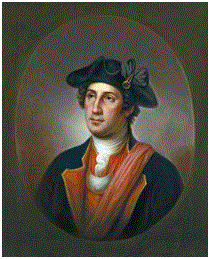
george washigtonWhen acting as politician, part of the local government to make decisions affecting constituents, a range of hats are potentially available. Continue reading