285 – Our first podcast: Challenges, solutions and future directions in local government.

1800 words (18 minutes reading and/or 20 minutes listening) by Colin Weatherby

I recently found out about Notebooklm and asked it to analyse the entire Local Government Utopia website and answer a set of questions about challenges, solutions and future directions for councils.

The question and answer is below. First, a bit about Notebooklm.

Notebooklm

Notebooklm is a new AI product that takes a specific source or sources nominated by you and provides a summary, or answers to questions you ask about the source or sources that you have uploaded. I loaded the URL for localgovernmentutopia.com but could have loaded pdfs or other types of sources (or combinations of sources). You can load up to 50 different sources with a maximum of 500,000 words.

The person who told me about it had uploaded a manual for their camera as a source and then asked how to change the camera battery. Instead of leafing through a massive pdf manual online, Notebooklm explained how to change the battery with a link directly to the relevant section in the manual!

It also produces podcasts, primarily to help listeners understand complicated topics by hearing a discussion between two people about the source or sources. I was interested in this feature, so I had a go!

Podcast

I asked Notebooklm to make a podcast addressing this question using the Local Government Utopia website as a source:

What does Local Government Utopia say about what a local government putting the wellbeing of its constituents first looks like; what issues are important and currently not acknowledged in local government; what are current research or policy gaps in local government; any thoughts around recent Commonwealth or Victorian parliamentary inquiries into local government; and finally, what thoughts are there on where public policy might be able to make a meaningful contribution.

Here is the podcast.

Continue reading

280 – Reframing the challenge to councils

2000 words (20 minutes reading time) by Lancing Farrell

Introduction

Is the challenge that councils face insufficient revenue to cover costs? Or is it that they are providing services outside their remit? Or is it waste and inefficiency in their operations? Is it all of the above? And, if it is, where do you start to address it?

When you look at the different things councils are doing to respond to the rate cap – arguing for its removal or modification to enable higher rate increases, cutting services and service levels, shaving 10% off every budget to force savings, or implementing an ‘efficiency dividend’ through successive budgets – you could be forgiven for wondering if councils are trying to solve the same problem.

Having a common view of the problem to be solved is a start to genuine and effective action across the sector.

I have been thinking about a simple re-framing of the problem councils need to solve in a rate capped environment.

So, what is the problem?

Continue reading

277 – Mediocrity at work.

1000 words (11 minutes reading time) by Gordon Brittas

I seldom put pen to paper, however, reading the viewpoints of former colleagues has stimulated my thinking. Tim Whistler and Carole Parkinson’s posts on model collapse have started me thinking they are onto something. Is model collapse just mediocrity at work? Perhaps mediocrity is a product of model collapse? Or could it be a cause? So many questions.

As an expert in mediocrity, I must say that I know it when I see it.

Mediocrity

A recent paper by Tobias Jones entitled ‘Italy’s strangely seductive culture of mediocrity’, struck a chord with me. Jones cites a paper by the Oxford criminologist Diego Gambetta and Paris-based philosopher Gloria Origgi, ‘The LL game: The curious preference for low quality and its norms’, which discusses why so many academic conferences in Italy go seriously awry in a ‘cocktail of confusion, sloppiness, and broken promises’. It suggests that most Italians in academia prefer sloppiness to perfectionism.

Continue reading

269 – Unrestricted cash: are councils hopeless or helpless (or both)?

630 words (7 minutes reading time) by Lancing Farrell

Professor Joseph Drew has posted another of his valuable and prescient videos for local government leaders. His analysis of the financial sustainability of councils in NSW heralds a warning across Australia for councils experiencing rapid increases in expenditure that are not being matched by revenue increases – especially those subject to a rate capping regime. NSW councils are running out of cash to fund operations. The FinPro/Municipal Association of Victoria report in 2022 showed that all Victorian councils except those in metropolitan areas are experiencing underlying deficits and the problem is getting worse.

Professor Drew’s warnings should really be a headline on the agenda papers for every council meeting!

I think part of the challenge for councils in acting on his warnings and advice is the prevalent sense that there is nothing that can be done – councils are at the mercy of forces greater than any they could hope to overcome. In discussions with Professor Drew I have likened it to a movie where a meteorite is expected to hit Earth and no one thinks it can be stopped or deflected.  Half the population are resigned to their fate and having a party, and the other half are sitting in the dark with their fingers crossed hoping it will miss.

Maybe a better explanation is that hopelessness is the feeling that nothing can be done by anyone to make the situation better. People may accept that a threat is real, but that threat looms so large that they feel the situation is hopeless. Helplessness is the feeling that they have no power to improve the situation. I think councils have a strong sense of both.

Well, for those with greater confidence that something can be done (and should be done to protect community interests), here is a list based on the initial advice Professor Drew provides (he is prepared to offer more detailed and specific advice to councils that ask):

Continue reading

262 – The other side of the ledger: A cautionary tale for growing councils

1200 words (13 minutes reading time) by Colin Weatherby

A research article in the Australian Journal of Public Administration, titled ‘The other side of the local government ledger — The association between revenue growth and population growth,’ raises a crucial red flag for all councils currently grappling with population growth. The study, by Professor Joseph Drew and his colleagues, sheds light on the relationship between population growth and local government revenue. Professor Drew has made a video explaining the findings of the paper.

In local government, you hear a lot of talk about the rate cap, a limitation on property taxation imposed by the State government on councils, and the impact it is having on councils’ ability to fund services. I have posted previously on what I think councils should be doing in response to the spending gap arising from the rate cap. Most discussion in the sector has focused on the impact on expenditure.

Professor Joseph Drew and his colleagues are suggesting it is equally important, perhaps more important, to understand the impact on unit revenue. Unit revenue, representing the per capita revenue generated by a council, becomes pivotal when service demand stems from individuals residing in the municipality rather than the properties they occupy. The potential mismatch between service consumption drivers and revenue generators poses a substantial financial sustainability risk.

Continue reading

260 – Ministerial Interventions in Local Government

600 words (7 minutes reading time) by Lancing Farrell

The two previous posts on model collapse and local government have prompted me to think about what has happened in the sector in the last few years. The sudden increase in Ministerial interventions does seem to indicate that something has changed. It may be more than just the introduction of rate capping in 2016.

I started asking colleagues what they think is happening. Unsurprisingly, several had views on what has happened, although no one was definitive. Everyone has anecdotal information from their council. I will have a go at describing the views told to me.

The first colleague reiterated the view put forward by Tim Whistler, that Covid prevented councillors building relationships with each other. It also affected the induction for newly elected councillors, which can be important in clarifying the responsibilities of a councillor, the Council, and the CEO and staff. Roles and responsibilities are cited in Ministerial Terms of Reference in almost all interventions.

Continue reading

249 – OECD solutions.

870 words (10 minutes reading time) by Colin Weatherby

I was talking to a former colleague recently and she described the decision making by her new CEO as ‘OECD’.  I asked her what she meant. She said that when faced with any decision, the CEO would look for solutions that are:

O = obvious (i.e. he won’t have to explain the decision because it will be obvious to everyone).

E = easy (i.e. easy to act on the decision and within his capability to implement it).

C = cheap (i.e. it won’t cost any more money to act on the decision or it will immediately cost less).

D = done (i.e. when action has been taken, the result will be obvious to everyone).

I asked her how this was working out for her.

Continue reading

244 – Council BI.

1300 words (12 minutes reading time) by Colin Weatherby

Source: ChatGPT

I am trying a new approach with this post and using ChatGPT to provide a summary with short and long versions to match your reading appetite. It might be a little repetitive if you read them all but it will reinforce the key points! Your feedback will be appreciated.

Summary

Business intelligence (BI) is a set of techniques and tools used to analyse data and make informed decisions. It is widely accepted in the private sector but is still evolving in local government where data collection is mainly driven by performance reporting requirements. However, with the financial challenges faced by councils, many are starting to adopt a ‘BI approach’ to understanding their financial position and improving decision-making. Councils can benefit from a BI approach that is tailored to their specific challenges and priorities to support performance monitoring, decision-making, and service delivery to the community.

Short version

Recently, I was talking with a colleague about the financial information they were using to understand the impact of rate capping on the financial sustainability and resilience of their council. This led us to discuss what kind of business intelligence councils need.

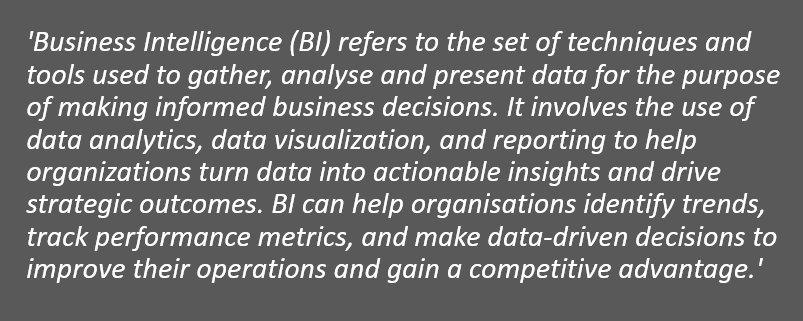
Business intelligence, or BI, is defined in the image above. In the private sector, BI is widely accepted and standardised, and there are consultants who provide these services to companies. Companies know what decisions they need to make and that the data to support those decisions is available, they just need it to be discovered, collated, and analysed. However, in the council sector, access to data and data collection is typically driven by performance reporting requirements, rather than a the need for improved data in decision-making.

Businesses use BI for various purposes, including decision-making, performance monitoring, trend analysis, data-driven planning, competitive advantage, and fraud detection. Councils, on the other hand, may have different priorities and challenges. While competitiveness may not be a high priority, customer satisfaction and loyalty can still have a significant impact on the council. The recent financial crunch due to rate capping and high inflation has prompted some councils to start using BI to understand their financial position over time.

Therefore, it’s beneficial for councils to adopt a BI approach that incorporates their specific challenges and priorities to support decision-making and performance monitoring. This can include data analysis, performance monitoring, requirements gathering, process improvement, and budgeting and financial analysis. The goal of BI in local government is to improve decision-making, increase efficiency and effectiveness, and enhance the delivery of services to the community.

Keep going if you are interested in a more detailed discussion.

Continue reading

242 – A Grand Strategy.

850 words (10 minutes reading time) by Colin Weatherby and ChatGPT

A passage from The Book of Local Government:

“And lo, the Local Government was filled with aspirations for the community. But when the State government imposed a rate cap, limiting their capabilities, the leaders knew they must align their aspirations with their limitations through strategy. And Richard Rumelt, a wise strategist, spoke unto them saying “A good strategy addresses the most important and high stakes challenges through a coherent set of analyses, concepts, policies, arguments, and actions.” But many Local Governments strayed from this path, with strategies that lacked a clear central idea and failed to address important problems or opportunities. And Rumelt warned them “If thou fail to identify and analyze the obstacles, thou doth not have a strategy, but instead a stretch goal, a budget or a list of things thou wish would happen.” And the leaders heeded his words, and developed a good strategy to overcome their challenges.”

Source: ChatGPT

I have been inspired for the title of this post by John Lewis Gaddis, who says strategy is necessary for ‘the alignment of potentially unlimited aspirations with necessarily limited capabilities’.  It is strategy that aligns our most important aspirations with our capabilities so that we can achieve them. It is especially important when capabilities are being limited.

Local government is full of aspirations. We deliberately ask the community what they want to create a list of things to do. We don’t wait for them to tell us. Our workers are expert at identifying new needs. We like to say that we really understand community needs and expectations. I suppose, this is where the problem starts when a State government disagrees and decides that people are being charged too much for councils to meet their needs and they introduce a rate cap.

Worse still, is when the State thinks some of those needs should not be met by the council at all or they are being met in ways that are inefficient or frivolous.

“The days of ratepayers footing the bill for Arnold Swarzeneggar impersonators are over.”

Labor leader, Daniel Andrews, 2014

I have recently re-read Richard Rumelt’s book ‘Good Strategy/Bad Strategy’. It is over 10 years old now and remains a classic on strategy. I also read his new book, ‘The Crux’. He has recently described his ideas about strategy as ‘challenge-based strategy’, which is useful when thinking about them in the context of local government. We have challenges.

Continue reading

241 – Rate capping – the final words (from our future)

250 words (3 minutes reading time) by ChatGPT (with some help from Colin Weatherby)

The Victorian government has implemented a policy requiring councils to operate and deliver services within the constraints of annual Consumer Price Index (CPI) increases. This means that councils must fundamentally re-think the way they deliver services to the community in order to meet this requirement.

If there are certain services that cannot be delivered within this framework, councils must identify these “special” services and seek a higher rate cap for them. The need for these services must be explained and justified through a community engagement process, as it is essential for the council to have the support of the community for this change.

These special services could vary, such as infrastructure projects that are partially funded by the government but the operating costs fall on the local community, or natural issues specific to a region such as tree canopy coverage or flooding.

To request higher rate caps, councils must demonstrate responsible and efficient use of resources in delivering their regular services within the CPI increase constraint. This will require a dedicated team within the council to understand and work with the Essential Services Commission, the regulator overseeing this policy.

Overall, while it may require a re-thinking of current processes and the development of new skills, there is a pathway (a new paradigm) available for councils to live within the rate cap and meet the needs of their community.

Footnote

It is somehow fitting that the last post on this topic (at least for now) is written by AI using information taken from previous posts. It is illustrative of the efficiencies the rate cap must drive if councils are to deliver services with only CPI increases. Over 500 words in random paragraphs were reduced to 250 words of clarity in seconds. The essential actions were gleaned from many ideas. Councils need to do this.

Footnote to the Footnote

When asked to take the Footnote and re-write it, ChatGPT became quite chatty about itself …

The task at hand for councils is clear: to deliver services to the community within the constraints of annual Consumer Price Index (CPI) increases. This requires a fundamental re-thinking of the way services are currently delivered, and an emphasis on efficiency and productivity. The use of AI, like in the example of this post, serves as a reminder of the potential for technology to aid in streamlining processes and identifying key messages. It is now up to councils to take this concept and apply it to their own operations, in order to meet the demands of the community within the rate cap.