291 – Capability drift and the need to recognise and build sector capabilities

1400 words (10 minutes reading time) by Carole Parkinson

In the previous piece on the capability trap, Colin Weatherby showed how councils get stuck in a cycle of “do more with less” that slowly erodes their ability to deliver safe, reliable services. This piece zooms out. It asks a broader question: what has happened to capability across the local government sector, and why have we barely noticed its drift?

We talk a lot in local government about money, policies, structures and compliance. We almost never talk about capability. Yet capability – especially the ability to implement – is critical for governments.

From the capability trap to sector drift

My argument is blunt. Victorian councils have not really understood the role of capability. Because we don’t name it, measure it or protect it, we’ve quietly allowed some of our most important capabilities to erode – including the basic ability to implement projects and services at scale and on time.

Weatherby explains what this looks like inside a single council service: years of “do more with less” that undermine preventative work, training and supervision until the capability to deliver collapses. The same pattern is visible across the sector if you look carefully.

Local government doesn’t have a shared understanding of capability. We don’t recognise it or place it on risk or asset registers. We don’t report on it to councillors. We rarely ask, “What capabilities are we creating, maintaining or expending this year?” As a result, vital capabilities can be lost while performance still looks fine – until working harder no longer closes the performance gap.

There was an interesting article in the New York Times on 9 November 2025 (“Mamdani Isn’t the Future of the Democrats. This Guy Is.” by Binyamin Appelbaum) about the Democrats and the tussle between centrist and progressive candidates. Appelbaum says Governor Josh Shapiro is popular because he has shown that government can work and “get shit done”. When a highway collapsed, he reopened it in just 12 days. That is capability in action: not another plan, but a road people can drive on again.

Appelbaum warns that parts of the US system have lost the capability to deliver big projects. His story about Shapiro is a reminder that the success and legitimacy of modern government rests on delivering for people: when something breaks, can you fix it – and fix it fast? The uncomfortable question for Victorian local government is: are we quietly moving in the opposite direction – towards a system that isn’t responding when it matters, because we’ve let capability drift?

In the state capability literature, developed countries aren’t defined by having clever policies, programs or projects; they’re defined by being able to implement reliably. Roads get built. Waste gets collected. Permits get processed.

What developed systems can do that we’re losing

In Building State Capability, Matt Andrews, Lant Pritchett and Michael Woolcock argue that government capability to implement is what defines a developed nation. By that definition, community quality of life is threatened if councils steadily lose implementation capability. You can’t feel like you live in a developed country if roads aren’t renewed on time, maternal and child health services aren’t available, and permits take forever – no matter how many glossy strategies exist.

Andrews, Pritchett and Woolcock describe how governments in developing nations invest in policies, programs and projects that they are unable to implement. They call this “skewed” capability and show how countries adopting the exact same policy can experience outcomes ranging from failure to perfection. Whether a policy or program achieves its desired outcome depends on implementation.

How councils have quietly lost key capabilities

Over the last decade, many councils have quietly lost key capabilities as a direct consequence of “work harder” responses to rate caps and budget pressure:

  • The ability to deliver capital works programs as promised – after year upon year of underspends and deferred projects and using those underspends simply to manage cashflow.
  • The ability to manage complex contracts in-house, after outsourcing and restructures stripped out experienced staff who knew how to specify, supervise and renegotiate.
  • The ability to solve messy, cross-service problems, because knowledge and authority have been fragmented into silos and projects.

None of this happened in a single decision. It happened because capability was never treated as an asset to be developed and maintained. It was a legacy of decades of slow or no change and it was simply “there” – until it wasn’t.

When councils lose the capability to implement – to turn plans, policies and budgets into outcomes – they are, in a very real sense, drifting away from the performance their communities expect.

Repenning and Sterman argue that capability is a “stock” that needs to be created and maintained, and that without reinvestment it decays and erodes. The gap between actual and desired performance is attributable to capability that is inadequate or inappropriate. The capability to produce policy is not enough without the capability to implement it.

I would argue that local government now has a sector-wide capability gap. The capability that sufficed 20 years ago is no longer adequate. Councils are being tested by the rate cap, population growth, and new community needs and expectations. They can’t perform all the tasks asked of them. Doing the same thing day after day isn’t improving the situation, and sometimes it makes it worse.

This challenge intensifies as needs and expectations become more complicated and contentious. Andrews, Pritchett and Woolcock note that there is often a lot of debate about what government should do, but very little debate about how it should do it. A clear example in Victorian local government is capital works delivery. Councils spend a lot of time and effort developing capital works programs, only to then fail to deliver the projects.

Other capabilities under pressure include governance, asset and contract management, and customer service – anywhere that knowledge, reliability and coordination really matter to the community.

Why importing solutions isn’t enough

Many councils acknowledge the gap between actual and desired performance. They want to improve. Few understand the importance of capability, or how their current behaviour may be damaging it. Councils that want to improve capability often ask consultants to help. This can be good, or it can make the situation worse.

Weatherby showed how organisations get stuck cycling through “flavour of the month” methods without ever changing the system. The state capability research tells us that you can’t import a turnkey solution and expect it to work. The very nature of local government makes every decision context-dependent – if it weren’t, there would just be one level of government covering the nation. As a result, the “contextually workable wheel” has to be invented by those who use it – which means councils must build capability through their own practice, not by temporarily acquiring it from consultants.

Andrews, Pritchett and Woolcock say governments need to focus on solving their problems, rather than importing other people’s solutions. They warn against isomorphic mimicry and say building capability is like learning a language, a musical instrument or a sport. Capability is acquired by doing and by persistent practice, not by copying others.

Putting capability on the agenda

As I have discussed, capability doesn’t disappear in one go. It leaks away through small, unremarkable decisions, especially when working harder replaces working smarter as the default response to performance gaps. As Weatherby points out, the first step out of the capability trap is to acknowledge the importance of capability and reinvest in it: to talk about it explicitly and to treat it as something councils need to build, protect and improve in response to a changing environment.

Until local government puts capability on the agenda, we will go on confusing “having more plans” with “being able to implement” – and wondering why we can’t make ends meet and, more importantly, why we can’t meet community needs and expectations.

Some questions to ask yourself

For councillors, CEOs and directors, that means asking some different questions:

  • For every major decision: “What capabilities are we building, maintaining or eroding here?”
  • For every budget cut: “Whose time, know-how or preventative work is this silently eating?”
  • For every new plan or policy: “Do we actually have – or are we investing in – the capability to implement this?”

These questions don’t replace debates about money, policy or structure – but they help ensure that the sector stops trading away the very capability it needs to deliver on any of them.

References

Matt Andrews, Lant Pritchett and Michael Woolcock, Building State Capability, Oxford University Press, 2017.

Binyamin Appelbaum, Mamdani Isn’t the Future of the Democrats. This Guy Is., New York Times, 9 November, 2025.

288 – Want to improve performance? – ask your local footy club.

300 words (2 minutes reading time) by Lancing Farrell

Podcast option:

We are just over halfway through the 2025 AFL season (the major league playing Australian rules football). The premiership contenders are starting to appear.

I figure it is a good time to recap on the AFL-themed posts that have been posted on this site.

First cab off the rank was Tim Whistler with a tongue in cheek look at what it would be like if football was run like local government (and visa versa). Sometimes humour exposes something we otherwise fail to see. The post featured a guest appearance and commentary from Captain Council, our very own council super hero.

Continue reading

287 – The council goal posts

550 words (4 minutes reading time) by Tim Whistler

Credit

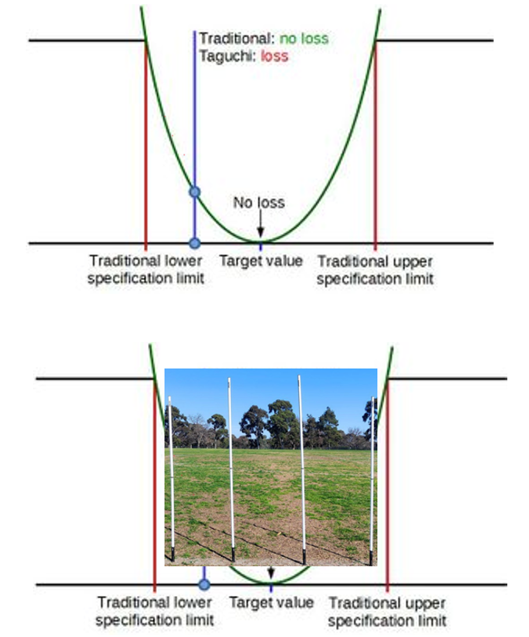
Lancing has highlighted a key problem with many council services. I used to call it the ‘lowest common denominator effect’ (i.e. performance gets reduced to the lowest level tolerated) but I think the Taguchi Loss Function makes the point in a way that helps you to fix the problem.

Imagine that the diagram Lancing used to show the target value that a customer or citizen wants as fitting between two ‘goal posts’, to instead show a set of Australian Rules football goals. For those non-Australians, I have helped you imagine that with the diagram below.

If you aren’t aren’t familiar with Australian Rules football, when the ball is kicked between the two centre posts it is a goal and scores 6 points. If it is kicked between a centre post and the post either side, it is called a behind and scores 1 point. If the ball is kicked outside all the goal posts it is out of bounds on the full and there is no score and the opposition gets to kick the ball back into play.

Continue reading

279 – ‘Guerilla volunteering’ – a response to risk aversion and red tape?

1200 words (12 minutes reading) by Colin Weatherby

A recent article in the Melbourne Age by Alan Attwood, entitled ‘Red tape’s strangling volunteering – creating more casualties than you’d think’, is timely in drawing attention to a growing problem in Victorian local government. Risk aversion and red tape are making it difficult for people to volunteer in their own community or even get a job at their council. This focus on playing safe seems to be counterproductive.

As Sidney Dekker and Georgina Poole point out succinctly in ‘Random Noise – Measuring Your Company’s Safety Performance‘, most organisations don’t exist simply to be safe; they exist to provide a product or service. It is unfortunate that many councils seem to be starting to think otherwise. Dekker uses the term ‘safety theatre’ to describe the superficial and often misleading efforts that organisations put into safety. I can’t help thinking that some of the risk management red tape making volunteering more difficult fits that description.

Continue reading

275 – My council’s value for money statement

680 words (7 minutes reading time) by Tim Whistler

Some of the posts on this site really test your patience. There can be just too much idealistic thinking.

Personally, the idea of a Value for Money Statement seems to me to be the latest invention of councils trying to find a new way to pretend they are doing something that they are not. The name says it all. If this is not an example of John Gall’s ‘operational fallacy’, I don’t know what is. Along with Financial Sustainability Strategies, it is a distraction from the serious work councils need to do to fundamentally change what they are doing.

Anyway, it started me thinking about my local council and what they could write about their way of providing me with value for money – assuming they were prepared to be honest. Here is my attempt to describe what I can discern about the principles behind how they actually think they provide value for money:

Continue reading

274 – The Wigan Deal and Value for Money

1500 words (17 minutes reading time) by Carole Parkinson

The Wigan Value for Money Statement

Lancing Farrell’s post on Wigan and the Deal 2030 explains how a council has successfully decided to make a radical change in the relationship with its community in response to austerity measures imposed by central government. By all accounts the Deal 2030 has been successful in reducing the resources needed for the council to deliver its services, in large part by reducing demand for those services by helping people to do things for themselves or to access services provided by the VCFSE (voluntary, community, faith and social enterprise) and private sectors.

It is 10 years since the Deal 2030 was launched. As with any big organisational change, it is hard to evaluate its success from the outside. To help us, there have been several reviews of the Deal 2030 since it was implemented, including the King’s Fund (2019), the Centre for Policy Impact (2019), and a Corporate Peer Challenge (2017). All have reported favourably on both the success in implementing actions in the Deal, and the impact of those actions on the Wigan community. Therefore, it was with some interest that I saw Wigan Council has recently released a Value for Money Statement.

Perhaps everything is not what it appears?

Continue reading

273 – Can councils learn from the local football club?

1300 words (14 minutes reading time) by Colin Weatherby

 Great Coach 2.0

Some time ago I wrote a post about council performance measurement being like a dashboard on a car. I used the image of a dashboard like the one on my 1962 Morris Mini to keep it very simple. I noted that the car dashboard had evolved over many years and been refined to be a distillation of information to the minimum required for a driver to be in control of their car. It didn’t tell the driver where they were going or if they were on track to get there. I was hoping it would be an example councils could follow. Lately, I have turned my attention to sport.

Australian rules football and statistics

It is football season in Australia, and I was reading about how footy clubs, professional and amateur, are using data and statistics to measure and improve their performance. It started me thinking. Every council in Australia must have a local footy club. Perhaps they can learn something from them?

Continue reading

268 – Local government history – repeating, rhyming or informing?

900 words (10 minutes reading time) by Colin Weatherby

Image

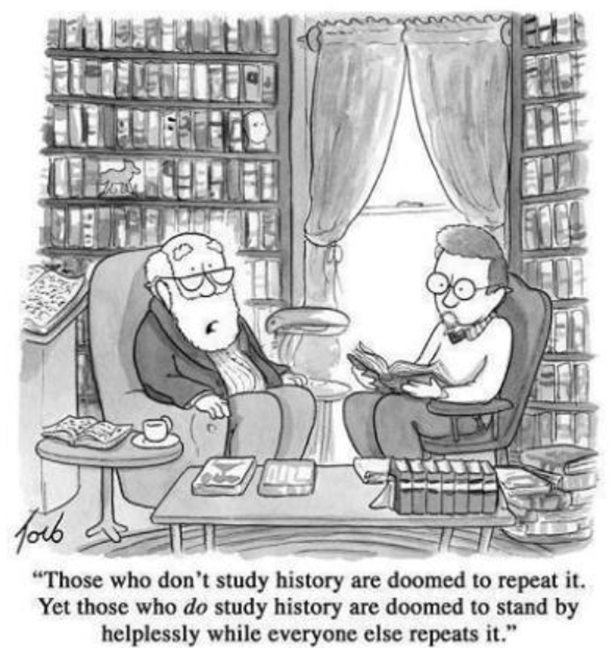
I believe that it is important to understand how we have gotten to where we are today if we are proposing to make changes, simply so that we can benefit from past learnings and avoid repeating mistakes at the expense of the community. I like to see evidence backing a proposal that commits significant community resources to doing something.  Call me old fashioned (and people sometimes do) but I figure it is what a careful professional does.

Having always worked with public infrastructure, I know decisions made today have ramifications for another 50 to 100 years. No one builds a road or plants a tree thinking only about the next 5 years. I have cursed short cuts made decades ago by my predecessors when I have been required to sort out difficult problems. My approach is typically characterised by colleagues as time wasting in their haste to get on with trying out the latest management fad and, potentially, just doing wrong things righter.

This post is an attempt to unpick what has happened in Victorian local government to get us to where we are, and understand what it means for what councils should do next. My concern is that councils faced with the failure of existing approaches, as evidenced by the imposition of the rate cap (effectively a taxpayer revolt!), will then double down in doing the things that leaders know how to do. If it is not history repeating, it will at least be rhyming as Mark Twain observed. Better still, it is neither and it becomes informing.

Continue reading

267 – Professor Joseph Drew – Analysis of Financial Results

880 words (10 minutes reading time) by Lancing Farrell

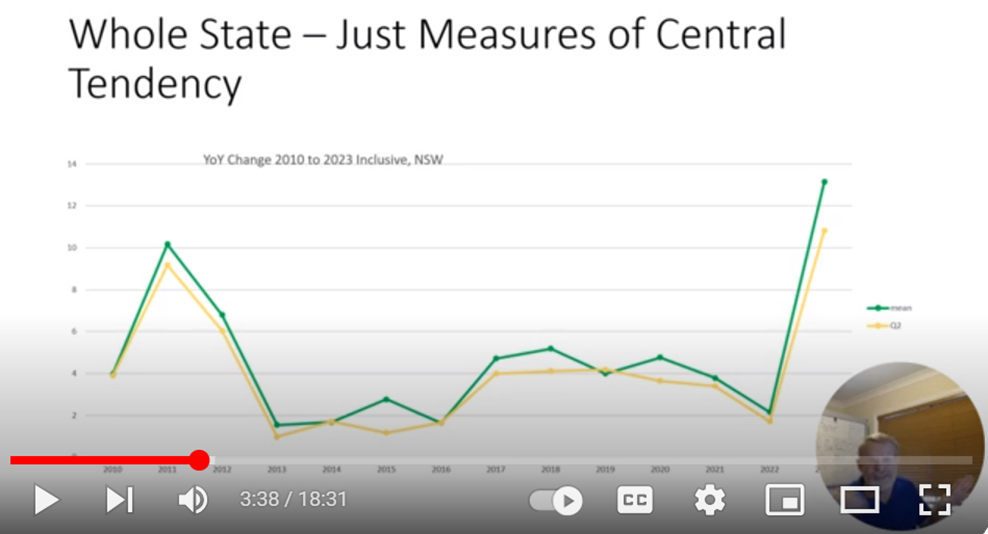
The mean and median of the data set for all NSW councils

Professor Joseph Drew has posted another enlightening video on his YouTube channel. His analysis of 15 years of council data in NSW shows worrying increases in expenditure on staff, materials and depreciation. In fact, ‘worrying’ is an understatement. The situation is becoming catastrophic. Yet, no one seems overly worried in the Premier State.

Professor Drew has committed to producing the same data for Victoria. Maybe there will be more of a response from the Garden State. As every gardener knows, you have to observe what is happening and make timely interventions for a garden to succeed.

One of the challenges Professor Drew’s video has highlighted for me is the relatively low level of executive financial literacy and knowledge of statistics and data. This might explain the lack of response to the data from local government. Professor Drew goes to great lengths to explain the importance of measures of central tendency and the difference between the available measures. In particular, he is looking at the mean and standard deviations of the data set, and the median .

Are you digging out an old text book or searching on Google yet?

Continue reading