Thorpe explains how he has overcome some big challenges. Inside the e-book you’ll find practical ways to think and act differently, including:
Managing for value to move a conversation from operational gripes to strategic leverage.
Aligning public value, legitimacy, and operational capability so good intentions can be delivered.
Designing operations for the visible signals that tell people a place is being cared for (especially when resources are tight).
Service blueprinting to map services end-to-end, anticipate fail points, and build recovery so services are safe-to-fail at go-live.
Accommodating variety by designing a menu of service options that fit different household circumstances.
Understanding system capability to understand what a system can actually produce, and why setting targets outside capability will damage capability.
Purpose-led improvement in statutory services by focussing on the applicant experience drivers so that statutory measures become a consequence, not the method.
Inspired by Mark Moore, W. Edwards Deming, John Seddon, and other systemic thinkers, Thorpe has thought deeply about the challenges that he and others experienced at work. He has then looked far and wide for theories to explain what he was observing to help him learn and improve.
Permeating each of the stories is the idea that when service purpose is defined in terms of what the customer, resident, applicant, or service user needs and expects, the right measures of performance and the right method for delivery become clearer. In comparison, when purpose is defined by what the organisation wants to achieve, report, or control, effort gets misdirected, and demands rebound as rework, complaints, and escalations.
The e-book has been written for councillors, executives, service managers, and improvement practitioners. Download the e-book and read these stories if you are tired of plans that promise more than your organisation can deliver.
700 words (3 minutes reading time) by Tim Whistler
‘The IT Wager’ by Tim Whistler (with the assistance of ChatGPT)
Carole Parkinson has put together a compelling and well researched post on how Councils can avoid gambling on IT investments – or at least how the risks in the bet can be understood.
I asked some experienced IT managers what they thought and they said the post was useful but didn’t go far enough.
I asked them why.
Why the IT bet feels safer than a service bet
The first point made was that the post should have explored why CEOs prefer to gamble on an IT bet than a service review and improvement bet. It was suggested that perhaps they didn’t understand how to make the service review and improvement bet. Or it was simply easier to bet on an IT product from a big vendor. It is a way for the CEO to outsource risk. They pass on the responsibility for organisational service improvement to a Big 4 consultancy and the software vendor.
One suggested that CEOs don’t have a choice because they are caught up in the race to digitise simply because their councils and communities expect them to do it. It is the new service standard. Non one wants to be left behind. Whilst this may be true, I have never seen a business case with a justification of ‘they are doing it, so we should too!’.
Why business cases mislead
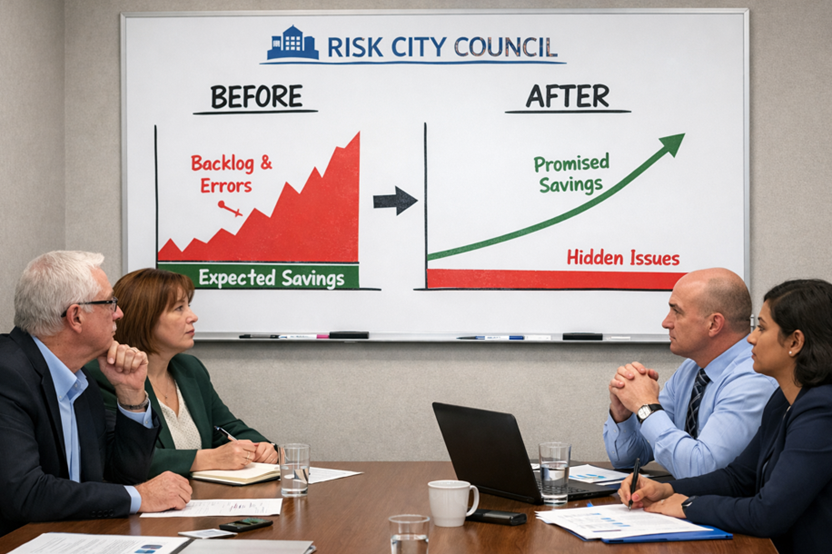
The second point was that excessive optimism is just one of the judgement errors CEO’s and councillors make. This could have been explained more. They saw it as accompanied by overestimation of benefits and underestimation of risks. Of course, they are related and Parkinson could have discussed how this occurs in the benefit:cost analysis of the business case. I suppose, in fairness to Carole, she did say to treat the business case as a ‘claim to test, not a plan to implement’. She encouraged Councillors to question the way benefits and risks are quantified.
What vendors actually guarantee
The last point they made was on vendor assurances or guarantees that their software will deliver the expected benefits. I was told attempts to set this up had all failed. A quick search using ChatGPT revealed that software vendors will provide some assurances. For example, the uptime/availability of their software for use by the purchaser. Typically there are numerous exclusions, remedies or damages are limited, and there is seldom compensation for losses. But they do provide it.
Vendors will also warranty that their software will conform with their specification and documentation, and they will rectify any defects. They don’t warranty that the software will achieve what the purchasers specification requires or transform their services. Whilst vendors often claim that their software will improve productivity/efficiency/service experience, their contracts don’t guarantee it.
To get a guarantee of business improvement, a purchaser would have to explicitly turn their expected operational outcomes into contractual obligations with measurement linked to payment – and then get the vendor to agree. This is unlikely to happen with the big software vendors because they would be taking on much more risk. It would also be reflected in their price if they did agree. Expect to pay a lot more.
In the end…
In the end, the uncomfortable truth is simple: vendors will stand behind availability and conformance to documentation, not the operational outcomes your business case is counting on. It is illustrative to think of an outcome guarantee as if it was a bet.
If the benefits in the business case are real and predictable, the vendor should be prepared to place a bet by putting meaningful fees at risk. This would help the council to monetise the risk it would otherwise take because the price of getting the vendor to accept the risk would equal the cost of the risk.
If the vendor won’t place the bet, why should the council?
2200 words (20 minutes reading time) by Carole Parkinson
Podcast option:
Credit: ChatGPT
In a nutshell…
This post explores the risks and pitfalls associated with large-scale IT investments in local government. It argues that councils often rely on technology and automation to fix financial deficits or service inefficiencies without first optimising their underlying processes. Drawing on expert theories, the post suggests that these ambitious projects frequently over-promise and under-deliver by ignoring the complexities of human-technical systems. To avoid failure, Parkinson recommends that leaders adopt a skeptical mindset, demand evidence-based service studies, and implement incremental project stages. Ultimately, Parkinson emphasizes that improving service design from a resident’s perspective is more effective than simply digitising outdated methods.
Introduction
“I voted for the IT project because the business case promised the budget would balance by year four. But no one told us what we’d do if the savings didn’t arrive. In the end, we automated our inefficient services instead of fixing them. It has now cost us more money than we have saved!
We should have demanded a service study to improve services first, limited the project scope, put a ‘kill-switch’ in place, and made sure the CEO had an effective early warning system in place for failure.”
Councillor
The lesson?
Big IT doesn’t fix services; it just automates them. You can make governance improvements to reduce the odds of an expensive disappointment.
Why councils are betting on IT
I have been reading the plans Victorian councils are releasing for the next 10 years. These plans are all a bit different. In essence they cover how a council will serve its community, define the services and projects the council will deliver, and show how the councils strategic direction will be funded.
IT investment is positioned as an enabler of efficient service delivery, better decisions, streamlined operations, and improved customer experience, while also promoting transparency and accessibility. It is justified as necessary to meet online-service expectations, modernise old systems, and sustain previous investments.
In a nutshell, they are relying on IT investment to improve how council work gets done so services are delivered more efficiently and conveniently. More importantly, they are relying on them to balance budgets through efficiency dividends from process automation and use of artificial intelligence.
How that bet goes wrong (in real life, not in the plan)
In these plans, some councils provide detailed action plans for IT investment. They describe how the investment in enterprise IT/digital/artificial intelligence (AI) will pay dividends through increased efficiency and better decision making. Few include quantifiable measures, like hours of customer/staff time saved, time or money saved from improved service performance, or number of blocked cyber threats.
Most make more general statements, such as IT investment improving ‘integration, efficiency, service responsiveness, analytics, and data protection’. They tend to flag things like AI and emerging tech as ‘disruptive’, and say they will need continued ‘exploration, upskilling and adoption’ to capture opportunities and maintain service effectiveness.
In all cases, there are lots of red flags. Savings are assumed to come from unspecified efficiencies, even when the way services are delivered hasn’t been optimised. Many benefits depend on behaviour change by people across the organisation, not just installing new software. None consider the cost shifting that happens when you reduce visible headcount but increase hidden work in data cleansing, workarounds, exception handling, and vendor dependency. Finally, they underestimate the cost of learning, backfilling, training, retrospective process redesign, change fatigue, and the productivity dip experienced after go-live.
A major IT investment isn’t simply a technology purchase. It’s a high-risk intervention in a complex socio-technical system. If you don’t understand the system first, IT will amplify the waste, workarounds, delays, and blame that is already there.
Here is how it can play out…
“At the planning counter, the new system looked slick—until the first week of lodgements. Applications bounced back for “missing information” that had already been provided, just in the wrong field. Staff spent mornings ringing applicants to re-collect the same details, then re-attaching the same documents. Phone calls doubled, mostly “Can you just tell me where it’s up to?” The dashboard said turnaround times were “on track” because the clock stopped during “awaiting customer” loops.
Meanwhile in local laws, officers found the system couldn’t handle the real-world exceptions. So, they started writing “manual notes” in notebooks and emailing themselves reminders. A shared spreadsheet reappeared to track cases the workflow couldn’t represent. At go-live, the backlog quietly grew: more clicks, more steps, more handoffs. Complaints rose—missed follow-ups, inconsistent decisions, people repeating their story. The weekly report stayed green, while the work moved off-system to get done.”
So, what can councils do?
The good news is that there are people trying to help councils to get major IT investments right.
Three due diligence tests before approving a major IT investment
Be pessimistic on purpose
This is the advice from Professor Robin Gauld and Professor Shaun Goldfinch in their book ‘Dangerous Enthusiasms: E-government, computer failure and information system development’. Across their work on public-sector IT investment failures, the recurring message is that large, ambitious, long-horizon projects routinely over-promise and under-deliver, especially when leaders get swept up in ‘e-government‘ enthusiasm and underestimate complexity and control problems.
Assume forecasts are biased (i.e. the cost, time, and benefits) and treat the business case as a claim to be tested, not a plan to be accepted and implemented.
Keep aims modest and measurable, and avoid ‘everything at once’ transformations.
Prefer modular, incremental projects with real-world checkpoints and the ability to stop without catastrophe (no ‘big bang’ that can’t be unwound).
Governance must surface bad news early (i.e. not just traffic lights, milestones, and spend-to-date). When control is mostly through reports and committees, failure can occur quietly.
Knowledge first, IT last
Professor John Seddon has supported service improvement in public and private organisations for over three decades. He advises ‘fix the method (i.e. way of delivering a service) before digitising it’ (i.e. configuring or coding IT software to support delivering the service). His consistent warning is that public services go wrong when leaders manage by targets, budgets and functional silos instead of studying demand and improving end-to-end service delivery. In those circumstances, digitisation often codifies the wrong work (including avoidable and capacity-stealing failure demand) and makes it harder to change later.
Before making a major IT investment, Seddon says:
Study real demand (i.e what matters to residents, what triggers customer contacts, rework, complaints, and escalations/follow-ups).
Redesign the service against purpose (i.e. ‘outside-in from the viewpoint of the customer) and variety in demand first; only then decide what IT software supports delivery of the improved service.
Be suspicious of ‘standardisation’ being sold as creating efficiency when the actual demand is variable and contextual (i.e. planning, local laws, assets, customer requests, aged services interfaces).
Measure capability and flow, not just activity like the calls handled, jobs closed, or milestones met.
Design for work-as-done, not work-as-imagined
Sidney Dekker’s core field is human factors/safety science: how people and technology interact in real work, why ‘human error’ is usually a symptom of deeper system conditions, and how complex organisations drift into failure over time. A major IT investment is a socio-technical change: it rewires workflows, decision rights, handoffs, and defines what ‘good work’ looks like. Dekker has studied the exact failure modes that show up and he specialises in better governance processes.
If you apply Dekker’s thinking to a council IT investment, the practical takeaway is:
Start with ‘work-as-done’ before procurement. Shadow frontline staff, map handoffs, exceptions, and the ‘real’ rules people follow to keep services moving, especially services with high variety like planning, local laws, customer requests, and asset maintenance. Then design the system and its supporting IT around that reality.
Expect workarounds and treat them as intelligence (i.e. signals of a mismatch), not as misconduct. Workarounds usually signal the system doesn’t match the reality for workers.
Look for drift signals: rising exceptions, backlog, duplicate handling, staff ‘shadow’ systems, increased complaints – even when (perhaps, especially when) if the project dashboard is green.
Build a learning response: safe pilots, parallel runs, rollback plans, strong user support, and time for training/practice. Otherwise, time and budget pressure will force risky shortcuts.
Make governance ‘just’ and inquiry-based: when things go wrong, ask “how did this make sense at the time?” so you uncover the system conditions that create failure (rather than hunting a culprit).
What are useful questions to ask before approving a major IT investment?
Based on the advice of Gauld and Goldfinch, Seddon and Dekker, there are three sets of questions to ask:
Set 1 – Method (Seddon): Ask for evidence – the demand study, failure demand estimate, and before and after measures. Make sure you have answers to these questions – What service study have we done? What demand did we observe? What did we change in the service design before identifying the potential new IT software?
Set 2 – Ambition (Gauld/Goldfinch): Ask for evidence – staged scope, kill switch criteria, and the independent audit/review arrangements. Make sure you have answers to these questions – Exactly what have we done to reduce project complexity? Have we looked at modular scope, short horizons, staged implementation, and independent reality checks?
Set 3 – Drift (Dekker): Ask for evidence – what are the rollback and continuity plans, and how will we detect “drift” early? Make sure you have answers to these questions – Are we looking for, and planning to respond to, staff workarounds, increasing exceptions, backlog growth, manual rekeying, and community complaints?
How can you help yourself?
The sets of questions (really, just due diligence tests) are useful, and I have identified three authoritative sources. There are many more sources of advice. If you are curious and want to know more, try asking ChatGPT or Copilot (or your favourite Ai) this question:
“Find credible, citable evidence (auditor-general reports, VAGO/GAO/NAO/ANAO, peer-reviewed studies, and major post-mortems) of enterprise ERP/CRM/asset IT failures in the public sector. For each case, summarise: what was promised, what happened, root causes, early warning signs, quantified impacts (cost/time/service), and 10 governance actions a council can take to reduce risk. Include citations and links.”
If you really want to tighten up your search, add:
“Prioritise sources from audit offices and primary documents; avoid vendor marketing; include publication dates and direct quotes under 25 words.”
Some final words…
Councils are looking for ways to respond to the challenges of population growth, changing community expectations, and the rate cap. In their long-term plans they are relying on major IT investments to deliver reductions in expenditure through increased productivity, better decisions, and improved customer service. It is a big bet. Firstly, because major IT projects are difficult and exceed the capability of councils to implement. Secondly, they are difficult to govern and there is a real risk of over optimism and drift that gets the council into difficulty before it is recognised. Lastly, unless services have been reviewed and optimised, the implementation of an enterprise IT system will only cement in place inefficiencies and waste.
Before deciding, ask the right questions about what is proposed and why.
A cautious councillor can ask for the IT supplier to carry more risk for their technology. This happens with aquatic facility construction where councils now ask the architect and builder to carry risk for Greenstar compliance and they reduce contract payments if the target Greenstar rating is not achieved. You can also ask for evidence of the success of previous IT installations. This could be at your own council for any major IT change in the last 10 years – ask: What were the reasons for the investment and were the benefits realized? How do you know? The vendor should be able to provide detailed analysis of their success in previous installations, including lessons learned and post-implementation reviews giving quantified achievement of benefits.
Before deciding, gather evidence on your organisations capability and performance of the software.
It is noteworthy that councillors are only given choices about the IT investment needed to improve organisational efficiency, make savings, and improve services. CEOs have decided that the only solution to the councils challenges will come in a cellophane wrapped box from someone else. They are channeling the council down this path and have excluded the alternative that they organise for the people managing the organisation to examine the services they deliver and improve them by focusing on what customers need and expect. It is easier to place a bet on someone else’s solution to your problem than to develop your own.
600 words (4 minutes reading time) by Tim Whistler
When reading local government plans, you could be forgiven for thinking that The Secret(2006) was a management manual: “ask, believe, and receive”. It is hard to see how some councils think they will make a difference from the way they plan.
To be fair, I agree that councils usually aren’t intentionally stupid or reckless. They’re juggling rate caps, grant uncertainty, ageing assets, and a community that wants more of everything. They are under pressure, and when it comes to their long-term plan, the temptation is to plug the spreadsheet gaps with “efficiency dividends” and “future asset sales” and hope it all works out.
But that doesn’t make it strategic. I call it Plan–Do–Hope.
1400 words (10 minutes reading time) by Carole Parkinson
In the previous piece on the capability trap, Colin Weatherby showed how councils get stuck in a cycle of “do more with less” that slowly erodes their ability to deliver safe, reliable services. This piece zooms out. It asks a broader question: what has happened to capability across the local government sector, and why have we barely noticed its drift?
We talk a lot in local government about money, policies, structures and compliance. We almost never talk about capability. Yet capability – especially the ability to implement – is critical for governments.
From the capability trap to sector drift
My argument is blunt. Victorian councils have not really understood the role of capability. Because we don’t name it, measure it or protect it, we’ve quietly allowed some of our most important capabilities to erode – including the basic ability to implement projects and services at scale and on time.
Weatherby explains what this looks like inside a single council service: years of “do more with less” that undermine preventative work, training and supervision until the capability to deliver collapses. The same pattern is visible across the sector if you look carefully.
Local government doesn’t have a shared understanding of capability. We don’t recognise it or place it on risk or asset registers. We don’t report on it to councillors. We rarely ask, “What capabilities are we creating, maintaining or expending this year?” As a result, vital capabilities can be lost while performance still looks fine – until working harder no longer closes the performance gap.
There was an interesting article in the New York Times on 9 November 2025 (“Mamdani Isn’t the Future of the Democrats. This Guy Is.” by Binyamin Appelbaum) about the Democrats and the tussle between centrist and progressive candidates. Appelbaum says Governor Josh Shapiro is popular because he has shown that government can work and “get shit done”. When a highway collapsed, he reopened it in just 12 days. That is capability in action: not another plan, but a road people can drive on again.
Appelbaum warns that parts of the US system have lost the capability to deliver big projects. His story about Shapiro is a reminder that the success and legitimacy of modern government rests on delivering for people: when something breaks, can you fix it – and fix it fast? The uncomfortable question for Victorian local government is: are we quietly moving in the opposite direction – towards a system that isn’t responding when it matters, because we’ve let capability drift?
In the state capability literature, developed countries aren’t defined by having clever policies, programs or projects; they’re defined by being able to implement reliably. Roads get built. Waste gets collected. Permits get processed.
What developed systems can do that we’re losing
In Building State Capability, Matt Andrews, Lant Pritchett and Michael Woolcock argue that government capability to implement is what defines a developed nation. By that definition, community quality of life is threatened if councils steadily lose implementation capability. You can’t feel like you live in a developed country if roads aren’t renewed on time, maternal and child health services aren’t available, and permits take forever – no matter how many glossy strategies exist.
Andrews, Pritchett and Woolcock describe how governments in developing nations invest in policies, programs and projects that they are unable to implement. They call this “skewed” capability and show how countries adopting the exact same policy can experience outcomes ranging from failure to perfection. Whether a policy or program achieves its desired outcome depends on implementation.
How councils have quietly lost key capabilities
Over the last decade, many councils have quietly lost key capabilities as a direct consequence of “work harder” responses to rate caps and budget pressure:
The ability to deliver capital works programs as promised – after year upon year of underspends and deferred projects and using those underspends simply to manage cashflow.
The ability to manage complex contracts in-house, after outsourcing and restructures stripped out experienced staff who knew how to specify, supervise and renegotiate.
The ability to solve messy, cross-service problems, because knowledge and authority have been fragmented into silos and projects.
None of this happened in a single decision. It happened because capability was never treated as an asset to be developed and maintained. It was a legacy of decades of slow or no change and it was simply “there” – until it wasn’t.
When councils lose the capability to implement – to turn plans, policies and budgets into outcomes – they are, in a very real sense, drifting away from the performance their communities expect.
Repenning and Sterman argue that capability is a “stock” that needs to be created and maintained, and that without reinvestment it decays and erodes. The gap between actual and desired performance is attributable to capability that is inadequate or inappropriate. The capability to produce policy is not enough without the capability to implement it.
I would argue that local government now has a sector-wide capability gap. The capability that sufficed 20 years ago is no longer adequate. Councils are being tested by the rate cap, population growth, and new community needs and expectations. They can’t perform all the tasks asked of them. Doing the same thing day after day isn’t improving the situation, and sometimes it makes it worse.
This challenge intensifies as needs and expectations become more complicated and contentious. Andrews, Pritchett and Woolcock note that there is often a lot of debate about what government should do, but very little debate about how it should do it. A clear example in Victorian local government is capital works delivery. Councils spend a lot of time and effort developing capital works programs, only to then fail to deliver the projects.
Other capabilities under pressure include governance, asset and contract management, and customer service – anywhere that knowledge, reliability and coordination really matter to the community.
Why importing solutions isn’t enough
Many councils acknowledge the gap between actual and desired performance. They want to improve. Few understand the importance of capability, or how their current behaviour may be damaging it. Councils that want to improve capability often ask consultants to help. This can be good, or it can make the situation worse.
Weatherby showed how organisations get stuck cycling through “flavour of the month” methods without ever changing the system. The state capability research tells us that you can’t import a turnkey solution and expect it to work. The very nature of local government makes every decision context-dependent – if it weren’t, there would just be one level of government covering the nation. As a result, the “contextually workable wheel” has to be invented by those who use it – which means councils must build capability through their own practice, not by temporarily acquiring it from consultants.
Andrews, Pritchett and Woolcock say governments need to focus on solving their problems, rather than importing other people’s solutions. They warn against isomorphic mimicry and say building capability is like learning a language, a musical instrument or a sport. Capability is acquired by doing and by persistent practice, not by copying others.
Putting capability on the agenda
As I have discussed, capability doesn’t disappear in one go. It leaks away through small, unremarkable decisions, especially when working harder replaces working smarter as the default response to performance gaps. As Weatherby points out, the first step out of the capability trap is to acknowledge the importance of capability and reinvest in it: to talk about it explicitly and to treat it as something councils need to build, protect and improve in response to a changing environment.
Until local government puts capability on the agenda, we will go on confusing “having more plans” with “being able to implement” – and wondering why we can’t make ends meet and, more importantly, why we can’t meet community needs and expectations.
Some questions to ask yourself
For councillors, CEOs and directors, that means asking some different questions:
For every major decision: “What capabilities are we building, maintaining or eroding here?”
For every budget cut: “Whose time, know-how or preventative work is this silently eating?”
For every new plan or policy: “Do we actually have – or are we investing in – the capability to implement this?”
These questions don’t replace debates about money, policy or structure – but they help ensure that the sector stops trading away the very capability it needs to deliver on any of them.
References
Matt Andrews, Lant Pritchett and Michael Woolcock, Building State Capability, Oxford University Press, 2017.
Binyamin Appelbaum, Mamdani Isn’t the Future of the Democrats. This Guy Is., New York Times, 9 November, 2025.
3100 words (15 minutes reading time) by Colin Weatherby
Podcast option:
Credit: ChatGPT
Summary
Councils under rate caps are being pushed into a capability trap: cutting investment in how work is done, while demanding the same (or more) output.
Doing more with less works for a while, then it quietly destroys the ability to deliver safe, reliable services.
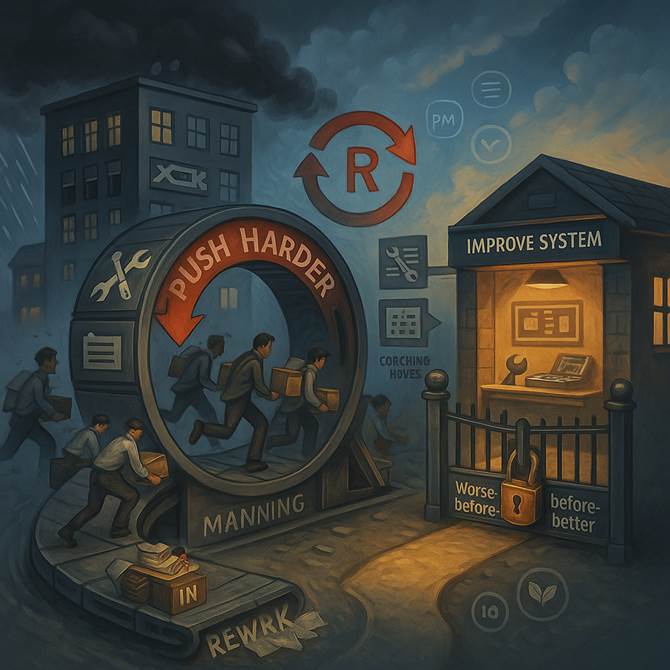
Escaping the trap means shifting from “work harder” to “work smarter” – investing in process capability, not just pushing people to do more.
This piece explains the trap in plain language and offers advice to avoid it.
Introduction
After ten years of “doing more with less”, many council roads managers describe their world like this:
“Today, I barely recognise our roads program. Every budget cycle we cop another efficiency dividend, another round of ‘temporary’ cuts to inspections, reseals, heavy patches and drainage repairs. On paper the program still looks coherent thanks to some clever rephasing and optimistic assumptions, but out on the network the cracks are literal.
We’ve gone from renewing assets at the right time to stretching them well past their use-by date. Crews that used to do planned maintenance now spend most of their time chasing potholes and complaints. We’ve sweated the plant so hard that breakdowns are normal, and cut training and supervision to the point where we’re relying on a few old hands to hold everything together.
What hurts most is knowing this was avoidable. Every ‘saving’ we booked was borrowed against the future condition of the network. We’ve lost capability in quiet ways – trainees we didn’t take on, engineers who left and weren’t replaced, inspectors who no longer have time to inspect, relationships with contractors hollowed out by always taking the lowest price.
The community still expects the same level of service, but we’re no longer set up to deliver it. We’ve traded investment in capability for short-term budget wins, and now the bill is arriving as risk, backlog and a network that’s deteriorating faster than we can look after it.”
This isn’t a story about lazy workers or bad managers. It’s what it looks like when a council slides into what Repenning and Sterman call the capability trap – without realising it.
580 words (6 minutes reading time) by Lancing Farrell
I recently completed a training course in the work of W. Edwards Deming. At the end of the course, one of the participants said they felt as though they now had the knowledge to become an architect in their work and cease being a fire fighter.
It made me think about how it is that leaders become fire fighters. It is a common complaint from executives in local government who are being exhausted on a treadmill of frantic and stressful activity.
I recently saw this piece on LinkedIn by Simon Dodds, a Health Care Engineer at SAASoft Ltd. I have reproduced it in full because it eloquently describes from a health care perspective, the same series of events that shifts managers and directors on the council treadmill from walking speed to sprinting. Here it is.
300 words (2 minutes reading time) by Lancing Farrell
Podcast option:
We are just over halfway through the 2025 AFL season (the major league playing Australian rules football). The premiership contenders are starting to appear.
I figure it is a good time to recap on the AFL-themed posts that have been posted on this site.
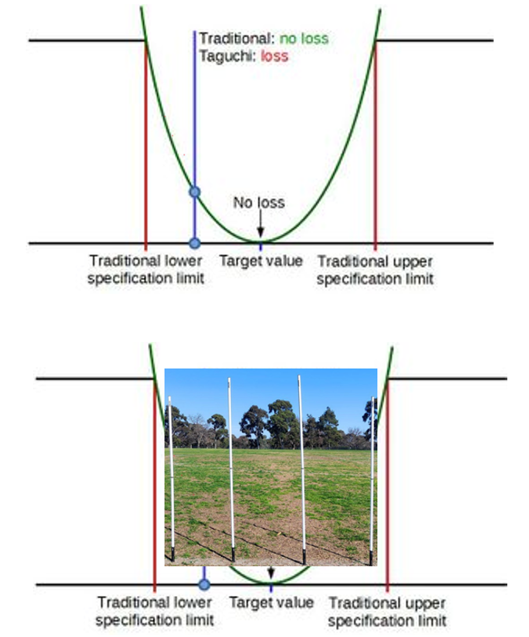
Lancing has highlighted a key problem with many council services. I used to call it the ‘lowest common denominator effect’ (i.e. performance gets reduced to the lowest level tolerated) but I think the Taguchi Loss Function makes the point in a way that helps you to fix the problem.
Imagine that the diagram Lancing used to show the target value that a customer or citizen wants as fitting between two ‘goal posts’, to instead show a set of Australian Rules football goals. For those non-Australians, I have helped you imagine that with the diagram below.
If you aren’t aren’t familiar with Australian Rules football, when the ball is kicked between the two centre posts it is a goal and scores 6 points. If it is kicked between a centre post and the post either side, it is called a behind and scores 1 point. If the ball is kicked outside all the goal posts it is out of bounds on the full and there is no score and the opposition gets to kick the ball back into play.
2000 words (18 minutes reading time) by Lancing Farrell
I might be drawing a long bow, but I think the Abundance agenda presents a fundamental challenge for those councils trying to find a way forward that is financially sustainable in a rate capped environment. It opens the door to reviewing regulatory and other service design to make savings and support economic growth.
Let me start at the beginning.
On 19 June 2025, in an article about a speech by Jim Chalmers, the Australian Treasurer, he was quoted as saying that left-leaning governments (as we currently have in Australia) are “strangling their own good intentions with bureaucracy”. He is asking regulators across the nation to identify regulations that can be axed or simplified to reduce compliance costs and increase the pace of economic growth. It is part of delivering a supply-side solution to the nation’s housing and energy problems by removing government-imposed impediments to production of goods and services.






 Local Government Utopia