290 – The Capability Trap: How Budget Cuts Damage Councils Long Before Anyone Notices.

3100 words (15 minutes reading time) by Colin Weatherby

Podcast option:
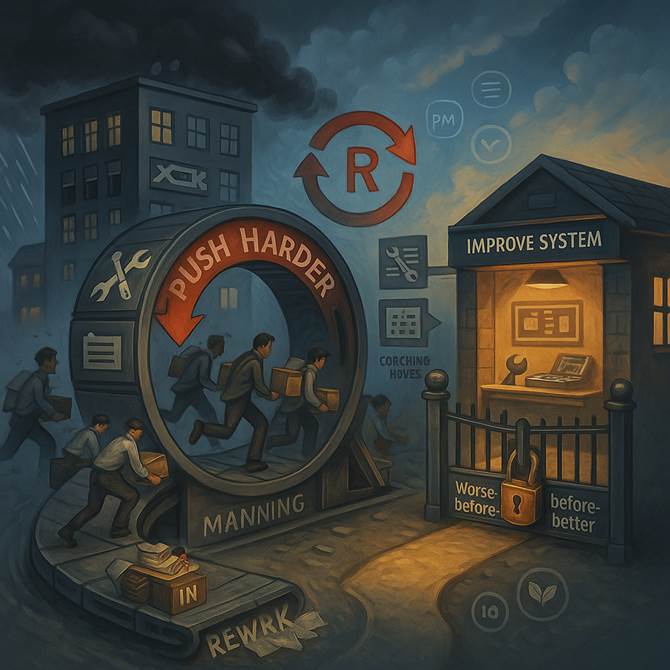
Credit: ChatGPT

Summary

  • Councils under rate caps are being pushed into a capability trap: cutting investment in how work is done, while demanding the same (or more) output.
  • Doing more with less works for a while, then it quietly destroys the ability to deliver safe, reliable services.
  • Escaping the trap means shifting from “work harder” to “work smarter” – investing in process capability, not just pushing people to do more.
  • This piece explains the trap in plain language and offers advice to avoid it.

Introduction

After ten years of “doing more with less”, many council roads managers describe their world like this:

“Today, I barely recognise our roads program. Every budget cycle we cop another efficiency dividend, another round of ‘temporary’ cuts to inspections, reseals, heavy patches and drainage repairs. On paper the program still looks coherent thanks to some clever rephasing and optimistic assumptions, but out on the network the cracks are literal.

We’ve gone from renewing assets at the right time to stretching them well past their use-by date. Crews that used to do planned maintenance now spend most of their time chasing potholes and complaints. We’ve sweated the plant so hard that breakdowns are normal, and cut training and supervision to the point where we’re relying on a few old hands to hold everything together.

What hurts most is knowing this was avoidable. Every ‘saving’ we booked was borrowed against the future condition of the network. We’ve lost capability in quiet ways – trainees we didn’t take on, engineers who left and weren’t replaced, inspectors who no longer have time to inspect, relationships with contractors hollowed out by always taking the lowest price.

The community still expects the same level of service, but we’re no longer set up to deliver it. We’ve traded investment in capability for short-term budget wins, and now the bill is arriving as risk, backlog and a network that’s deteriorating faster than we can look after it.”

This isn’t a story about lazy workers or bad managers. It’s what it looks like when a council slides into what Repenning and Sterman call the capability trap – without realising it.

Continue reading

285 – Our first podcast: Challenges, solutions and future directions in local government.

1800 words (18 minutes reading and/or 20 minutes listening) by Colin Weatherby

I recently found out about Notebooklm and asked it to analyse the entire Local Government Utopia website and answer a set of questions about challenges, solutions and future directions for councils.

The question and answer is below. First, a bit about Notebooklm.

Notebooklm

Notebooklm is a new AI product that takes a specific source or sources nominated by you and provides a summary, or answers to questions you ask about the source or sources that you have uploaded. I loaded the URL for localgovernmentutopia.com but could have loaded pdfs or other types of sources (or combinations of sources). You can load up to 50 different sources with a maximum of 500,000 words.

The person who told me about it had uploaded a manual for their camera as a source and then asked how to change the camera battery. Instead of leafing through a massive pdf manual online, Notebooklm explained how to change the battery with a link directly to the relevant section in the manual!

It also produces podcasts, primarily to help listeners understand complicated topics by hearing a discussion between two people about the source or sources. I was interested in this feature, so I had a go!

Podcast

I asked Notebooklm to make a podcast addressing this question using the Local Government Utopia website as a source:

What does Local Government Utopia say about what a local government putting the wellbeing of its constituents first looks like; what issues are important and currently not acknowledged in local government; what are current research or policy gaps in local government; any thoughts around recent Commonwealth or Victorian parliamentary inquiries into local government; and finally, what thoughts are there on where public policy might be able to make a meaningful contribution.

Here is the podcast.

Continue reading

270 – Local government and Financial Sustainability Strategies

2850 words (30 minutes reading time) by Colin Weatherby

Councils across Australia have recently started developing financial sustainability strategies. This sounds like a good idea, but is it?  Are the goals in these strategies realistic and achievable? Do they seriously address fundamental issues affecting sustainability or are they just another distraction? The latest fad?

To kick this post off, let’s look at 3 councils, Logan Council in Queensland, Central Coast Council in New South Wales, and Yarra City Council in Victoria.

It is a long post but worth the effort!

Financial sustainability and corporate planning

Given the parlous condition of council finances and the existential threat from rate capping in NSW and Victoria, it is interesting to see where the financial sustainability strategy fits into organisational planning for councils.

Continue reading

262 – The other side of the ledger: A cautionary tale for growing councils

1200 words (13 minutes reading time) by Colin Weatherby

A research article in the Australian Journal of Public Administration, titled ‘The other side of the local government ledger — The association between revenue growth and population growth,’ raises a crucial red flag for all councils currently grappling with population growth. The study, by Professor Joseph Drew and his colleagues, sheds light on the relationship between population growth and local government revenue. Professor Drew has made a video explaining the findings of the paper.

In local government, you hear a lot of talk about the rate cap, a limitation on property taxation imposed by the State government on councils, and the impact it is having on councils’ ability to fund services. I have posted previously on what I think councils should be doing in response to the spending gap arising from the rate cap. Most discussion in the sector has focused on the impact on expenditure.

Professor Joseph Drew and his colleagues are suggesting it is equally important, perhaps more important, to understand the impact on unit revenue. Unit revenue, representing the per capita revenue generated by a council, becomes pivotal when service demand stems from individuals residing in the municipality rather than the properties they occupy. The potential mismatch between service consumption drivers and revenue generators poses a substantial financial sustainability risk.

Continue reading