145 – The deep web and local government recruitment.

Posted by Colin Weatherby                                                                                         1100 words

deep web

Local government executive recruitment is a game. Often recruitment is not genuinely based on competence and ability. In many cases, relationships are far more important. I have heard it described as the ‘deep web’ – what you see isn’t all there is. So, how does it work?

Councils recruiting a new CEO tend to go for ‘tried and true’ or ‘shiny and new’.  I think analysis will show an alternating pattern from one to another. It is almost as though councilors become bored with their CEO, or, more likely, the CEO refuses to do what they tell them to do. Once a CEO stands up and says ‘no’, they are likely to be on the way out.

Councilors know that they can demand that a CEO does what they want – whether or not it is in their or the community’s best interests. I think that once a council has dismissed a CEO and they have a ‘taste of blood’ they are more likely to do it again and a cycle of CEO non-reappointments and appointments begins (with all the disruption this brings).

When councils are recruiting a CEO, they rely on assistance from the recruiters – companies that specialise in helping councils to recruit executives. These companies can be highly influential. Continue reading

142 – A question. If I was the CEO what would I do? Answer: Focus the change effort.

Posted by Colin Weatherby                                                                                            740 words

boat builder CEO

I am sure being a CEO isn’t easy. The political environment in Australia is difficult and even more so in local government where the politicians are unpaid and not supported by political parties. There are many other pressures from the external environment – i.e. changing State government legislated responsibilities and increasing oversight of council operations; contentious urban growth and renewal planning decisions; inadequate State services for transport, education and health; and changing community expectations of service. So, if it was me, what would I do?

To begin I would not let the limitations and problems of the political and external environments dominate my management of the organisation. They are both urgent and sometimes important. However, they are not easily influenced and can take all of top management’s time and energy for little return. By all means be engaged and influence where you can but my approach would be to put my effort where no one else can and where I will get the best return.

By doing this, I think there would also be an improvement in the political environment and a stronger position to tackle the external pressures.

What do I mean? I would get my house in order. I would ensure that the resources at my disposal are used to create the maximum value for the community that has provided them. My goal would be for every ratepayer and resident to love living in my municipality. They would love it so much that they would tell all of their friends about it. They would offer to pay more for the services that they or their neighbours need. Every day social media would have stories of the great experiences people have had dealing with the council and the surprisingly good value they received.

Expectations would be met for basic service and exceeded where the value is visible and appreciated. This is the value capture that Sayan Chatterjee  talks about – councils don’t want people to value the services they provide and to offer to pay more so that the council can make a profit. Councils are not in that business. Instead, councils want them to be loyal customers who enjoy the value they get from paying their taxes. That enjoyment and loyalty is the value capture.

I wouldn’t ignore the outside world but I would want to be leading an organisation that redefines community expectations and delivers outstanding value. Here is how I would do that in order.

  1. Provide a more inclusive and less autocratic management style that suits local government culture and organisations expected to work that way with their customers.
  2. Set clear strategy – who are/are not customers; what service will/will not be provided to them; and how will it be done efficiently using available resources.
  3. Improve the customer focus by putting customers first (I mean really putting them first, not just saying it) through understanding the value they expect and designing services to provide it within available resources, now and in the long-term.
  4. Create better processes to make decisions and delegate more decision making and empower staff throughout the organisation so that more decisions are made and faster.
  5. Establish greater accountability by setting expectations and measuring performance so that feedback is provided to support achievement and create a performance-orientated culture.
  6. Focus innovation on areas of the organisation where significant change is required and set up systems to so that everyone continuously improves.
  7. Simplify the complexity inherent in local government by identifying and eliminating process constraints that have developed over time.
  8. Focus on productivity by ‘unlocking’ the capacity of people and resources to ensure that the required services are being provided as efficiently as possible.

I have been told (by a CEO) that a world where ratepayers and residents enjoy the value they get for the taxes is unrealistic and unachievable.  If that is what our leaders think, what hope is there?

I have used an image of a boat builder for a reason. I have a relative who owns and builds wooden sailing boats. After talking to him, I think that leading an organisation is a lot like building a boat. You need to design the boat to optimise the performance required – does it have to be safe in all conditions, will it have to make fast passages, or will it carry burdensome loads? One boat can’t do them all.

Then materials must be selected and the builder needs to understand the properties of those materials – how they are worked to make the boat, how they will perform under load, how they will fail, and how they can be repaired.

A boat must be made with care. There is a right and a wrong way to do it, and doing it the wrong way could lead to failure and loss of life. Finally, the boat needs to be beautiful.

This is an important point for local government.  In the same way that there is no joy in building or owning an ugly boat, success in local government must also include a sense of pride and achievement in having contributed to something worthwhile.

Chatterjee, Sayan 2013. Simple Rules for Designing Business Models, California Management Review, Winter.


139 – A question. If I was the CEO what would I do? Answer: Nothing.

Posted by Whistler                                                                          230 words

heart rate

This is my response to the question posed by Lancing Farrell.  I think the CEO has found local government the way we like it. I am not sure what their problem is. A strong and autocratic style from the CEO reassures us that there is someone at the top calling the shots and keeping the councillors in line. With no one prepared to make difficult decisions it keeps things stable and predictable. This suits the low level of organisational achievement and absence of time consciousness. What more could you ask for?

With people running the place who have been rewarded for their allegiances and length of service, this would be a predictable and easily understood workplace. Recruitment would be straightforward and safe. Anyone with experience in the sector would easily fit in and, so long as they got along with those in charge, could be quite successful.

Why the need for change? After all, why change something when you don’t have a clear idea of what you could or should change it to? Maintaining the status quo is a time honoured way to manage, especially in the face of uncertainty. Doing nothing could be the best thing to do and it is the lowest risk for those in charge.

Fear of change has been a hallmark of local government and an approach that has served it well. It has kept everything in its place. Consistency is important in service delivery and local government has been extremely consistent over many years. Everyone knows what to expect.

129 – ‘Postformal’ leadership. Are you the leader simply because you, or others, say that you are?

Posted by Parkinson                                                                      700 words

mattang

Mattang image

Colin Weatherby posted a long read on three recent reports about leadership in local government. The first looked at research into best practice leader development, the second the results of leadership at a capital city council and the third at the role of leadership in preventing corrupt or inappropriate behaviour in council works depots. I don’t think anyone would argue that we don’t need good leadership, even though we seem to survive well without it.

A colleague recently attended a lecture by Australian adventurer and leadership researcher Earl de Blonville. The focus of the talk was ‘postformal leadership’,  a new way of thinking about leadership that he has developed from thinking in postformal psychology. Continue reading

124 – The butcher, the baker and the candlestick maker. Our councillors?

Posted by Whistler                                                                                          800 words

butcher baker candlestick maker

Image

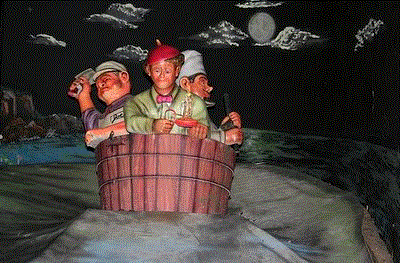
The original version of the rhyme ‘rub-a-dub-dub’ supposedly tells of three townsfolk watching a dubious sideshow at a fair. Later versions talk of them being ‘all put out to sea’, perhaps a reference to being ‘at sea’ or puzzled or bewildered (thanks Wikipedia). I think either version could work for some of our councillors today.

Councils usually have greater gender balance and occupational representation than in the rhyme. My question is, who are the people who become councillors? What attracts them to the role? Why do they do it? What do they offer? Do they really reflect the communities they represent? Continue reading

119 – Long read: Three recent local government leadership pieces from ACELG, MCC and IBAC.

Posted by Colin Weatherby                                                         1450 words

ACELG values based leadership ethos

From time to time something worthwhile will be written about leadership in local government. Mostly, what is written is highly aspirational and touching, but not useful. Three recent reports do provide a useful insight into local government leadership.

The first is a report ‘Council approaches to leadership – Research into good practice’, published in April 2015 by the Australian Centre of Excellence for Local Government (ACELG) and the University of Sydney – Centre for Local Government.  It reports on a research project conducted with 8 councils to look at approaches to leadership development identified as ‘good practice’. The aims are to:

  • Present examples of councils with good practice approaches to in-house leadership development initiatives.
  • Outline the themes and program structures within the council examples that work well to build the leadership capacity of local government managers.
  • Provide some practical guidance for local governments in developing their own leadership programs.
  • Explore some different examples of leadership capability frameworks in use by the sector.

The second report is the ‘Organisational Capability Review’ completed in May 2015 for Melbourne City Council (MCC) by Jude Munro, Dr Bronte Adams and Steve Parker.

The review is an independent assessment of how the organisation is performing. It examined how the City of Melbourne sets its direction, plans and prioritises, collaborates, manages organisational performance and develops and motivates its people.Jude Munro AO   Dr Bronte Adams Steve Parker

The third report is the ‘Local Government: Review of council works depots’ report completed by the Victorian Independent Broad-based Anti-corruption Commission (IBAC) in May 2015. The review was conducted to identify common vulnerabilities and opportunities to strengthen processes in local government works depots. It looked at four areas of depot management – procurement; management of bulk consumables; management of small plant and equipment; and leadership and culture.

What do they tell us that is useful?

118 – Improving service operations. Why it doesn’t happen in local government.

Posted by Whistler                                                                                          500 words

 walking the plank

I have read Lancing Farrell and Colin Weatherby’s posts on characteristics of demands, redesigning operations and improving service operations through action plans and service redesign, with some interest. It is all good stuff and not too difficult to understand or do. The question I ask myself is why I don’t see it happening everywhere across the sector. The ‘special and different’ posts partially explain it but I think there is more to it.

To begin with, the motivation to make improvements doesn’t really exist. People say they want to improve the quality of services to their community, and in response to threats like rate capping they say they want to be more efficient. But they don’t really want to do either.

Most councils have the potential to improve productivity by 10-15% (more in some councils). Continue reading

116 – Are we really that ‘special and different?’ Another answer: ‘Yes, of course’.

Posted by Parkinson                                                                                       450 words

fingerprint

It has been a while since I posted but I couldn’t resist this topic. I appreciate the views put forward by Lancing Farrell and they have merit. But, from my point of view it is obvious why councils are different and should remain different.

Councils need different capabilities to serve their communities. These capabilities have often been developed over time in response to drivers evident to community leaders. For example, provide excellent customer service in delivering basic services to an affluent and demanding community; be able to build new infrastructure quickly and well to meet the needs of a rapidly growing peri-urban council – with limited resources; make sure that ageing facilities are cared for to protect their cultural values in a heritage place.

The leadership of every community will be different. Continue reading

108 – Melbourne City Council: Organisational Capability Review, May 2015.

Posted by Colin Weatherby                                                                         1300 words

Melbourne capability review model

The public release of this critical report has been something of a surprise. Commissioned in March 2015 and released in May, the report prepared by Jude Munro, Dr Bronte Adams and Steve Parker has looked at three key capabilities; leadership, strategy and delivery. Each has been rated on a four point scale for several elements. Out of the ten attributes rated, six were seen as a ’development area’ and one as a ‘serious concern’. The remaining three were seen as ‘well placed’ and none were seen as ‘strong’ (p.14). So what does this mean?

melbourne assessment criteria ratingsThe report states that this is the first time that this review model has been applied to local government in Australia. Its intention is to provide a forward looking, whole of organisation review that assesses an organisation’s ability to meet future objectives and challenges.


“This review provides the opportunity and impetus to take a very good organisation and make it even better.” Ben Rimmer, CEO

Continue reading

63 – ‘The more experienced the managers, the more they trust simple intuition’. Or do they?

Posted by Colin Weatherby                                                                         700 words

intuition

Some time ago I posted on an idea from Richard Farson’s book, Management of the Absurd – Paradoxes in Leadership. This post has been inspired by another chapter in that book.

Farson says that the one quality that top executives say separates them from their less successful colleagues is their intuition. Their ‘immediate visceral reactions’ to people and events are usually accurate, which makes their judgements valuable. Farson defines intuition as the ‘accumulation of many learning experiences that have sensitised them, making them able to read situations quickly’. It is a quality that allows top management to make fast decisions that are effective. However, when top management starts to lack confidence, they start to apply formal processes to make decisions. They replace their immediate visceral reaction with complicated analytical thinking. Continue reading