271 – Victorian government enquiry into local government

1000 words (11 minutes reading time) by Colin Weatherby
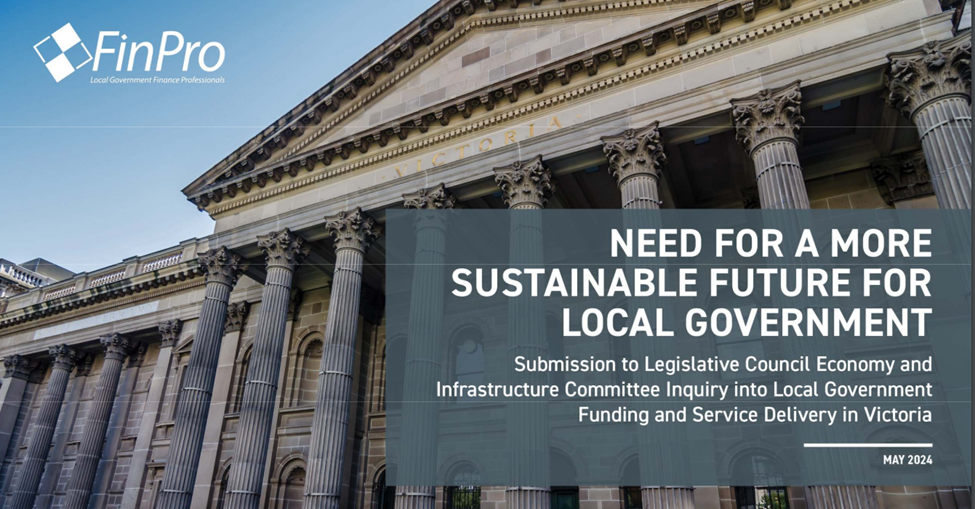
The Victorian state government’s Legislative Council Economy and Infrastructure Committee has started an enquiry in to the funding and service delivery of local government in the state, which will look at:

  • The effects of cost shifting from the state and federal governments to local councils in an examination of vertical and horizontal fiscal imbalances.
  • Whether local councils are adequately delivering on their core service delivery objectives.
  • The overall revenue structure of local government.
  • Whether the existing revenue structure is sustainable and appropriate or if alternative models of funding would be more sustainable and appropriate.
  • Any other related matters.

This is a timely review and comes at the same time that the national government is also holding an enquiry into the financial sustainability of local government. It seems that the other levels of government have become concerned about whether councils are able to meet community needs and expectations now and in the future.

Unsurprisingly, the Local Government Finance Professionals (FinPro) have made a submission to the Victorian enquiry . They make a number of interesting points in their submission.

Continue reading

270 – Local government and Financial Sustainability Strategies

2850 words (30 minutes reading time) by Colin Weatherby

Councils across Australia have recently started developing financial sustainability strategies. This sounds like a good idea, but is it?  Are the goals in these strategies realistic and achievable? Do they seriously address fundamental issues affecting sustainability or are they just another distraction? The latest fad?

To kick this post off, let’s look at 3 councils, Logan Council in Queensland, Central Coast Council in New South Wales, and Yarra City Council in Victoria.

It is a long post but worth the effort!

Financial sustainability and corporate planning

Given the parlous condition of council finances and the existential threat from rate capping in NSW and Victoria, it is interesting to see where the financial sustainability strategy fits into organisational planning for councils.

Continue reading

269 – Unrestricted cash: are councils hopeless or helpless (or both)?

630 words (7 minutes reading time) by Lancing Farrell

Professor Joseph Drew has posted another of his valuable and prescient videos for local government leaders. His analysis of the financial sustainability of councils in NSW heralds a warning across Australia for councils experiencing rapid increases in expenditure that are not being matched by revenue increases – especially those subject to a rate capping regime. NSW councils are running out of cash to fund operations. The FinPro/Municipal Association of Victoria report in 2022 showed that all Victorian councils except those in metropolitan areas are experiencing underlying deficits and the problem is getting worse.

Professor Drew’s warnings should really be a headline on the agenda papers for every council meeting!

I think part of the challenge for councils in acting on his warnings and advice is the prevalent sense that there is nothing that can be done – councils are at the mercy of forces greater than any they could hope to overcome. In discussions with Professor Drew I have likened it to a movie where a meteorite is expected to hit Earth and no one thinks it can be stopped or deflected.  Half the population are resigned to their fate and having a party, and the other half are sitting in the dark with their fingers crossed hoping it will miss.

Maybe a better explanation is that hopelessness is the feeling that nothing can be done by anyone to make the situation better. People may accept that a threat is real, but that threat looms so large that they feel the situation is hopeless. Helplessness is the feeling that they have no power to improve the situation. I think councils have a strong sense of both.

Well, for those with greater confidence that something can be done (and should be done to protect community interests), here is a list based on the initial advice Professor Drew provides (he is prepared to offer more detailed and specific advice to councils that ask):

Continue reading

267 – Professor Joseph Drew – Analysis of Financial Results

880 words (10 minutes reading time) by Lancing Farrell

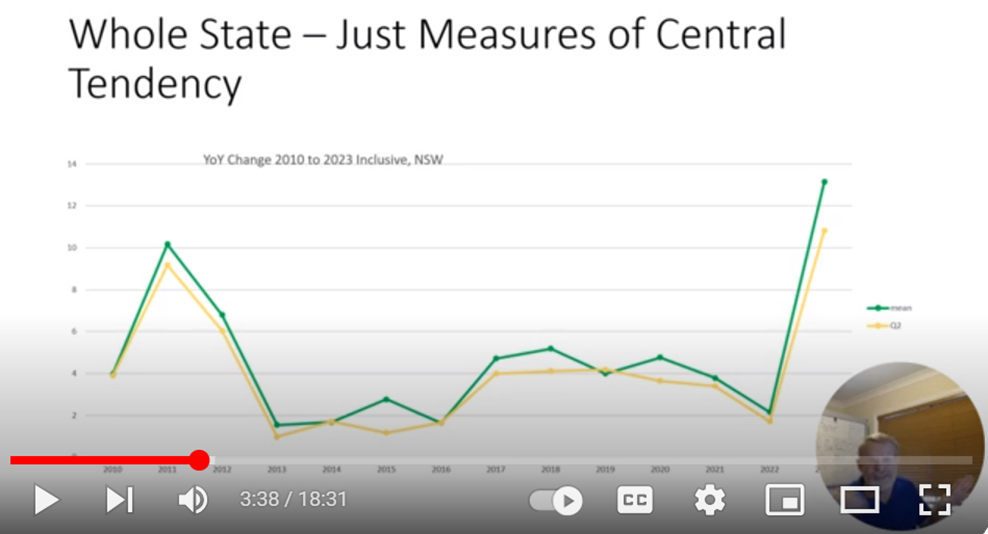
The mean and median of the data set for all NSW councils

Professor Joseph Drew has posted another enlightening video on his YouTube channel. His analysis of 15 years of council data in NSW shows worrying increases in expenditure on staff, materials and depreciation. In fact, ‘worrying’ is an understatement. The situation is becoming catastrophic. Yet, no one seems overly worried in the Premier State.

Professor Drew has committed to producing the same data for Victoria. Maybe there will be more of a response from the Garden State. As every gardener knows, you have to observe what is happening and make timely interventions for a garden to succeed.

One of the challenges Professor Drew’s video has highlighted for me is the relatively low level of executive financial literacy and knowledge of statistics and data. This might explain the lack of response to the data from local government. Professor Drew goes to great lengths to explain the importance of measures of central tendency and the difference between the available measures. In particular, he is looking at the mean and standard deviations of the data set, and the median .

Are you digging out an old text book or searching on Google yet?

Continue reading

266 – System governance or Smartie sorting?


400 words (5 minutes reading time) by Tim Whistler

Saying that system governance is the key to paradigm change is stating the obvious. Any way of thinking about change requires existing power structures to be understood and for the people controlling those power structures to be given incentives to start thinking and behaving differently. We see it happening every day.

A friend who works as a consultant to various councils was explaining her work to me recently. She was dumbing it down for me and used the analogy of cake decoration. She said her role is the equivalent of helping community to sort out Smarties to pick colours to decorate the council cake. Everyone knows people have favourite Smartie colours, and there will be the ‘right’ colours for the cake. Without knowing exactly who will be eating the cake it can be tricky, and a lot of effort goes into talking to the community about the colour of the Smarties.

Continue reading

263 – System governance is the key to shifting the local government paradigm

850 words (9 minutes reading time) by Lancing Farrell

The need for a new paradigm in local government in Victoria has been mentioned in a few posts recently (see 241 – Rate capping – the final words (from our future), 253 – Minds Change: My Journey to Transform Local Government Performance, and 261 – Reinventing Local Government). Model collapse, as described by Carole Parkinson and Tim Whistler, signals the end of an existing paradigm. This raises critical questions about the current paradigm in local government and the need for change. A recent podcast in the Reimagining Government series by the Centre for Public Impact, ‘What on earth is a paradigm shift?’, discusses paradigms and provides insights and practical tips for those wanting to bring about transformative change.

Defining Paradigms

The podcast features host Adrian Brown and Professor Toby Lowe from the Centre for Public Impact, Henk-Jan Dekker from the International Centre for Environmental Research and Development, and Jessica Studdert from think tank ‘New Local’. Drawing on the work of Thomas Kuhn and Margaret Masterman, a paradigm was defined as a ‘grand explanatory narrative for how a part of the world works’.  It operates on metaphysical, sociological, and exemplar levels, shaping perceptions of what exists and what should be valued. Understanding how paradigms work is crucial for those seeking systemic change in local government.

Continue reading

258 – Model Collapse or Cultural Evolution? Mental Models and Victorian Local Government

700 words (8 minutes reading time) by Carole Parkinson

In many aspects of human endeavor, the belief that successive generations inherently improve holds true. Take sports, for example, where each Olympics sees records shattered by athletes who are better selected, trained, and conditioned than their predecessors. This continuous improvement is driven by a powerful incentive for each generation to surpass the achievements of the previous one.

However, this upward trajectory doesn’t always apply. In the realm of artificial intelligence (AI), there’s a phenomenon known as model collapse. Without diverse human-generated training data, AI systems risk malfunctioning if inundated with AI-generated content. The first generation of AI benefits from drawing on decades of human ingenuity, but as subsequent generations draw from their own created information, the pool of new ideas dwindles, resulting in a homogenised output.

Continue reading

254 – Hacking your bureaucracy

850 words (9 minutes reading time) by Colin Weatherby

As regular readers will know, we are partial to a good book that throws some light on the issues facing local government. The idea that knowledge of theory should underpin practice, or that learning how others have solved the problems you face can provide useful insights, is, unfortunately, not always valued as much as it should be

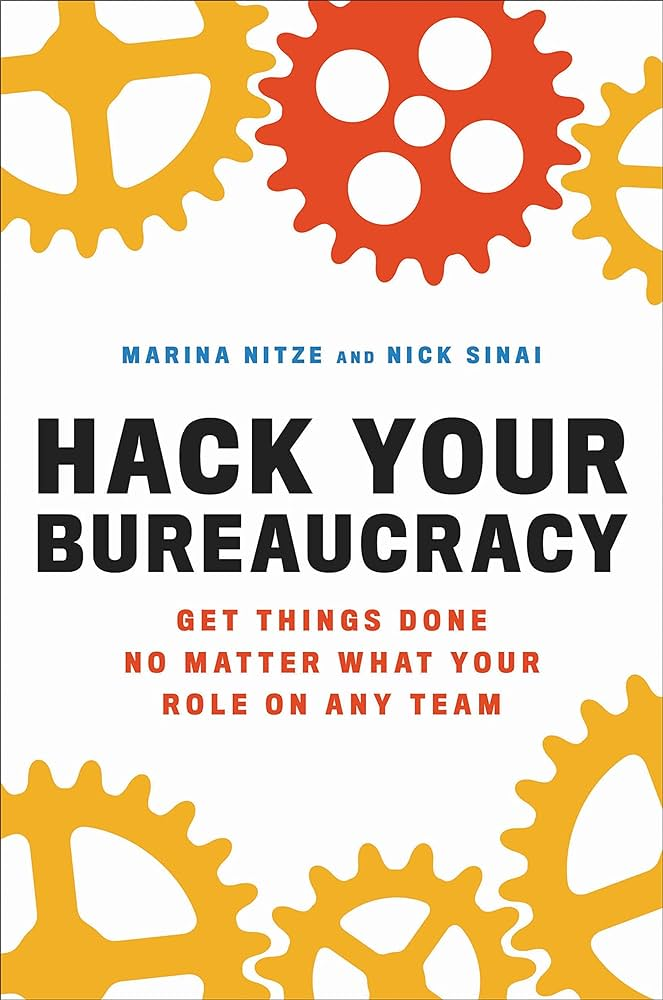
My latest read is an interesting book.  ‘Hack Your Bureaucracy – Get Things Done No Matter What your Role on any Team’ is presented as a ‘how to manual’ of tips and tricks to work within bureaucracy to, unsurprisingly, ‘get things done’.

Continue reading

253 – Minds Change: My Journey to Transform Local Government Performance

600 words (7 minutes reading time) by Lancing Farrell

Have you ever had that eureka moment where something you were trying to understand is suddenly made crystal clear to you? That’s exactly what happened to me after reading David McRaney’s thought-provoking book, ‘How Minds Change – The New Science of Belief, Opinion, and Persuasion.’ This enlightening read gave me reason to revisit some past posts on improving local government performance. In reading the book (and this is deliberate by the author) I was led through Piaget’s stages of assimilation and accommodation, before eventually reaching a Kuhnian paradigm shift. My epiphany was realising why organisational change is so hard.

When I looked back at my earlier posts, I realised that my growth as a leader accelerated when I first saw work as a system. At the same time, I genuinely believed that I needed to become the architect of better approaches. I had an academic background, experience of travelling overseas to broaden my outlook, and a relentless passion for my work. I thought that if anyone could revolutionise services, it would be me.

However, this view eventually transformed into a more holistic and community-oriented perspective as I started to see the work as a ‘frog’ system, not a ‘bike’ system. You’ll need to read my previous posts to grasp the analogy, but in essence, I transitioned from a thinking I needed to be a one-man show and lead others by giving them better ways, to a more participatory approach where everyone is engaged in finding improvements.

Continue reading

252 – Preserving the Essence of Citizenship: A Plea for Traditional Values in Local Governance

700 words (8 minutes reading time) by Lancing Farrell

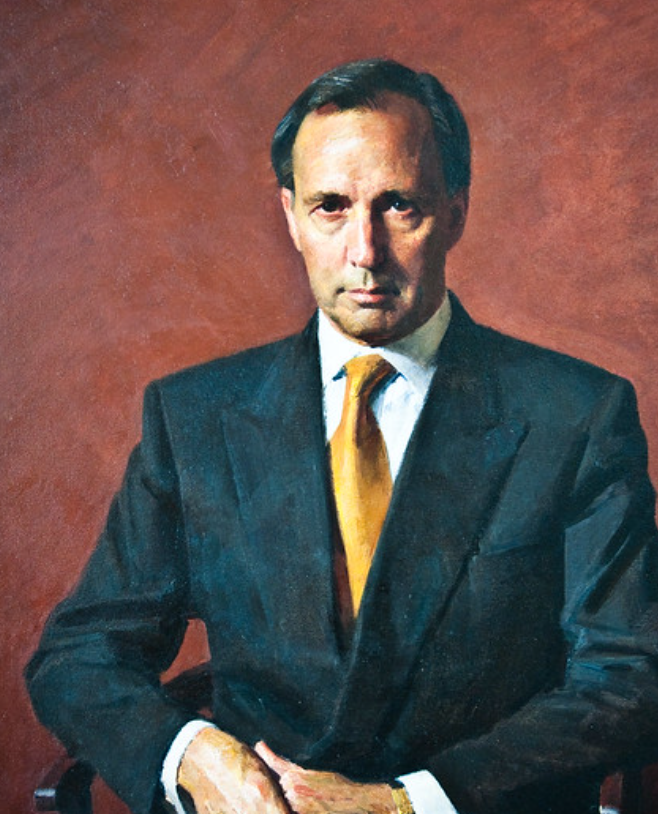
Former Prime Minister, Paul Keating

I have been reading an MBA thesis written by an experienced local government CEO in 1999. It looks in detail at performance measurement and discusses many aspects of local government management in a thought provoking way. I have been reflecting on how much or how little has changed since then and whether or not the expectation evident in the writing, i.e. that the major reforms endured by the sector in the 1990s would herald improved performance, have been realised.

I selected the insight into citizenship and consumerism to draft a short post. Rather than test your patience with my detailed analysis, I asked ChatGPT to craft my notes into a speech in the style of former Australian Prime Minister Paul Keating.

Enjoy.

Ladies and gentlemen,

In the realm of local governance, we witnessed tides of transformation during the 1990s, as corporate management and managerialism made their grand entrance. These management practices, often lauded for their prowess, introduced a new lexicon into the world of local governance, terms like ‘client,’ ‘customer,’ and ‘consumer,’ now marching in lockstep with our cherished ‘citizen.’ Three decades on, it is imperative that we hold fast to the timeless values of traditional governance and citizenship.

Continue reading