269 – Unrestricted cash: are councils hopeless or helpless (or both)?

630 words (7 minutes reading time) by Lancing Farrell

Professor Joseph Drew has posted another of his valuable and prescient videos for local government leaders. His analysis of the financial sustainability of councils in NSW heralds a warning across Australia for councils experiencing rapid increases in expenditure that are not being matched by revenue increases – especially those subject to a rate capping regime. NSW councils are running out of cash to fund operations. The FinPro/Municipal Association of Victoria report in 2022 showed that all Victorian councils except those in metropolitan areas are experiencing underlying deficits and the problem is getting worse.

Professor Drew’s warnings should really be a headline on the agenda papers for every council meeting!

I think part of the challenge for councils in acting on his warnings and advice is the prevalent sense that there is nothing that can be done – councils are at the mercy of forces greater than any they could hope to overcome. In discussions with Professor Drew I have likened it to a movie where a meteorite is expected to hit Earth and no one thinks it can be stopped or deflected.  Half the population are resigned to their fate and having a party, and the other half are sitting in the dark with their fingers crossed hoping it will miss.

Maybe a better explanation is that hopelessness is the feeling that nothing can be done by anyone to make the situation better. People may accept that a threat is real, but that threat looms so large that they feel the situation is hopeless. Helplessness is the feeling that they have no power to improve the situation. I think councils have a strong sense of both.

Well, for those with greater confidence that something can be done (and should be done to protect community interests), here is a list based on the initial advice Professor Drew provides (he is prepared to offer more detailed and specific advice to councils that ask):

Continue reading

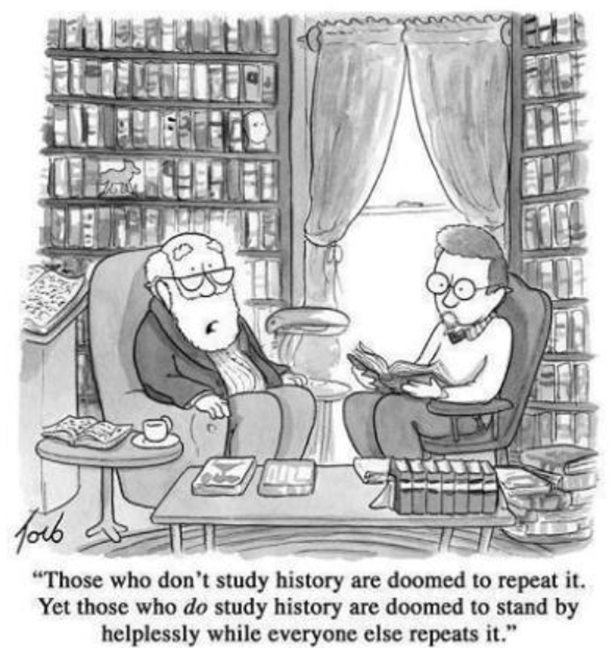
268 – Local government history – repeating, rhyming or informing?

900 words (10 minutes reading time) by Colin Weatherby

Image

I believe that it is important to understand how we have gotten to where we are today if we are proposing to make changes, simply so that we can benefit from past learnings and avoid repeating mistakes at the expense of the community. I like to see evidence backing a proposal that commits significant community resources to doing something.  Call me old fashioned (and people sometimes do) but I figure it is what a careful professional does.

Having always worked with public infrastructure, I know decisions made today have ramifications for another 50 to 100 years. No one builds a road or plants a tree thinking only about the next 5 years. I have cursed short cuts made decades ago by my predecessors when I have been required to sort out difficult problems. My approach is typically characterised by colleagues as time wasting in their haste to get on with trying out the latest management fad and, potentially, just doing wrong things righter.

This post is an attempt to unpick what has happened in Victorian local government to get us to where we are, and understand what it means for what councils should do next. My concern is that councils faced with the failure of existing approaches, as evidenced by the imposition of the rate cap (effectively a taxpayer revolt!), will then double down in doing the things that leaders know how to do. If it is not history repeating, it will at least be rhyming as Mark Twain observed. Better still, it is neither and it becomes informing.

Continue reading

267 – Professor Joseph Drew – Analysis of Financial Results

880 words (10 minutes reading time) by Lancing Farrell

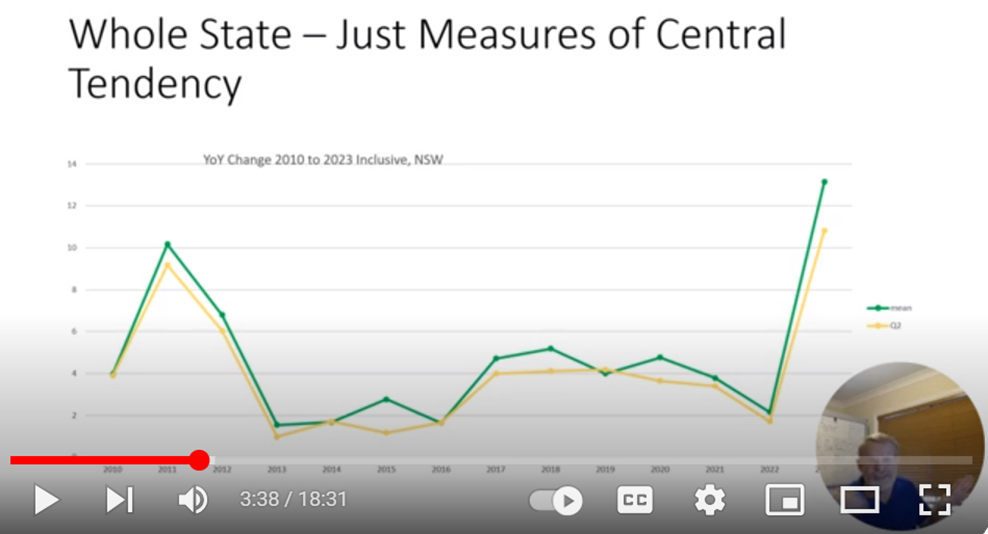
The mean and median of the data set for all NSW councils

Professor Joseph Drew has posted another enlightening video on his YouTube channel. His analysis of 15 years of council data in NSW shows worrying increases in expenditure on staff, materials and depreciation. In fact, ‘worrying’ is an understatement. The situation is becoming catastrophic. Yet, no one seems overly worried in the Premier State.

Professor Drew has committed to producing the same data for Victoria. Maybe there will be more of a response from the Garden State. As every gardener knows, you have to observe what is happening and make timely interventions for a garden to succeed.

One of the challenges Professor Drew’s video has highlighted for me is the relatively low level of executive financial literacy and knowledge of statistics and data. This might explain the lack of response to the data from local government. Professor Drew goes to great lengths to explain the importance of measures of central tendency and the difference between the available measures. In particular, he is looking at the mean and standard deviations of the data set, and the median .

Are you digging out an old text book or searching on Google yet?

Continue reading

266 – System governance or Smartie sorting?


400 words (5 minutes reading time) by Tim Whistler

Saying that system governance is the key to paradigm change is stating the obvious. Any way of thinking about change requires existing power structures to be understood and for the people controlling those power structures to be given incentives to start thinking and behaving differently. We see it happening every day.

A friend who works as a consultant to various councils was explaining her work to me recently. She was dumbing it down for me and used the analogy of cake decoration. She said her role is the equivalent of helping community to sort out Smarties to pick colours to decorate the council cake. Everyone knows people have favourite Smartie colours, and there will be the ‘right’ colours for the cake. Without knowing exactly who will be eating the cake it can be tricky, and a lot of effort goes into talking to the community about the colour of the Smarties.

Continue reading

264 – ‘What on earth is a paradigm shift?’ – Centre for Public Impact

400 words (5 minutes reading time) by Colin Weatherby

I have been experimenting with Microsoft’s ‘everyday AI companion’, called Copilot. I asked it to analyse the podcast ‘What on earth is a paradigm shift?’ by the Centre for Public Impact.  I am not trying to second guess the great work by Lancing Farrell, simply to show how some new technology works!

This is what it came back with:

The podcast ‘What on earth is a paradigm shift?’ by the Centre for Public Impact (CPI), is a  conversation between Adrian Brown and Professor Toby Lowe, who are both part of the CPI team. They discuss the concept of paradigms and how they apply to public service and systems change.

Here is a brief summary of the podcast:

Continue reading

263 – System governance is the key to shifting the local government paradigm

850 words (9 minutes reading time) by Lancing Farrell

The need for a new paradigm in local government in Victoria has been mentioned in a few posts recently (see 241 – Rate capping – the final words (from our future), 253 – Minds Change: My Journey to Transform Local Government Performance, and 261 – Reinventing Local Government). Model collapse, as described by Carole Parkinson and Tim Whistler, signals the end of an existing paradigm. This raises critical questions about the current paradigm in local government and the need for change. A recent podcast in the Reimagining Government series by the Centre for Public Impact, ‘What on earth is a paradigm shift?’, discusses paradigms and provides insights and practical tips for those wanting to bring about transformative change.

Defining Paradigms

The podcast features host Adrian Brown and Professor Toby Lowe from the Centre for Public Impact, Henk-Jan Dekker from the International Centre for Environmental Research and Development, and Jessica Studdert from think tank ‘New Local’. Drawing on the work of Thomas Kuhn and Margaret Masterman, a paradigm was defined as a ‘grand explanatory narrative for how a part of the world works’.  It operates on metaphysical, sociological, and exemplar levels, shaping perceptions of what exists and what should be valued. Understanding how paradigms work is crucial for those seeking systemic change in local government.

Continue reading

261 – Reinventing Local Government

600 words (7 minutes reading time) by Lancing Farrell

I recently acquired a ‘new’ copy of the 1992 book ‘Reinventing Government – How the Entrepreneurial Spirit is Transforming the Public Sector‘ by David Osborne and Ted Gaebler, a work that wielded significant influence globally in its time.

The impact of Osborne and Gaebler on world leaders can be discerned through the timing of policy changes, public declarations, and the alignment of advocated principles with the reform initiatives undertaken by these leaders. Some explicitly referenced the book in speeches, policy documents, or interviews, revealing its profound effect on their perspectives. In other instances, reforms closely mirroring the book’s principles suggest a potential influence. The book’s impact must be viewed within the broader context of prevailing ideas and reforms during that period.

Continue reading

260 – Ministerial Interventions in Local Government

600 words (7 minutes reading time) by Lancing Farrell

The two previous posts on model collapse and local government have prompted me to think about what has happened in the sector in the last few years. The sudden increase in Ministerial interventions does seem to indicate that something has changed. It may be more than just the introduction of rate capping in 2016.

I started asking colleagues what they think is happening. Unsurprisingly, several had views on what has happened, although no one was definitive. Everyone has anecdotal information from their council. I will have a go at describing the views told to me.

The first colleague reiterated the view put forward by Tim Whistler, that Covid prevented councillors building relationships with each other. It also affected the induction for newly elected councillors, which can be important in clarifying the responsibilities of a councillor, the Council, and the CEO and staff. Roles and responsibilities are cited in Ministerial Terms of Reference in almost all interventions.

Continue reading

259 – Model Collapse in Local Government: A Performance Measurement Dilemma?

700 words (8 minutes reading time) by Tim Whistler

In the world of artificial intelligence (AI), the concept of model collapse is a well-recognised challenge. Now it is potentially reaching into my everyday life if my Spotify-generated daylist starts to select songs from a previous daylist! Yet, my concern isn’t confined to personal playlists, and it should be echoing through the corridors of local government and raising questions about what performance measurement actually tells us.

Carole Parkinson’s question at the end of her footnote resonates with me: How can we detect model collapse in local government? It may well be a moot question, and model collapse is simply an explanation of the current situation, as one of Carole’s colleagues suggested.  This should become apparent if ChatGPT’s methods to identify model collapse in AI are accurate. Five seem particularly relevant for the local government context:

Continue reading