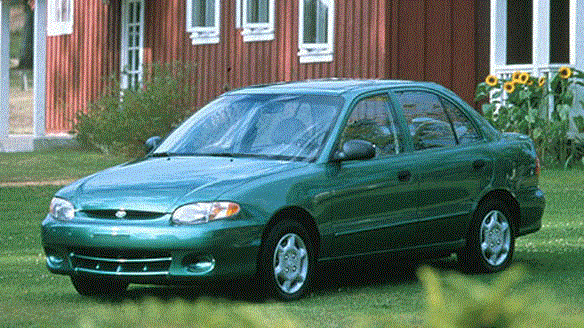
133 – If local government was a car, what sort of car would it be? The Hyundai Excel Sprint

Posted by Whistler                                                                                         700 words

hyundai excel

I have often wondered what local government would be like to work in if we were making cars. For a start we would need to produce something that resembled what the customer had in mind. We would need to make sure that cars left the assembly line with all of their wheels on, with doors all the same colour, and the engine connected to the drive train. People would be more easily able to judge the quality of output.

Then I started thinking about what if a council was a car, what it would be. After a random survey of colleagues, I settled on five choices. Each car is part of the Australian motoring tradition.

Think about what car your council might be.

The first is the Hyundai Excel. Economy car choice for thousands of Australians. Economical, reliable and inconspicuous. The car to own for the budget conscious. Own one of these and, if asked, none of your friends will be able to say what car you drive. Continue reading

132 – ‘A new theory of value creation for local government’. Do we need one? Part 3 – operations strategy.

Posted by Lancing Farrell

Slack operations strategy

Image from Operations Management, 6th Edition, Slack, Chambers and Johnston.

In this third post in this series, I look at the concept of the operations strategy. Every organisation has one. Your organisation does, but do you know why or what it is? And how does it relate to the business model?

This series of posts is intended to make the case that local government needs a theory of value creation – a clear explanation of what local government does to create public value. That theory will require a reappraisal of the operations strategy and the role that operational capability can play in supporting the business model and strategy execution.

Hayes and Wheelwright describe operations strategy as guiding decisions about vertical integration (i.e. the extent to which the council owns the value chain), capacity planning (i.e. how variation in demands will be met), facilities planning (i.e. the facilities needed to deliver services), services technologies (e.g. information systems) and process technologies (e.g. batch or make-to-order).

The academics Nigel Slack, Stuart Chambers and Robert Johnston in their text Operations Management talk about strategy and the connection to operations Continue reading

131 – The Local Government Utopia syntopicon.

Posted by Lancing Farrell

syntopicon

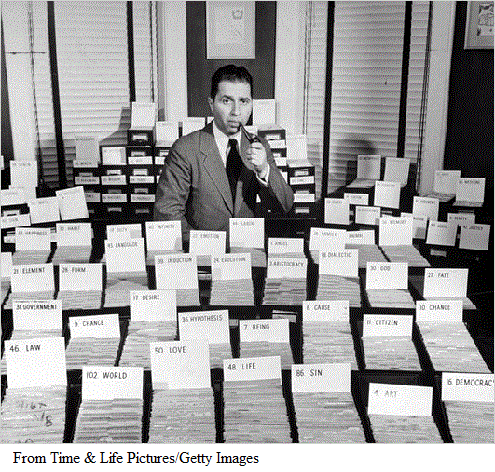
A syntopicon for the blog has been under construction for a few months. It now covers all topics for the first 100 posts. I will endeavour to make sure that it is updated every 25 posts from here on. It replaces the index posts that were made after every 25 posts.

The link is under the banner.

If you want to quickly get a feel for the matters covered by the blog, this is a good place to start. It is also useful if you want to see the progressive development of ideas as various writers have posted on topics over the course of the year.

For those who are interested, the image shows author Mortimer J. Adler creating the syntopicon for the Great Books of the Western World series. Please note, the Local Government Utopia blog has no pretensions to being the local government equivalent!

129 – ‘Postformal’ leadership. Are you the leader simply because you, or others, say that you are?

Posted by Parkinson                                                                      700 words

mattang

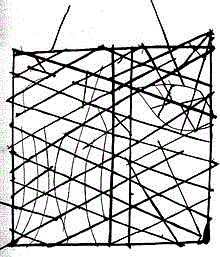
Mattang image

Colin Weatherby posted a long read on three recent reports about leadership in local government. The first looked at research into best practice leader development, the second the results of leadership at a capital city council and the third at the role of leadership in preventing corrupt or inappropriate behaviour in council works depots. I don’t think anyone would argue that we don’t need good leadership, even though we seem to survive well without it.

A colleague recently attended a lecture by Australian adventurer and leadership researcher Earl de Blonville. The focus of the talk was ‘postformal leadership’,  a new way of thinking about leadership that he has developed from thinking in postformal psychology. Continue reading

125 – The outskirts of town. Mia Dyson.

Posted by Whistler                                                                                          300 words

houses ianluntecology

I was listening to this song on my way home and it brought to mind the people I had seen standing on the roadside waiting for a bus in the new subdivisions around Melbourne – bleak bus stops built on the edge of a barren construction wasteland in front of dozens of near- identical houses.

The opening stanza of the song sets the scene.

“On the outskirts of town where brutish new houses rush up to meet you

On treeless streets, a freeway wind blowing, no soul to greet you

Oh hell, it is here, if you open the door

But you won’t feel a thing if you shut the blinds and flick on the screen”

What sort of lives have we created for people living in these new suburbs? Why is it that peace comes with shutting out the world and turning on the TV? Continue reading

124 – The butcher, the baker and the candlestick maker. Our councillors?

Posted by Whistler                                                                                          800 words

butcher baker candlestick maker

Image

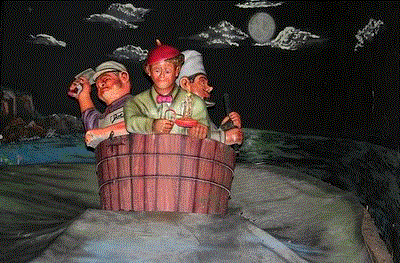
The original version of the rhyme ‘rub-a-dub-dub’ supposedly tells of three townsfolk watching a dubious sideshow at a fair. Later versions talk of them being ‘all put out to sea’, perhaps a reference to being ‘at sea’ or puzzled or bewildered (thanks Wikipedia). I think either version could work for some of our councillors today.

Councils usually have greater gender balance and occupational representation than in the rhyme. My question is, who are the people who become councillors? What attracts them to the role? Why do they do it? What do they offer? Do they really reflect the communities they represent? Continue reading

122 – Are we really that ‘special and different?’ The answer: ‘No’.

Posted by Whistler                                                                                          340 words

the same

Really, what is all this nonsense? (more nonsense here and here) Ratepayers pay their money for efficient and effective services. They don’t care about all the other stuff and they don’t want a relationship with the Council, council officers or their councillors. They just wish that it all worked really well. For me, this Thinkpurpose.com post says it all.

While councils mess around wasting time exploring their differences and putting effort into looking different to their neighbours – nothing like a new livery and big signs at all city entrances to add value for the ratepayers – and not agreeing with neighbours about regional initiatives just for the sake of it (‘we can’t share their facilities, they’re from the other side of the river!’), they will never get it right.

People just want consistent services, wherever they live. When you move homes to another suburb, why should you have to learn a whole lot of new systems to get your rubbish collected, or pay your rates, or register your pet? Surely once your pet has been registered, you should be able to live anywhere with it? Why do there need to be different systems for taking rubbish away? The bins all look the same (actually, they are often different colours to show they are from somewhere special!).

Even within councils, more emphasis on being similar and the same instead of special and different would help. How many people at the council do you have to contact to register your name for paying rates, joining a club, registering your dog, paying a fine? Every department seems to have its own register of people it deals with. How many times has someone from the council come to your home for one purpose and when asked about something else they say ‘I am sorry, I can’t help you with that. That’s another department’.

Come on. People at the council are just more faceless people in the life of most residents. They don’t want a relationship. They don’t want to spend money on frills. They just want services to be delivered efficiently and effectively. The two eff words we don’t like to use.
121 – Squire to the giants. Who are the giants in common?

Posted by Colin Weatherby                                                                                                 830 words

squire

I recently found a new and interesting blog called ‘Squire to the Giants’. Much like thinkpurpose.com this blog site is aimed at people who have an interest in improving their organisation through systems thinking. A recent post talks about the ‘giants’ that have influenced the Squire’s thinking. I am familiar with some of the ‘giants’ and have others of my own.

The Squire lists the following giants:

Regular readers of this blog will be familiar with the work of Peter Scholtes  and John Seddon. Both have influenced the thinking of writers. The biographical pieces written by the Squire  are worth a look.

I have decided to produce a blog on one of my giants.


mark h moore picProfessor Mark H. Moore

First some background. Mark H. Moore is the Hauser Professor of Nonprofit Organisations and director of the Hauser Centre for Nonprofit Organisations, at the John F. Kennedy School of Government at Harvard University.

His research interests include public management and leadership, civil society and community mobilization, and criminal justice policy and management. Continue reading

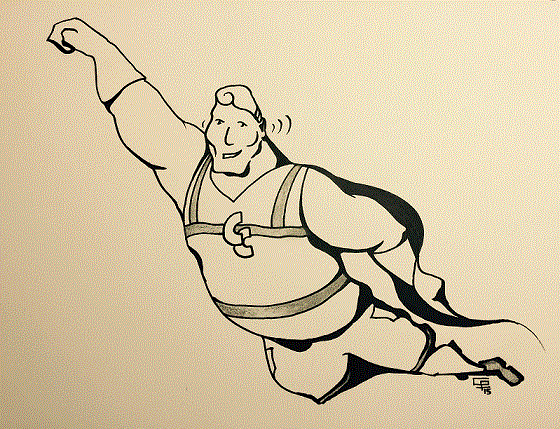
120 – Captain Council discovers a superpower – BFV.

Posted by Linda Perkin                                                                                                  750 words

Captain Council flying

In the first instalment, Captain Council cast the management alchemy spell, only to immediately fall unconscious to the ground. Awakening some time later, he rushes to that evening’s council meeting ….

Taking his seat, Captain Council looked around the chamber. The usual crew were present. All of the councillors were in their usual positions, watching each other warily. The CEO and officers were sitting nervously waiting for business to commence.   Perched on chairs at the front of the auditorium were the two regular attendees – like Statler and Waldorf. Continue reading

118 – Improving service operations. Why it doesn’t happen in local government.

Posted by Whistler                                                                                          500 words

 walking the plank

I have read Lancing Farrell and Colin Weatherby’s posts on characteristics of demands, redesigning operations and improving service operations through action plans and service redesign, with some interest. It is all good stuff and not too difficult to understand or do. The question I ask myself is why I don’t see it happening everywhere across the sector. The ‘special and different’ posts partially explain it but I think there is more to it.

To begin with, the motivation to make improvements doesn’t really exist. People say they want to improve the quality of services to their community, and in response to threats like rate capping they say they want to be more efficient. But they don’t really want to do either.

Most councils have the potential to improve productivity by 10-15% (more in some councils). Continue reading