188 – The council value proposition – what could it be?

Posted by Colin Weatherby                                                                                         1100 words

Kano model and brand

There have been a number of posts on value. In the context of imminent rate capping in Victoria it is timely to revisit some concepts of value relevant to local government. It is easy to overlook the fact that public service expenditure is about creating public value.  Especially when revenues are being constrained and thinking is turning towards making savings and cutting costs.

In the diagram above I have used the Kano model from Wikipedia and positioned three key council services that many regard as ‘core’ services – the provision of public parks, waste collection from residential properties, and provision of roads. Each has been placed in a different place on the diagram and I will explain why. Continue reading

171 – A series: Managers as designers in local government. Part 3.

Posted by Lancing Farrell                                                                              500 words

design and thinking

This is the third post in a series of four. It addresses some of the challenges to design-thinking.  Jon Kolko has identified several.

His first challenge is accepting that you will be dealing with more ambiguity.

“It is difficult if not impossible to understand how much value will be delivered through a better experience or to calculate the return on investment in creativity.”

He says that ambiguity doesn’t fit well with organisations that value ‘repeatable, predictable operational efficiency’. This will be an issue for councils seeking to use design-thinking. For councils, there is an expectation that value will be created through efficient use of resources without any waste. The strong risk aversion of local government reinforces elimination of uncertainty, or at least pretending it has been eliminated. Embracing a culture or experimentation, customer value creation and risk taking will be very challenging. Continue reading

169 – A series: Managers as designers in local government. Part 2.

Posted by Lancing Farrell                                                                              800 words

rapid prototyping

This is the second post in a series of four. It discusses the second and third principles of design-thinking.

Models can be used to examine complex problems. In this context, the ‘model’ is an artefact of the design process that is used to ‘explore, define and communicate’. Typically this will include diagrams and sketches instead of (or in addition to) the spreadsheets and specifications usually used to analyse and resolve problems. According to Kolko, they ‘add a fluid dimensions to the exploration of complexity, allowing for non-linear thought when tackling non-linear problems”.

There are a number of local government services that routinely use models or design artefacts in their work. Continue reading

168 – A series: Managers as designers in local government. Part 1.

Posted by Lancing Farrell                                                                              800 words

empathy hand holding

This is the first in a series of four posts on managers as designers in local government. It might seem like an esoteric topic and hardly relevant, however, every day managers make design decisions, often in ignorance. There is now a body of work on how managers can use design-thinking to improve the customer experience and organisational decision making. I challenge you to say it is irrelevant to your council.

Some years ago I read a book called ‘Managers as Designers in the Public Services’ by David Wastell (Professor of Information Systems at Nottingham University Business School). It made a lasting impression on me. Continue reading

160 – Making a local government service catalogue. Part 2: What to do with it?

Posted by Colin Weatherby                                                                                      630 words

service category

In the first post I described a service catalogue and looked at where (and how) to start making one. This post discusses what to do next to refine the service catalogue and use it to improve organisational performance. I have no doubt that a service catalogue is essential to starting a discussion with the community about services required in a rate capped operating environment, however it should also drive continuous improvement by providing a focus for service reviews.

The ‘first cut’ service catalogue that defines services from the customer viewpoint and links that view to organisational structure, is really just the start.

Further analysis is required to determine the link between the service catalogue and organisational strategic plans (especially the council plan). This can be achieved by coding the spreadsheet of cost centres with the themes or key objectives or themes in the plans. This will allow further analysis by pivoting on different criteria. What is the link between council plan objectives, customer defined services and cost centres? Continue reading

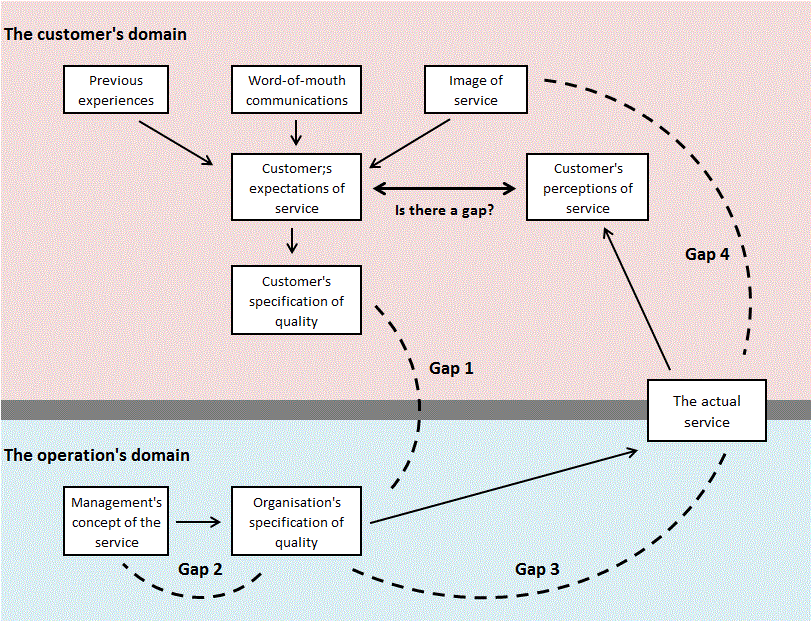
158 – Customer perception. Why is it important in local government services?

Posted by Lancing Farrell                                                                              670 words

customer service gaps

Image adapted from Slack, Chambers, Harland, Harrison, and Johnston 1998, Operations Management, 2nd Edition.

There have been a number of posts on aspects of customer service – who are our customers, customer-introduced variability, how do you listen to the ‘voice of the customer, internal customers , what Gordon Ramsay might think about council customer service, and captive customers. If there has been a thread through these posts, it has been the need to look at services from the customers’ viewpoint and to understand constitutes value for them.

The posts on value have discussed how to understand both private and public value – why do we provide the services that we do, the private-public value continuum, applying the public value scorecar , public value gap analysis, local government and commodity services, value-led management, and a series on a new theory of value creation in local government. The idea that people seek private value and councils set out to create public value is at the heart of a lot of customer service problems.

One aspect of customer service that hasn’t been discussed is the role of perception. Continue reading

150 – ‘Muzzle on council rates’. The Age, 31 July 2015.

Posted by Colin Weatherby                                                                         800 words

muzzle

The pressure is on. The Essential Services Commission has released its draft report on the proposed rate capping for councils in Victoria. It has a number of interesting elements and some significant implications for local government. The report sets out which revenues are proposed to be capped, how the rate cap could be calculated, the current forecast for rate increases to 2018/19 under the proposed system (see below), and the impact of the application of an ‘efficiency factor’ to provide an incentive to pursue efficiencies.

The article in The Age describes the major impacts.

“Victoria’s 79 councils had an average rate increase of 3.8 per cent this year. Several councils increased their rates by more than 6 per cent.

The draft report includes indicative forecasts for an annual rate cap of 3.05 per cent in 2016-17, dropping to 2.85 per cent in 2017-18 and 2.8 per cent in 2018-19.

In addition to the cap, the review calls for a new “efficiency” deduction to be introduced from 2017-18 where councils would need to reduce their rates bill by 0.05 per cent because of efficiencies (increasing by 0.05 percentage points each year). Jason Dowling, The Age, 31 July 2015.

So, what are the likely implications for councils?

There have been some previous posts on this topic (see  Council rates capped from mid-2016’, The Age, 21 January 2015 and Labor’s rate cap to hurt services and infrastructure, ratings agency warns’, The Age, 27 February 2015.). That thinking still stands. Councils will have to say ‘no’ louder and more often. Difficult choices will need to be made about what services to offer or not offer, and what the levels of service will be. Some people will no longer be eligible for services as councils start to distinguish more strongly between those who are or are not customers. Expect much more customer segmentation for services delivery. All of this will be difficult for our politicians who succeed by pleasing their constituents.

In many ways this is the easy bit Continue reading

146 – If local government was a car, what sort of car would it be? Part 4 – the Alfa Romeo 1750 GT.

Posted by Whistler                                                                                          600 words

alfa romeo

This is the fourth post in a series of five. The first review was for the Hyundai Excel Sprint council, the second was the Leyland P76, the third was the Volvo 240 series.

The fourth possibility is the Alfa Romeo 1750 GT. Stylish and fancy (and often seen with the bonnet up).   Plenty of glamour here for the ‘Alfisti’. The choice of Romeos worldwide, it was a real eye catcher that brought lots of attention. They came in bright and classical Italian automotive colours and have a great exhaust note. You wouldn’t own one to cart around your family or as your main transport to work (you needed a Hyundai or Volvo for that) but there were many weekend warriors with a 1750 in the garage. Continue reading

134 – ‘A new theory of value creation for local government’. Do we need one? Part 4 – Integrating the thinking.

Posted by Lancing Farrell                                                                              1600 words

cutting diamond

This last post in this series (see here, here and here for previous posts) is an attempt to synthesise a new theory of value creation for local government using the ideas discussed in the previous posts.

First, a quick recap on strategy, business models and operations stratgey.

  • The strategy is the position that an organisation takes in relation its market, the value it decides to create, and how it decides to create that value and operate at a surplus.
  • Every organisation explicitly or implicitly employs a business model that describes the design or architecture of the value creation, delivery, and capture mechanisms it will use.
  • The operating strategy then guides decisions about vertical integration, capacity planning, facilities planning, services technologies, and process technologies.

A new theory of value creation for local government will need to integrate these concepts into a cohesive and repeatable approach. Continue reading

127 – ‘A new theory of value creation for local government’. Do we need one? Part 2 – Business Model.

Posted by Lancing Farrell                                                                              750 words

walt disney theory of value creation

Image: ‘The greatest theory ever told’ – Walt Disney’s 1957 value creation map.

This is the second post in the series intended to make the case for a new theory of value creation for local government. The first post discussed business strategy. This post looks at the link between strategy and the business model.

Once the strategy has been determined, it leads directly to the selection of a business model that can deliver that strategy. I have chosen the following description of a business model from organisational theorist and academic David Teece to set the scene.

“Whenever a business enterprise is established, it either explicitly or implicitly employs a particular business model that describes the design or architecture of the value creation, delivery, and capture mechanisms it employs.

The essence of a business model is in defining the manner by which the enterprise delivers value to customers, entices customers to pay for value, and converts those payments to profit.

It thus reflects management’s hypothesis about what customers want, how they want it, and how the enterprise can organize to best meet those needs, get paid for doing so, and make a profit.”

As with strategy decisions, the difficulties for local government are again apparent. Continue reading