295 – Seven Practical Stories in a Free E-Book

Every so often, along comes a free AND useful publication.

Purpose, Public Value, and Service Design in Local Government – Seven stories from Nova Ratio Publica by Stephen Thorpe is a good example. Drawing on 30 years of leadership experience in local government in Victoria, Australia, the e-book provides seven easy to understand public service stories to help you improve your work.

Thorpe explains how he has overcome some big challenges. Inside the e-book you’ll find practical ways to think and act differently, including:

  • Managing for value to move a conversation from operational gripes to strategic leverage.
  • Aligning public value, legitimacy, and operational capability so good intentions can be delivered.
  • Designing operations for the visible signals that tell people a place is being cared for (especially when resources are tight).
  • Service blueprinting to map services end-to-end, anticipate fail points, and build recovery so services are safe-to-fail at go-live.
  • Accommodating variety by designing a menu of service options that fit different household circumstances.
  • Understanding system capability to understand what a system can actually produce, and why setting targets outside capability will damage capability.
  • Purpose-led improvement in statutory services by focussing on the applicant experience drivers so that statutory measures become a consequence, not the method.

Inspired by Mark Moore, W. Edwards Deming, John Seddon, and other systemic thinkers, Thorpe has thought deeply about the challenges that he and others experienced at work. He has then looked far and wide for theories to explain what he was observing to help him learn and improve.

Permeating each of the stories is the idea that when service purpose is defined in terms of what the customer, resident, applicant, or service user needs and expects, the right measures of performance and the right method for delivery become clearer. In comparison, when purpose is defined by what the organisation wants to achieve, report, or control, effort gets misdirected, and demands rebound as rework, complaints, and escalations.

The e-book has been written for councillors, executives, service managers, and improvement practitioners. Download the e-book and read these stories if you are tired of plans that promise more than your organisation can deliver.

Download free from Nova Ratio Publica

251 – Commotion Inaction

180 words (2 minutes reading time) by Gordon Brittas

Image source

In my days at the helm, I used the phrase ‘Commotion Inaction’ to describe behaviour like OECD.

It isn’t a recognised term (well, not yet) but its meaning is clear. ‘Commotion’ refers to a state of noisy or turbulent activity, often involving a lot of movement and noise. ‘Inaction’ means the failure to take necessary steps to address a situation.

Therefore, Commotion Inaction is when there is a lot of noise or activity, but no effective action is being taken. It describes a situation where people are busy but not achieving any meaningful results due to a lack of purposeful action.

Commotion Inaction is a lot of activity for no meaningful result.

Gordon Brittas

Feel free to use it.

Here are a few tips on how you use it in everyday workplace conversations:

  1. “Are you saying we have tried it before without success and we are doing it again? It sounds like Commotion Inaction”.
  2. “The bosses say just do it. They aren’t interested in the data to understand if it will work. Commotion Inaction, yet again!”
  3. “This is going to be a difficult decision and there could be some real risks in making it. We need Commotion Inaction.”

Ah, its good to be back.

238 – Il comune povero- ‘The poor municipality’

1600 words (15 minutes reading time) by Colin Weatherby                                                                                                                

Great post by Lancing Farrell. I like the link to the creative and enduring solutions people have devised in response to food scarcity. Human ingenuity can be a marvellous thing.

The impact of declining financial sustainability on asset management is disturbing. As anyone directly responsible for council assets knows, for many years the biggest challenge for local government in Victoria has been the cost of caring for assets. The Institute of Public Works Engineers (IPWEA) has been advocating for better asset management for years. I would argue that the principal council service is to own and care for assets on behalf of the ‘community. The rate cap has rapidly made this much more difficult, and as Lancing showed, the challenge is not spread evenly across councils.

What can councils do in response to funding scarcity? Will our commitment and creativity help us find new ways to provide the services the community needs and expects? Our own il comune povero.

Continue reading

230 – A way to show performance is determined by the system.

600 words (3 minutes reading time)                                                         Colin Weatherby

95 - 5 Vanguard

Source: Vanguard video ‘Tactics for helping people learn about the 95:5 principle, Part 1′

There have been several posts about performance appraisal and the ineffectiveness of systems designed to improve the performance of individuals. This posts picks up on the key theme of those posts – i.e. a person is not totally responsible for their performance in a system of work and managers need skills in understanding and improving the system.

This has been a compelling idea in my thinking and my work. Despite the many criticisms and problems encountered with people and their work in local government, I have met very few people who come to work to do a bad job. Many years of watching people work and talking to them about their work had led me to conclude that it was the way they were asked to do the work and the tools they were given that created most of the problems. I just didn’t know how to describe it.

Then I read Peter Scholtes’ book ‘The Leaders Handbook: making things happen, getting things done’, and his quote from Edwards W. Deming struck a chord with me:

“The fact is that the system that people work in and the interaction with people may account for 90 or 95 percent of performance.”

Continue reading

224 – Risk taking in local government

By Colin Weatherby                                                                                               900 words

opportunity.png

Image

Lancing Farrell raised several important issues in providing advice to a colleague regarding risk management. How does a council balance the pressure not to take risks and fail, with the competing pressure (often from the same sources) to take risks and meet demands to create new value?  

Risk is an interesting concept and there are various definitions. I like to think of it simply as the uncertainties related to achieving your goals. It is about the hazards along the pathway as you make your way towards your destination.

Businesses that don’t take risks will fail. They become uncompetitive or customer satisfaction drops. Either way, they lose business to competitors taking risks to create value that customers want and will pay for. We can all think of the companies that have taken big risks in redefining a service or product to create a new market.

You are probably wondering what this might have to do with local government. Aren’t we just doing what we have always done?

Many councils are. Whether they should be, or whether they will be able to continue to do so, should be questioned. We now live in the ‘age of the customer’ – residents want personalisation, mobility, self-service, rapid response, and efficiency (efficiency for them, not the council). The variability introduced by customers must be quickly and effectively absorbed by the organisation. Complexity, by its very nature, creates risks.

In conjunction with mandated limits on prices (the rate cap) and growing numbers of customers (as Lancing points out, Melbourne is growing rapidly), the rising expectations of residents means that councils must do things differently. Different usually involves risk taking.

I recently attended a training session on developing an organisational risk appetite. It showed me how councils could identify hazards and manage risks differently, yet still satisfy the pressure to stop things going wrong while meeting the demand to create new value. It needs a re-think and a more sophisticated approach to risk and compliance. Continue reading

223 – Risk management in local government

By Lancing Farrell                                                                                                  730 words

risk taking

Image

Is there a delegation for taking risks at your council? Does your council have a risk appetite? Are the strategic risks that have been identified appropriate? Are the operational risks relevant? Does the audit program decrease or increase risk?

These are questions that a colleague raised with me recently when trying to understand the way risks were managed at their council. I suggested they look at their risk management framework – how is risk assessed in terms of likelihood and consequence. This should explain the inherent risk, current risk rating, the target risk and rate the effectiveness of controls. It can make interesting reading.

Next, I suggested they look for their organisations lists of key risks – strategic and operational. These are usually in the risk register. This isn’t always easy to find. Someone in the risk department will have it. Most councils will have up to 8-12 strategic risks. There will be many more operational risks.

Councils are very risk aware. Some people describe it as risk aversion. I think this is driven by the multiple accountabilities that councils live with – the Minister for Local Government, the Ombudsman, the courts, the media and the community. Sometimes it is hard to know who is going to take issue with what you have done. Continue reading

222 – Execution – the discipline of getting things done. Read it.

By Colin Weatherby                                                                               1200 words

execution

Occasionally someone tells you about a management book that provides insight and leads to a new understanding of what you do every day. Or what you don’t do. This is one of those books and every leader in local government should read it.

Larry Bossidy and Ram Charan have combined their knowledge of practice and theory to provide advice on linking the three core processes that they believe are at the heart of every organisation – people, strategy and operations – to get things done.

Failure to execute is a common criticism of local government. People often say that councils are overly bureaucratic, full of red tape, unable to make decisions or constantly changing them under pressure. I read the book not knowing what to expect. It is a book that really shouldn’t be necessary. After all, organisations only exist to do something and doesn’t doing something require execution?

It doesn’t take long before you realise the book is not just about doing something, it is about doing what is needed to meet your commitments and achieve the results you have promised. It is about helping leaders make commitments outside their organisation that can be delivered and ensuring that commitment obtained inside their organisation is followed through to execution. Continue reading

204 – Rate capping: an update.

Posted by Whistler                                                                         900 words

service brainstorming 2

It has been some time since discussions commenced regarding the imposition of a rate cap on local government in Victoria. There have been a few earlier posts on the topic (see here, here, here, here and here). The rate cap has now been set and the process for any council seeking an exemption from the rate cap has been communicated. The Essential Services Commission has been effectively positioned as a regulator for local government. So what have councils been doing?

I would say not much. The requirement that the community support must be demonstrated if seeking an exemption, coupled with 2016 being an election year, has stifled activity across the sector. According to The Age newspaper 21 councils have indicated they may apply for an exemption. Some councils, including Melbourne City Council, have attempted to demonstrate community support for their rating strategy, which could support an application for an exemption from the cap.

The results from the few people’s panels held have been interesting but not unexpected. The community expects the council to use current resources well before asking for more. They want to see value for money before they will support asking people to pay more tax. Fair enough. Continue reading

173 – A series: Managers as designers in local government. Part 4.

Posted by Lancing Farrell                                                                                              1000 words

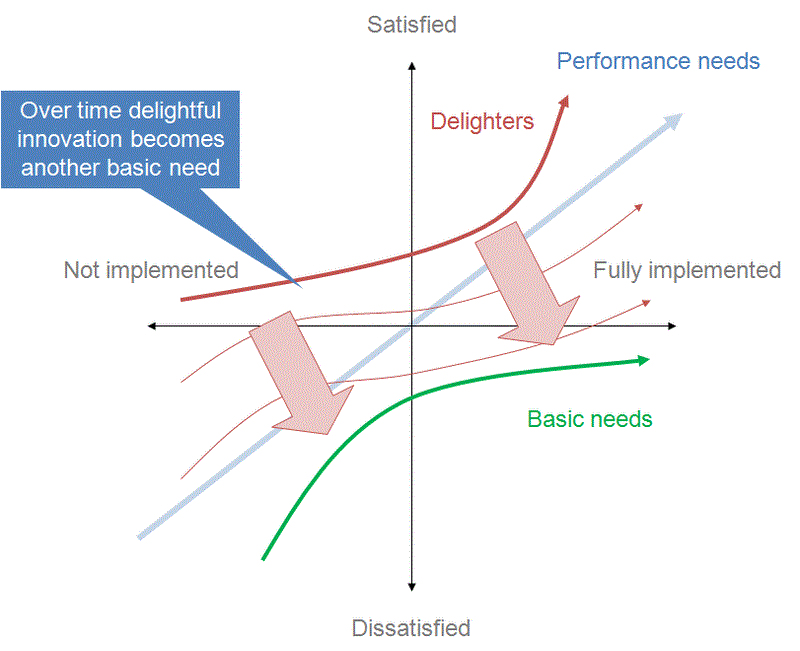
Kano model Wikipedia

Kano’s model

This is the last post in this series. It looks at how design can be used for new services and their implementation in local government.

Roger Martin and Tim Brown provide a related but different view of design in organisations. They see it as helping stakeholders and organisations work better together as a system. This is a systems-thinking approach as much as it involves design-thinking.

They describe the evolution of use of design in organisations as the ‘classic path of intellectual process’ as each design process is more sophisticated than the one before it because it was enabled by learning from that preceding stage. As designers have become more skilled in applying design to shape user experiences of products, they have turned to ‘user interfaces’ and other experiences. Continue reading

65 – Service suppliers to local government. What do they do differently and why?

Posted by Parkinson                                                                                       350 words

integrated systems

It has always intrigued me that the major suppliers of services to local government operate quite differently. What are some of the differences and why?

The first difference that is obvious is the investment in enterprise management systems. Some are better developed and more integrated than others but all have a third party accredited quality (ISO 9001), safety (AS4801), and environment (ISO 1400) systems. They will also have a corporate operations manual and a management manual setting out company policy and requirements. Continue reading