98 – Is your organisation an echosystem? How would you know, … know, … know?

Posted by Whistler                                                                                          530 words

The scream

Does everything seem to echo around? Messages are usually heard when they reverberate off distant walls? Management decisions are revisited regularly – ‘Hasn’t a decision been made on that already?’ Worse still are the matters that keep coming up, decisions aren’t made and they keep going up and down the organisational hierarchy. Perhaps your echosystem is afflicted by re-managing.

I suppose you are thinking what is ‘re-managing’. I didn’t invent the term. I have borrowed it from Managing the White Space by Geary Rummler and Alan Brache. They use it to describe the behaviour of senior managers when they re-manage the work already carried out by the managers below them. In local government the senior managers are typically Directors or Group Managers. You may ask why they find the need to do this. After all, haven’t they got more ‘strategic’ work to do? Continue reading

97 – A question: What if we treated the community the way we treat internal customers?

Posted by Whistler                                                                                          400 words

bins in street

Colin Weatherby’s post about corporate services reminded me about a video clip that I saw some time ago showing what life might be like if the airlines ran like the health service. It was an interesting way to challenge accepted standards and made the whole system look out of touch. Colin’s post about our corporate services colleagues made me think that a similar parody might be needed to highlight the lack of respect internal service providers within councils often show for their customers.

Here goes.

Customer Service Officer (CSO) sitting in call centre answers the telephone to incoming call from a resident.

CSO:                      Hello, how can I help you?

Resident:             Hello. I put my bin out for collection on Monday and it hasn’t been collected. It is now Wednesday and I am wondering what is happening.

CSO:                      Did you put it out the front?

Resident:             Yes. I put it where I always put it on the nature strip.

CSO:                      Ah. There is your problem.

Resident:             I don’t understand.

CSO:                    Well, we no longer collect bins from out the front of houses. It is a new cost saving measure that will save lots of money. We won’t have to increase your rates by nearly as much this year. It will save at least $5 a week per household.

Resident:             But no one told me.

CSO:                     That’s because it would have cost us a lot of money to tell people. We don’t want to waste money.

Resident:             So what will happen now?

CSO:                      That depends. Do you still want your bin emptied? Continue reading

96 – A corporate services productivity initiative. Are you sure?

Posted by Colin Weatherby                                                                         360 words

lawn mower

How long is it since your corporate services team decided to make some improvements to their productivity? Maybe they had to take a budget cut o show some leadership when their Group Manager was asking everyone else to make cuts. Maybe they genuinely think they have produced the same or more value at less cost. Sometimes they aren’t seeking to improve productivity, they are simply complying with the recommendations of yet another internal audit and the opportunity has come up for what seems like greater efficiency. After all, isn’t being more efficient hard to argue with?

Whichever way it happens, the flow on effects are always the same. Someone downstream gets to do more work. Continue reading

94 – ‘An interview with Wanksy, Penis Doodler and Pothole Avenger’, The Atlantic CITYLAB, 1 May 2015.

Posted by Colin Weatherby                                                                                         430 words

Wanksy image

Image from CITYLAB.

The sub title to this article says it all – ‘How an English construction worker is fighting for better road infrastructure by scribbling on the streets like a third-grader’. What is it that reduces people to this behavior? Why do they feel compelled to break the rules to get something done? There have been various articles on guerilla gardening, depaving and other aspects of DIY urbanism, but this is the first ‘guerilla maintenance’ article I have seen.

According to the article, Wanksy is a surveyor and professional artist who became fed up with the numerous potholes in his hometown, so he started drawing penises around them. And it seems to be working Continue reading

93 – ‘Cost shifting’, or ‘State services paid for by rates’? It is our choice.

Posted by Colin Weatherby                                                                         670 words

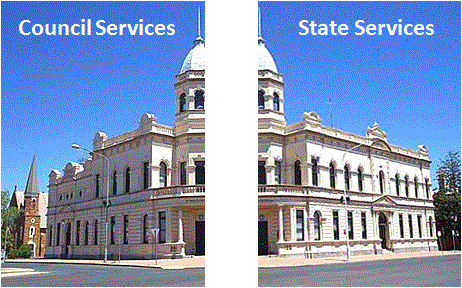
townhall 2

In local government in Victoria middle maangers are often asked to identify ‘cost shifting’ at budget time to identify the portion of the planned rate increase that is needed to cover additional costs in delivering services prescribed by the State government. A little bit of whinging usually goes along with it. Councils often feel as though they are victims being forced to do something against their will. I think it is a mindset problem.

What is really happening is that the State government is choosing to have its services delivered through local councils and for those services to be paid for by the people who receive them through their rates (property tax). Continue reading

88 – Classic paper – ‘Managing the public service institution’. Peter F. Drucker.

Posted by Colin Weatherby                                                                         Long read 1900 words

Editors Note: This is the first of a new type of post – the long read. Rather than split long pieces or edit out important ideas they will be a run as a long read. It is only recommended for those scoring more than 7/10 in the local government reading test!

In this insightful paper published in 1973, Peter F Drucker looks at why public service organisations are less efficient than business enterprises. In it he reaffirms public services as being ‘load-bearing members of the main structure’ of modern society – a provider of services that are essential to society. Despite this importance, he says the performance of public service organisations is unimpressive. They have large budgets and require ‘ever-growing subsidies’ but are providing poorer service. Citizens are complaining about ‘bureaucracy and mismanagement’ in the institutions that are supposed to serve them.

Why was that the case in 1973 and is it still the case in local government today?

78 – Organisational comfort zones in local government. Where is yours?

Posted by Colin Weatherby                                                                         730 words

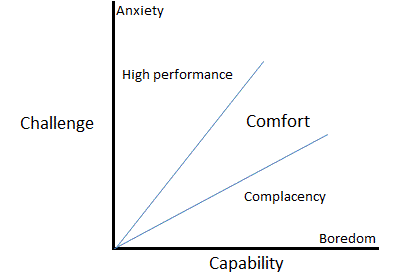
Challenge capability diagram
The idea that people are often in their comfort zones and that learning and improvement occurs when you move out of it has currency in local government today. The concern is that when people find their comfort zone they settle in and thereafter resist change, even beneficial change. Individuals are regularly being asked to leave their comfort zone and accept challenges. Does an organisation also have a comfort zone?

I think many organisations do – and they stay in them. It will usually be the zone that the organisational leaders, the council or the CEO and Executive, allow it to be in. Frequently, it is a place that they understand and there will be a level of challenge and change activity that the leaders are comfortable to support. The question is what is that level at your organisation? Continue reading

77 – Operational excellence in local government. Does it matter?

Posted by Lancing Farrell                                                                        600 words

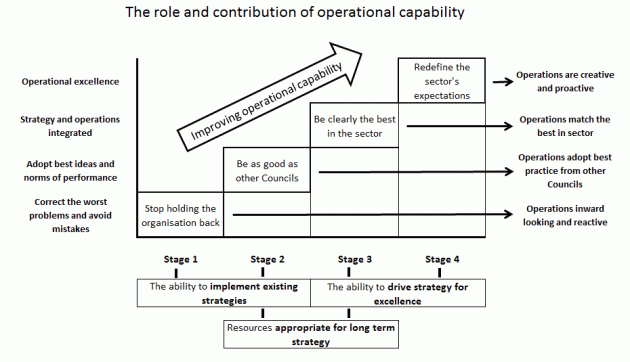
operational capability

In a recent discussion with a colleague she mentioned that in her previous employment outside local government they had set organisational performance goals for leadership, finances, relationships, safety and operational excellence.   Each area of performance was rated equally. It started me thinking about how little you hear about operational excellence in local government. Is that because it doesn’t matter?

I am sure that operational performance matters. Whether councils want to be excellent or not, I am less sure. I think that the reason it is seldom discussed is that few people have a real understanding of operations management or what excellence would look like or how to achieve it. Continue reading

73 – ‘Social media changes the rules of engagement’ , The Age, 4 April 2015

Posted by Colin Weatherby                                                                         730 words

multi channel

This article contains a healthy warning for local government about the need to design services with the customer in mind, and to look ‘outwards-in’. There have been a number of previous posts on services (see here, here, here and here). Disgruntled customers of councils are just as likely to use social media to vent their anger and concerns.

“Customers want influence over the contents of what they’re buying; they customise the muesli they order online; stream entertainment that is tailored to their interests, and pitch ideas to software companies as they develop new products.”

In this environment, councils that just continue to offer the same old services, or who alter services in ways that make them less responsive to customers, or more responsive but less reliable, are likely to frustrate people using those services. Continue reading

71 – ‘Melbourne People’s Panel makes bold decisions where politicians fear to tread’, The Age, 1 April 2015.

Posted by Colin Weatherby                                                                         550 words

Peoples panel

“The public is smart if given the time and information necessary to work through an issue. And this has been demonstrated by a people’s “jury” which has delivered its verdict in a bold experiment in democracy by the Melbourne Town Hall.

The results should give hope to people despairing that Australia has lost its reform mojo, as it provides a new way for government to get hard but necessary things done.”

I read this article by Nicholas Reece, a Principal Fellow at Melbourne University, with some interest. Involving the community in budgeting is not new. Continue reading