188 – The council value proposition – what could it be?

Posted by Colin Weatherby                                                                                         1100 words

Kano model and brand

There have been a number of posts on value. In the context of imminent rate capping in Victoria it is timely to revisit some concepts of value relevant to local government. It is easy to overlook the fact that public service expenditure is about creating public value.  Especially when revenues are being constrained and thinking is turning towards making savings and cutting costs.

In the diagram above I have used the Kano model from Wikipedia and positioned three key council services that many regard as ‘core’ services – the provision of public parks, waste collection from residential properties, and provision of roads. Each has been placed in a different place on the diagram and I will explain why. Continue reading

180 – Long Read: Managers as designers in local government.

Posted by Lancing Farrell                                                                              300 words

design thinking wordle

This is a long read compilation of the series of posts on the manager as designer in local government. For those who prefer to get the whole story in one go, here it is.

Some years ago I read a book called ‘Managers as Designers in the Public Services’ by David Wastell (Professor of Information Systems at Nottingham University Business School). It made a lasting impression on me. It is a book worth reading for its treatment of systems thinking in public service management.

More recently, I read two articles from the September 2015 issue of Harvard Business Review; ‘Design Thinking Comes of Age’ by Jon Kolko and ‘Design for Action’ by Tim Brown and Roger Martin. Each article extends the idea of the manager as designer with specific application to improve corporate processes and culture.

Jon Kolko discusses the application of design to the way people work. He says that people need help to make sense out of the complexity that exists in their interactions with technologies and complex systems, and that design-thinking can make this ‘simple, intuitive and pleasurable’.

“ … design thinking principles have the potential to be … powerful when applied to managing the intangible challenges involved in getting people to engage with and adapt innovative new ideas and experiences.”

The principles he is referring to are empathy with users, the discipline of prototyping and tolerance of failure.

Roger Martin and Tim Brown provide a related but different view of design in organisations. They see it as helping stakeholders and organisations work better together as a system. The focus of their article is the ‘intervention’ required for stakeholders to accept a new design artefact – whether ‘product, user experience, strategy or complex system’.

They argue that the design of the ‘intervention’ (i.e. the way a new product or service is introduced to users and its integration into the status quo) is even more critical to success than the design of the product or service itself.

In effect, there are two parallel design processes; the artefact (i.e. a new service) and the intervention for its implementation (i.e. the change management).

So, how is this all relevant to local government? Read on …

171 – A series: Managers as designers in local government. Part 3.

Posted by Lancing Farrell                                                                              500 words

design and thinking

This is the third post in a series of four. It addresses some of the challenges to design-thinking.  Jon Kolko has identified several.

His first challenge is accepting that you will be dealing with more ambiguity.

“It is difficult if not impossible to understand how much value will be delivered through a better experience or to calculate the return on investment in creativity.”

He says that ambiguity doesn’t fit well with organisations that value ‘repeatable, predictable operational efficiency’. This will be an issue for councils seeking to use design-thinking. For councils, there is an expectation that value will be created through efficient use of resources without any waste. The strong risk aversion of local government reinforces elimination of uncertainty, or at least pretending it has been eliminated. Embracing a culture or experimentation, customer value creation and risk taking will be very challenging. Continue reading

169 – A series: Managers as designers in local government. Part 2.

Posted by Lancing Farrell                                                                              800 words

rapid prototyping

This is the second post in a series of four. It discusses the second and third principles of design-thinking.

Models can be used to examine complex problems. In this context, the ‘model’ is an artefact of the design process that is used to ‘explore, define and communicate’. Typically this will include diagrams and sketches instead of (or in addition to) the spreadsheets and specifications usually used to analyse and resolve problems. According to Kolko, they ‘add a fluid dimensions to the exploration of complexity, allowing for non-linear thought when tackling non-linear problems”.

There are a number of local government services that routinely use models or design artefacts in their work. Continue reading

168 – A series: Managers as designers in local government. Part 1.

Posted by Lancing Farrell                                                                              800 words

empathy hand holding

This is the first in a series of four posts on managers as designers in local government. It might seem like an esoteric topic and hardly relevant, however, every day managers make design decisions, often in ignorance. There is now a body of work on how managers can use design-thinking to improve the customer experience and organisational decision making. I challenge you to say it is irrelevant to your council.

Some years ago I read a book called ‘Managers as Designers in the Public Services’ by David Wastell (Professor of Information Systems at Nottingham University Business School). It made a lasting impression on me. Continue reading

166 – Long read: Understanding the customer experience in local government.

Posted by Colin Weatherby                                                                                         260 words

service guarantee

There have been a number of posts on services and customer service, with the most recent by Lancing Farrell . Each post has explored a different aspect of service or customer service. This post looks at customer experience using two excellent articles from the Harvard Business Review as a guide; the first is ‘Understanding Customer Experience’ by Christopher Meyer and Andre Schwager, and the second is ‘Lean consumption’ by James Womack and Daniel Jones.

In their article, Meyer and Schwager describe the customer experience as encompassing

“… every aspect of a company’s offering the quality of customer care, of course, but also advertising, packaging, product and service features, ease of use, and reliability.’

They make the point that in many organisations few of the people responsible for each of these activities have thought about how their separate decisions contribute to the overall customer experience. Worse still, if they do think about it, they all have different ideas and there is no one senior who oversees everyone’s efforts to bring agreement on what needs to be done.   This is local government’s problem with service delivery in a nutshell.

Womack and Jones define ‘lean consumption’ as ‘minimising customers’ time and effort and delivering exactly what they want when and where they want it’. They see it as transforming consumption in the same way that lean production transformed manufacturing. It involves customers and service providers collaborating to ‘reduce total cost and wasted time and create new value’.

How are these two ideas relevant to the local government customer experience? Read on …

158 – Customer perception. Why is it important in local government services?

Posted by Lancing Farrell                                                                              670 words

customer service gaps

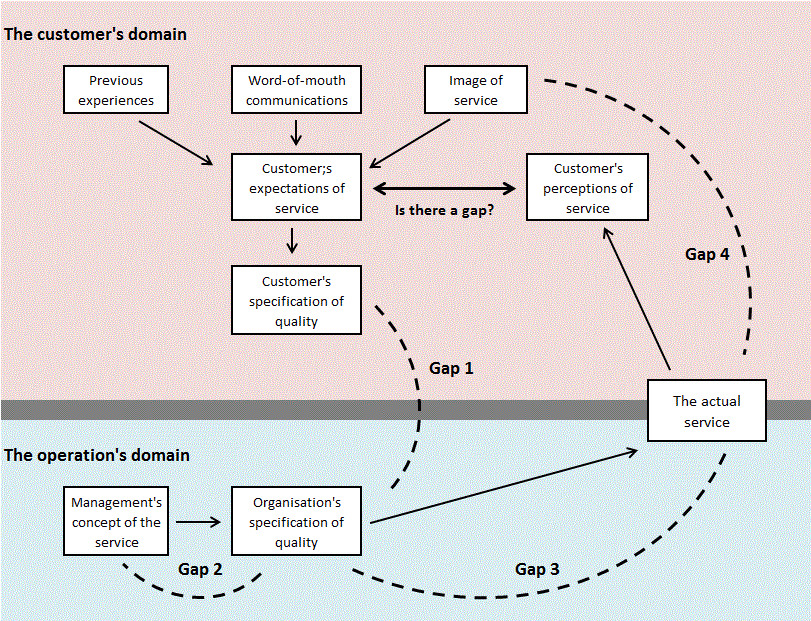
Image adapted from Slack, Chambers, Harland, Harrison, and Johnston 1998, Operations Management, 2nd Edition.

There have been a number of posts on aspects of customer service – who are our customers, customer-introduced variability, how do you listen to the ‘voice of the customer, internal customers , what Gordon Ramsay might think about council customer service, and captive customers. If there has been a thread through these posts, it has been the need to look at services from the customers’ viewpoint and to understand constitutes value for them.

The posts on value have discussed how to understand both private and public value – why do we provide the services that we do, the private-public value continuum, applying the public value scorecar , public value gap analysis, local government and commodity services, value-led management, and a series on a new theory of value creation in local government. The idea that people seek private value and councils set out to create public value is at the heart of a lot of customer service problems.

One aspect of customer service that hasn’t been discussed is the role of perception. Continue reading

157 – Captive customers. Why are they so special?

Posted by Colin Weatherby                                                                         850 words

captive

The idea that our customers (i.e. the ratepayers, residents, businesses and citizens in the community) are captive to our services is not new, however the implications are seldom discussed in local government. What does it really mean for service providers when their customers are forced to pay for services they may not use, or for service levels that may not meet their specific needs?

The idea that we will have choice in matters affecting our lives has become sacrosanct in western society, especially if we are paying. Customer service standards today are unrecognisable from those of the last century. Nobody expects to wait. If what they want isn’t available, they expect the service provider to get it – and quickly. If service falls below the normal standard they expect compensation. Social media is giving voice to unhappy customers and putting pressure of organisations.

In this environment, getting customers to pay for services in quarterly instalments and then receive standard services designed to suit ‘everyone’, leads to obvious conflicts. Continue reading

113 – Improving service operations. Finish with service redesign.

Posted by Colin Weatherby                                                                         1300 words

service redesign board

The first post on improving service operations covered service action planning. Both posts have followed a discussion about service improvement with a colleague in which he described a process he has been using with operational staff to work out how their work can be improved. This post discusses redesigning services when that has been an action identified in the service action plan.

If the need to redesign services has been identified in the service action plan there is a good chance that all team members are on board and prepared to discuss some big changes. This is really a prerequisite for significant change in local government, otherwise there is a risk that you are just ‘revolutionising’ people and will have no long term effect.

Stage 2 – Service redesign.

The first step is to separate the services with different demands, operations typology and performance objectives (this has been the subject of an earlier post). Then related services are grouped together. The last step is to redesign services to integrate similar services and plan implementation of the new service. This includes risk analysis of key aspects of the service and planning the new supervisory role required to make the service design work. Continue reading

107 – Separate, relate and integrate. Redesign operations to meet services demands.

Posted by Lancing Farrell                                                                              570 words

good cheap fast

Some basic tools are needed to redesign operations to improve performance. Many people charged with responsibility for managing services have limited skills in how to redesign and improve them. Here is a simple and effective approach – just separate, relate and integrate.

The separate bit is about understanding the different demands being placed on the system. Usually, a performance problem is masked by a mess of different demands that have been mixed in one or two delivery processes. The important characteristics of services demand are the expectations of people creating the demand and how the demand is presented. It is essential to separate each type of demand according to its performance objectives and characteristics. Continue reading