65 – Service suppliers to local government. What do they do differently and why?

Posted by Parkinson                                                                                       350 words

integrated systems

It has always intrigued me that the major suppliers of services to local government operate quite differently. What are some of the differences and why?

The first difference that is obvious is the investment in enterprise management systems. Some are better developed and more integrated than others but all have a third party accredited quality (ISO 9001), safety (AS4801), and environment (ISO 1400) systems. They will also have a corporate operations manual and a management manual setting out company policy and requirements. Continue reading

64 – Ambition, culture and performance. A tale of middle management in local government.

Posted by Whistler                                                                                          750 words

cathedral

I was recently involved in a discussion where the metaphor of the three stonemasons came up. The person telling the story described the response of the three stonemasons to the question ‘what are you doing?’ You may know it.

The first stonemason said ‘I am making a stone’. The second said ‘I am making a wall’. The third said ‘I am making a cathedral’.

The purpose in telling the story was to illustrate the various motivations of people at work in local government and that, hopefully, we are all here to make a cathedral and we know it. Well, I started thinking about how many of the workers cleaning the same public toilets every day, or mowing the same parks, or emptying the same bins, think they are making a cathedral. The chances are that they are just diligently making a stone. Whether it is used to make a cathedral or not is probably not important to them and never will be.

Then my thinking moved on to thinking about myself and the other middle managers I deal with. Surely we are all making cathedrals? Continue reading

63 – ‘The more experienced the managers, the more they trust simple intuition’. Or do they?

Posted by Colin Weatherby                                                                         700 words

intuition

Some time ago I posted on an idea from Richard Farson’s book, Management of the Absurd – Paradoxes in Leadership. This post has been inspired by another chapter in that book.

Farson says that the one quality that top executives say separates them from their less successful colleagues is their intuition. Their ‘immediate visceral reactions’ to people and events are usually accurate, which makes their judgements valuable. Farson defines intuition as the ‘accumulation of many learning experiences that have sensitised them, making them able to read situations quickly’. It is a quality that allows top management to make fast decisions that are effective. However, when top management starts to lack confidence, they start to apply formal processes to make decisions. They replace their immediate visceral reaction with complicated analytical thinking. Continue reading

62 – “The way to make it in local government is to forget ambition and pigeon hole yourself before someone else does”.

Posted by S. Dogood                                                               1000 words

pigeon hole

This was the advice I received during a discussion with a colleague this week.  Pigeon hole yourself he advised and local government becomes a good place to work.  In some ways he is right.  The discussion started me thinking about why that is the case and how it could be different.

The ambitious face a number of challenges.  First and foremost they can’t be threatening to the Executive.  Secondly, they need to be realistic about their skills and value.  Lastly, regardless of their own role breadth or experience, they run the recruitment gamut as there is always a hierarchy of preferred candidates for any role.  Hiring traditionally take the following hierarchy seeking to recruit someone who Continue reading

61 – Public value gap analysis. Some actions.

Posted by Colin Weatherby                                                                         280 words

gaps

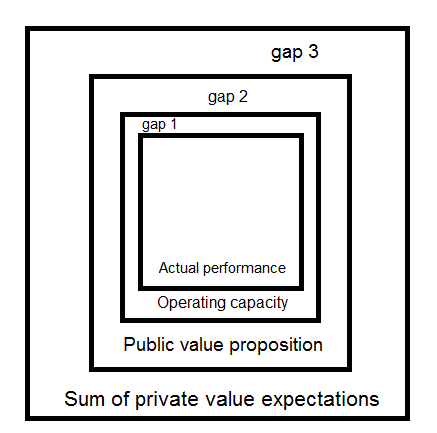
I posted on a tool that can help to identify gaps in public value creation. This post briefly suggests some actions for each gap.

The first gap between actual performance and operating capacity, or potential performance, is best addressed though organisational processes to improve productivity. Recognising the gap is important and then it is in the hands of the organisation to justify its performance or improve it. Utilising all available operating capacity efficiently is the responsibility of organisational management.

Gap 2 requires something new to happen. It isn’t simply a matter of being more efficient and productive. Continue reading

60 – Public value gap analysis. A tool.

Posted by Colin Weatherby                                                                         790 words

private public operation actual

One of the challenges in local government is understanding public value – what it is for your community and how you can create it. It can  be difficult to separate it from private value expectations and to see the relationship with the operating capacity of the organisation. This post explores a conceptual tool to understand public value and gaps that need to be addressed in achieving it.

Many years ago when asked to be the officer leading a community advisory committee I developed a model to help the group understand what we were talking about and to focus on gaps where we could be most effective in making a difference. It worked very well. At the time I didn’t really understand why. Now I think it was because is identified the public value gap that the group could work on. Here it is. Continue reading

59 – Decision hats for middle management. Some suggestions.

Posted by Whistler                                                                          570 words

I recently posted on hats that councillors could wear when making decisions in their different capacities, or when making different types of decision. The hats would provide a cue to other councillors and onlookers. I received some comments from readers and since then I conducted an informal poll of colleagues to determine what head gear they think could be worn when they make decisions. Again, the idea is to signal intention to others.

Managers mostly operate in the one capacity but they make many different types of decisions. Here are some thoughts on hats that could go with them. Continue reading

58 – Performance appraisal in local government 4/4. What else could we do?

Posted by Lancing Farrell                                                                              650 words

optimus prime transformer

This is the last post in this series. It is also where things start to get interesting. There are alternatives to performance appraisal the way we have always done it. The difficulty is that most are quite different to the current approach and pursuing them will involve the risks that always accompany change. Are we up for it?

We could just stop using performance appraisals. As Peter R. Scholtes writes in The Leaders Handbook, this would require us to start thinking differently. In essence, this would involve adopting a ‘systems thinking’ approach to managing the organisation. This is likely to require systems to support employee development and promotion, providing feedback for improvement, determining training needs, and performance managing the poor performers.

Scholtes proposes what he calls ‘debundling’ of performance appraisal to focus on each benefit that the performance appraisal system supposedly provides. Continue reading

57 – Some types of thinking observed in local government.

Posted by Whistler                                                                          580 words

ant on leaf

Image from http://caracaschronicles.com

Convenient thinking. I think this is a preferred way of thinking for many people. It is the easiest. What is the quickest way to deal with this matter? Is there someone else who should be doing it? What is likely to have the least impact on me? Once you start asking these questions, you are well on the way to some convenient thinking. It is most problematic when senior management regularly engage in convenient thinking.

Consequential thinking. This is related to convenient thinking but is more focussed on the possible outcomes from doing something. What could go wrong? Who could be upset? Will it move my career forward? Continue reading

56 – Local government performance appraisal 3/4. What can you do in response to the issues?

Posted by Lancing Farrell                                                                                              530 words

apple and orange

Choices are necessary regarding the role of performance appraisal and how it will be done. I don’t think anyone thinks that performance should not be measured. It is a matter of how you do it.

Peter R. Scholtes points out the fundamental choice facing every organisation very clearly in The Leaders Handbook. What is most important to your organisation – controlling the behaviour of people to the satisfaction of management, or understanding, controlling and improving processes to benefit customers? Continue reading