115 – Roadmap, recipe or game plan. Does it matter which metaphor you use?

Posted by Whistler                                                                            360 words

neverland cake

There are various metaphors for organisational strategy in circulation. The idea that it is a road map for a journey to a predetermined destination undertaken in a car while watching the dashboard (to know the car is working properly) is popular. One I was less familiar with is Norton and Kaplan’s cooking metaphor.

They describe an on organisation is an assemblage of ingredients brought together to make a meal. Making the meal requires raw materials (ingredients), tangible capital and assets (cooking implements, an oven), and intangible human assets (the chef). A great meal requires a recipe to take advantage of these tangible and intangible assets. The recipe transforms assets that each has standalone value into a great meal with greater combined value. The recipe corresponds to an organisational strategy that combines resources and capabilities to create unique value.

Another metaphor that I relate to is the game plan. Continue reading
114 – Classic paper: ‘Forget your people – real leaders act on the system’. John Seddon.

Posted by Colin Weatherby                                                                         2200 words

john seddon

John Seddon won the first Harvard Business Review/ McKinsey Management Innovation Prize for ‘Reinventing Leadership’ in 2010 for this paper. The prize was awarded for:

“ … the best story (a real-world case study of management innovation) or hack (a bold idea for tackling a critical management challenge) around … redefining the work of leadership, increasing trust (reducing fear), and taking the work out of work.”

As the title suggests it is a provocative paper. In his usual way, Seddon provides challenging ideas supported by practical evidence.

The context for the story is Owen Buckwell, the head of housing at Portsmouth City Council in England. Over 40,000 people rely on him for warm, safe and comfortable homes. Each year he is responsible for dealing with 17,000 blocked toilets and 100,000 dripping taps in the 17,000 council houses.

Owen has been managing housing for 6 years. Seddon describes him as a curious man who likes to get to the bottom of things.

What does Owen do?

113 – Improving service operations. Finish with service redesign.

Posted by Colin Weatherby                                                                         1300 words

service redesign board

The first post on improving service operations covered service action planning. Both posts have followed a discussion about service improvement with a colleague in which he described a process he has been using with operational staff to work out how their work can be improved. This post discusses redesigning services when that has been an action identified in the service action plan.

If the need to redesign services has been identified in the service action plan there is a good chance that all team members are on board and prepared to discuss some big changes. This is really a prerequisite for significant change in local government, otherwise there is a risk that you are just ‘revolutionising’ people and will have no long term effect.

Stage 2 – Service redesign.

The first step is to separate the services with different demands, operations typology and performance objectives (this has been the subject of an earlier post). Then related services are grouped together. The last step is to redesign services to integrate similar services and plan implementation of the new service. This includes risk analysis of key aspects of the service and planning the new supervisory role required to make the service design work. Continue reading

112 – Are we really that ‘special and different?’ An answer: ‘Yes, but’.

Posted by Lancing Farrell                                                                              400 words

peas in pod

This question was posted a week or so ago and readers and writers were asked to respond.  One reader responded (see comments below original post).  Here is my go at a response.

I am not a big fan of ‘yes, but’. In this case it is a useful way to respond to this question.

‘Yes’, of course every community is different – different people, different landscape, different housing. I could go on. These differences are important in determining the exact nature of the role each local government should play and the services they should provide. I wrote about this some time ago. Understanding these differences is critical to getting the public value proposition right and creating the value expected by the community.

I suppose the ‘but’ bit is about how the organisation responds to these differences. Because each community is different, does each organisation serving them need to be different? Continue reading

111 – High performance: ‘The Best and the Rest’. Claudio Fernández-Aráoz.

Posted by Colin Weatherby                                                                         560 words

star

This is the title of a chapter in Fernández-Aroáz’s book ‘It’s not the How or the What but the Who’. It discusses the difference between a typical worker and a highly productive worker. I was surprised at the differences in performance between the best and the rest.

Fernández-Aráoz says that a ‘star’ worker in simple jobs, for example an assembly line, and a ‘typical’ worker is about 40%. The distribution of performance follows a normal distribution, or bell curve. The distance between the best and the rest grows quickly with increasing complexity of work. He cites a top life insurance salesperson as being 240% more productive than an average salesperson, and star software developers outperforming others by 1,200%. Continue reading

110 – Improving service operations. Start with a service action plan.

Posted by Colin Weatherby                                                                         1250 words

service brainstorming

I was recently discussing service improvement with a colleague. He described to me a two-stage process he has been using with operational staff in his team to determine how their work can be improved generally, and then how to re-design services if required.

It is an intensely practical two-stage approach to working with teams collaboratively to understand work and improve operations to get better customer outcomes.

The first stage involves bounded brainstorming by the whole work group, their Team Leader and the Manager to respond to the question – how can we do our work better? It is not intended to question whether or not services should be delivered, just how they can be improved. The process is intended to be inclusive and to quickly lead to action. The output is a service action plan.

The second stage involves redesigning services if this has been identified the way to make improvement. The redesign process is led by the Team Leaders and Manager using some simple reengineering and operations management tools. The output is a new service design.

Stage 1 – The service action plan Continue reading

109 – How can you influence a council decision? Some tips.

Posted by Posted by Colin Weatherby                                                                  670 words

sprinfield monorail

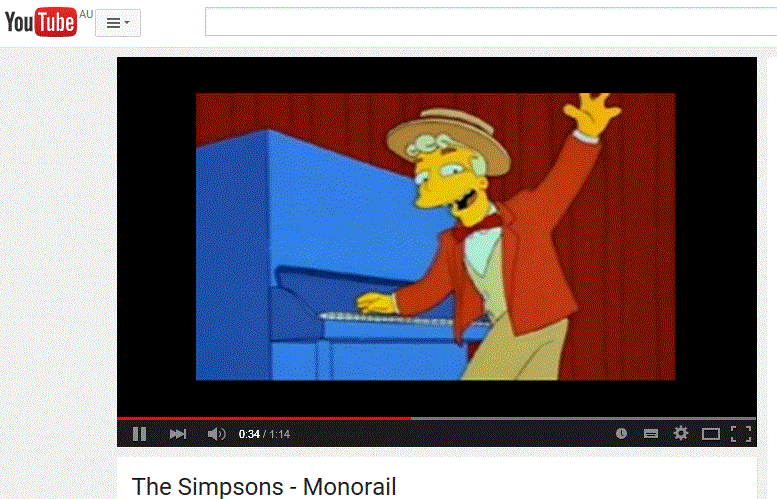
Hear the song.

 A friend recently asked me for advice on influencing a council decision regarding a park near his home. His council had plans to demolish an old community building in a park and allow a nearby disused tennis facility to be converted into bowling greens by the club based at the park. He disagreed with the plan and wanted to see the building retained and the old tennis courts turned into open parkland.

After thinking about it overnight I proposed the following ten actions Continue reading

108 – Melbourne City Council: Organisational Capability Review, May 2015.

Posted by Colin Weatherby                                                                         1300 words

Melbourne capability review model

The public release of this critical report has been something of a surprise. Commissioned in March 2015 and released in May, the report prepared by Jude Munro, Dr Bronte Adams and Steve Parker has looked at three key capabilities; leadership, strategy and delivery. Each has been rated on a four point scale for several elements. Out of the ten attributes rated, six were seen as a ’development area’ and one as a ‘serious concern’. The remaining three were seen as ‘well placed’ and none were seen as ‘strong’ (p.14). So what does this mean?

melbourne assessment criteria ratingsThe report states that this is the first time that this review model has been applied to local government in Australia. Its intention is to provide a forward looking, whole of organisation review that assesses an organisation’s ability to meet future objectives and challenges.


“This review provides the opportunity and impetus to take a very good organisation and make it even better.” Ben Rimmer, CEO

Continue reading

107 – Separate, relate and integrate. Redesign operations to meet services demands.

Posted by Lancing Farrell                                                                              570 words

good cheap fast

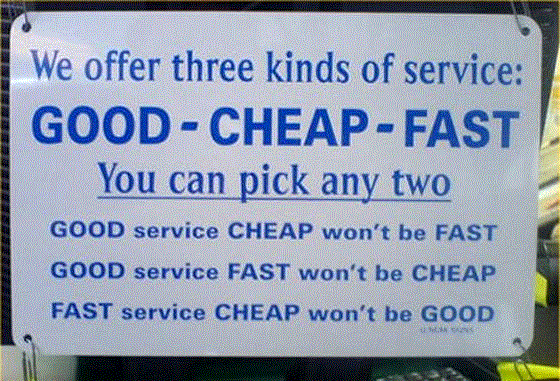
Some basic tools are needed to redesign operations to improve performance. Many people charged with responsibility for managing services have limited skills in how to redesign and improve them. Here is a simple and effective approach – just separate, relate and integrate.

The separate bit is about understanding the different demands being placed on the system. Usually, a performance problem is masked by a mess of different demands that have been mixed in one or two delivery processes. The important characteristics of services demand are the expectations of people creating the demand and how the demand is presented. It is essential to separate each type of demand according to its performance objectives and characteristics. Continue reading

106 – Some of the seldom asked questions in local government. What are they?

Posted by Whistler                                                                                          390 words

the thinker

I am sure these are not the only great unasked questions. But they are questions that frequently come to mind when you are in one of those interminable meetings talking about the same old topics.

  1. How does this add value? This is a question that often runs through my mind but it never seems appropriate to ask it. It just doesn’t seem relevant. As much as we say that we are serving the community, we choose to do it in our own way. What the community sees as value, and how they want it to be delivered, isn’t something we question enough.
  2. Am I the best person to do this? I like this question and have regularly asked it of my direct reports and encouraged them to ask it. My Group Manager has never asked it. As officer, we seem to like spending time doing things that we know how to do well, or that make us feel good because we have ‘saved the day’, or because it is just easier than the effort required in getting someone else to do it properly. Looking for the work that only you can do, and then doing it, can take you out of your comfort zone.
  3. What can we do to act on the customer survey? Each year, councils in Victoria participate in sector wide customer satisfaction monitoring. The survey results are made public and daily media report on the state wide results. Through this process it is possible to be identified as the worst performing council and this places a high level of pressure on councils. But does it lead to serious questioning of what can be done to act on the survey and really make a difference? Not often. There will be discussion about the results. A lot of time will be spent discussing the shortcomings of the methodology. But really trying to understand the results and act to improve customer or community satisfaction by taking some risks to improve value? I don’t think so.

After writing them, I found that there was a theme to these questions – we need to question what we are doing to make sure that we are adding value by doing what needs to be done to satisfy purpose or meet need or create value. Call it what you like, just do it.