135 – A question: What would you do if you were the CEO?

Posted by Colin Weatherby                                                                         180 words

woman

A colleague working at a council with a new CEO sent me a list of the organisation’s woes as identified by that CEO with their summary of the situation. It started me thinking, ‘what would I do if I was the CEO?’

Here is the list:

  • Strong autocratic and bureaucratic style on the part of the previous CEO.
  • People fearful to make decisions and comfortable not making them.
  • Strong avoidance of accountability.
  • A very conventional approach – ‘we have always done it like this’.
  • Low level of achievement – ‘if we don’t get it done today, there is always tomorrow’.
  • A low level of self actualisation and self worth.
  • Younger staff desperate for change.
  • Older staff scared of change.
  • A number of senior staff complacent in believing that all is perfect.

All of this led to a realisation that as a council with a demanding community and limited resources, the current culture would not support the future.

What would you do?

Please comment below or send your response to localgovernmentutopia@gmail.com

134 – ‘A new theory of value creation for local government’. Do we need one? Part 4 – Integrating the thinking.

Posted by Lancing Farrell                                                                              1600 words

cutting diamond

This last post in this series (see here, here and here for previous posts) is an attempt to synthesise a new theory of value creation for local government using the ideas discussed in the previous posts.

First, a quick recap on strategy, business models and operations stratgey.

  • The strategy is the position that an organisation takes in relation its market, the value it decides to create, and how it decides to create that value and operate at a surplus.
  • Every organisation explicitly or implicitly employs a business model that describes the design or architecture of the value creation, delivery, and capture mechanisms it will use.
  • The operating strategy then guides decisions about vertical integration, capacity planning, facilities planning, services technologies, and process technologies.

A new theory of value creation for local government will need to integrate these concepts into a cohesive and repeatable approach. Continue reading

133 – If local government was a car, what sort of car would it be? The Hyundai Excel Sprint

Posted by Whistler                                                                                         700 words

hyundai excel

I have often wondered what local government would be like to work in if we were making cars. For a start we would need to produce something that resembled what the customer had in mind. We would need to make sure that cars left the assembly line with all of their wheels on, with doors all the same colour, and the engine connected to the drive train. People would be more easily able to judge the quality of output.

Then I started thinking about what if a council was a car, what it would be. After a random survey of colleagues, I settled on five choices. Each car is part of the Australian motoring tradition.

Think about what car your council might be.

The first is the Hyundai Excel. Economy car choice for thousands of Australians. Economical, reliable and inconspicuous. The car to own for the budget conscious. Own one of these and, if asked, none of your friends will be able to say what car you drive. Continue reading

132 – ‘A new theory of value creation for local government’. Do we need one? Part 3 – operations strategy.

Posted by Lancing Farrell

Slack operations strategy

Image from Operations Management, 6th Edition, Slack, Chambers and Johnston.

In this third post in this series, I look at the concept of the operations strategy. Every organisation has one. Your organisation does, but do you know why or what it is? And how does it relate to the business model?

This series of posts is intended to make the case that local government needs a theory of value creation – a clear explanation of what local government does to create public value. That theory will require a reappraisal of the operations strategy and the role that operational capability can play in supporting the business model and strategy execution.

Hayes and Wheelwright describe operations strategy as guiding decisions about vertical integration (i.e. the extent to which the council owns the value chain), capacity planning (i.e. how variation in demands will be met), facilities planning (i.e. the facilities needed to deliver services), services technologies (e.g. information systems) and process technologies (e.g. batch or make-to-order).

The academics Nigel Slack, Stuart Chambers and Robert Johnston in their text Operations Management talk about strategy and the connection to operations Continue reading

131 – The Local Government Utopia syntopicon.

Posted by Lancing Farrell

syntopicon

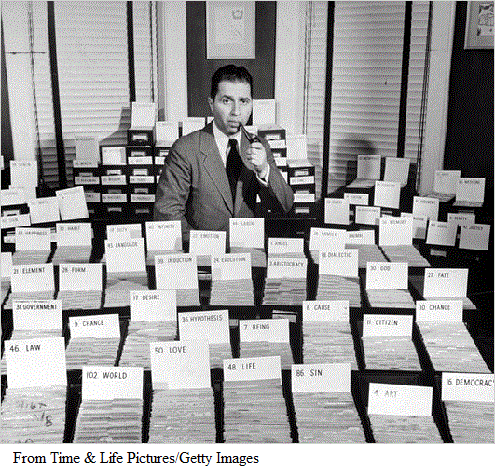
A syntopicon for the blog has been under construction for a few months. It now covers all topics for the first 100 posts. I will endeavour to make sure that it is updated every 25 posts from here on. It replaces the index posts that were made after every 25 posts.

The link is under the banner.

If you want to quickly get a feel for the matters covered by the blog, this is a good place to start. It is also useful if you want to see the progressive development of ideas as various writers have posted on topics over the course of the year.

For those who are interested, the image shows author Mortimer J. Adler creating the syntopicon for the Great Books of the Western World series. Please note, the Local Government Utopia blog has no pretensions to being the local government equivalent!

130 – Another Giant for the Squire – David Maister.

Posted by Colin Weatherby                                                                                         1400 words

david maister

This post continues a series started by Squire to the giants about his giants. David Maister will be best known to anyone responsible for running a professional services firm. In the late 1990’s when he visited Australia his seminars were expensive and quickly sold out. ‘The Professional Service Firm’ and ‘True Professionalism’ are still must reads. Maister retired in 2009 and much of his material is still available from his website.

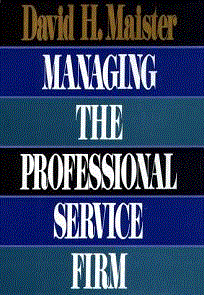
maister managing the professional service firmDavid Maister was born in Great Britain where he completed his Bachelor’s degree in Mathematics, economics and Statistics at the University of Birmingham (England), his Master’s in Operations Research at the London School of Economics. Continue reading

129 – ‘Postformal’ leadership. Are you the leader simply because you, or others, say that you are?

Posted by Parkinson                                                                      700 words

mattang

Mattang image

Colin Weatherby posted a long read on three recent reports about leadership in local government. The first looked at research into best practice leader development, the second the results of leadership at a capital city council and the third at the role of leadership in preventing corrupt or inappropriate behaviour in council works depots. I don’t think anyone would argue that we don’t need good leadership, even though we seem to survive well without it.

A colleague recently attended a lecture by Australian adventurer and leadership researcher Earl de Blonville. The focus of the talk was ‘postformal leadership’,  a new way of thinking about leadership that he has developed from thinking in postformal psychology. Continue reading

128 – Council superheroes. Some feedback from readers.

Posted by Lancing Farrell                                                                              300 words

reader feedback

Editorship has some privileges. I have enjoyed Linda Perkin’s posts on Captain Council and look forward to what will unfold in future posts. Captain Council has generated some interest, with a few people ‘connecting some dots’ and telling us about them.

Apparently western suburbs local print media shock jock Kevin Hillier has commented that councillors in his community have a ‘cloak of invisibility’. It seems they haven’t been as publicly accountable as he would like.

It was suggested that Captain Council might need this superpower. If he did, I am sure it would not be to hide from his constituents!

Another colleague pointed out a scholarly article written a few years ago about whether CEO’s in local government are superheroes or puppets. In the introduction, the author comments that:

“… CEO’s are required to operate across multiple dimensions simultaneously.”

This sounds like ‘shape shifting’ to me. A quick check on Wikipedia reveals that this superpower is more likely to be ‘dimensional travel’ (i.e. the ability to travel between two or more dimensions, realities, realms) or ‘omnipresence’ (i.e. the ability to be present anywhere and everywhere simultaneously). Secretly, I think many CEO’s do aspire to omnipotence.

I should probably take this article more seriously. It concludes with the view that:

“Successful CEOs share several common characteristics which reflect the ability to effectively manage along the three edges+. These CEO’s tend to possess transformational, charismatic, and almost superhuman qualities.”

It is all starting to sound a bit eerie to me, but my confidence was restored by a more thorough perusal of the article, which revealed that the research was strictly scholarly and involved nothing supernatural.

+ The concept of the ‘three edges’ was developed by Henry Mintzberg to describe the work of the public sector manager. The edges are the ‘operating edge’, the ‘stakeholder edge’ and the ‘political edge’.

Jones, Stephen 2011. ‘Superheroes or Puppets? Local Government Chief Executive Officers in Victoria and Queensland’, Journal of Economic and Social Policy, August.


127 – ‘A new theory of value creation for local government’. Do we need one? Part 2 – Business Model.

Posted by Lancing Farrell                                                                              750 words

walt disney theory of value creation

Image: ‘The greatest theory ever told’ – Walt Disney’s 1957 value creation map.

This is the second post in the series intended to make the case for a new theory of value creation for local government. The first post discussed business strategy. This post looks at the link between strategy and the business model.

Once the strategy has been determined, it leads directly to the selection of a business model that can deliver that strategy. I have chosen the following description of a business model from organisational theorist and academic David Teece to set the scene.

“Whenever a business enterprise is established, it either explicitly or implicitly employs a particular business model that describes the design or architecture of the value creation, delivery, and capture mechanisms it employs.

The essence of a business model is in defining the manner by which the enterprise delivers value to customers, entices customers to pay for value, and converts those payments to profit.

It thus reflects management’s hypothesis about what customers want, how they want it, and how the enterprise can organize to best meet those needs, get paid for doing so, and make a profit.”

As with strategy decisions, the difficulties for local government are again apparent. Continue reading

126 – ‘A new theory of value creation for local government’. Do we need one? Part 1 – Strategy.

Posted by Lancing Farrell                                                                              850 words

value diagram shaded

This is the first post in a series  exploring the relationship between business strategy, the business model and operations strategy. It is an attempt to pick up on the ideas in Colin Weatherby’s previous post discussing Henry Mintzberg’s ideas about different models for government organisations. Hopefully the series of posts will make my case for a local government theory of value creation.

I will begin with business strategy. To set the scene, I have chosen the following quotations from management consultant and academic David Maister  to highlight the strategy problem for local government.

“A strategy is not just choosing a target market, but is about actually designing an operation that will consistently deliver the superior client benefits you claim to provide.

However, each decision you make to be more effective at delivering the preferences of those you target will (inevitable, inescapably, unavoidably) make you less attractive to clients or market segments that look for different benefits.

You could try to design your operations to meet a wide variety of preferences and needs, serving each client or customer group differently, according to their individual wishes.

Your market appeal will then come down to ‘tell us what you want us to do for you and we’ll do that. We’ll do something different for other people tomorrow!’

The very essence of having a strategy is being selective about choosing the criteria on which a firm wishes to compete, and then being creative and disciplined in designing an operation that is finely tuned to deliver those particular virtues.

An operation designed to provide the highest quality is unlikely to be the one that achieves the lowest cost, and one that can respond to a wide variety of customized requests will be unlikely to provide fast response and turnaround. Any business that tried to deliver all four virtues of quality, cost, variety and speed would be doomed to failure.”

Maister may not have had local government in mind when he wrote this piece, but he provides an insight into the challenges in determining what provides value to people receiving services. He calls it ‘superior client benefits’. In the public service context, academic Mark H. Moore has called it public value. It is the same idea Continue reading