147 – ‘The Voice’ for local government. An alternative recruitment approach?

Posted by Whistler                                                                                          600 words

the voice

Image

Did any of the judges in The Voice Italy expect to see a Nun when they turned around?   Watch the linked video. My guess is, no. Would a Nun have won through normal auditions? Maybe in Italy (she won by The Voice by the way). I am not saying that she wasn’t a good singer. The question is, would she (and other winning contestants) have found their way through the first round of auditions if they could be seen by the judges as they performed?

Blind auditioning removes some of the obvious prejudices that hamper institutionalised selection processes, like television pop music. You might ask why it is potentially useful to local government. Continue reading

146 – If local government was a car, what sort of car would it be? Part 4 – the Alfa Romeo 1750 GT.

Posted by Whistler                                                                                          600 words

alfa romeo

This is the fourth post in a series of five. The first review was for the Hyundai Excel Sprint council, the second was the Leyland P76, the third was the Volvo 240 series.

The fourth possibility is the Alfa Romeo 1750 GT. Stylish and fancy (and often seen with the bonnet up).   Plenty of glamour here for the ‘Alfisti’. The choice of Romeos worldwide, it was a real eye catcher that brought lots of attention. They came in bright and classical Italian automotive colours and have a great exhaust note. You wouldn’t own one to cart around your family or as your main transport to work (you needed a Hyundai or Volvo for that) but there were many weekend warriors with a 1750 in the garage. Continue reading

144 -The local government coracle.

Posted by Whistler                                                                          200 words

coracle paddling

I read Colin Weatherby’s post on what he would do as the CEO in response to Lancing Farrell’s question with some delight. I too have often made the connection between local government and boats, but in a different way.

Celtic monks gained a certain amount of fame for setting off in coracles to see where God, by way of currents, led them. Some of them set off without even an oar. Monks are famous for this kind of faith and their willingness to take risks.

Despite the propensity of coracle sailors to take risks, it somehow seems an apt craft for local government. The idea that many councils are like little round boats that go where wind and tide takes them is fitting. Having no front or back, it doesn’t matter which direction they go in. Having no method of propulsion leaves them at the mercy of external forces. Even a skilled navigator would struggle to take one in the direction they wanted to go.

I am not suggesting that every council is a coracle or that CEO’s and senior management must sit idle while the organisation goes in whatever direction greater forces take it. But sometimes it feels like it.

141 – If local government was a car, what sort of car would it be? Part 3 – the Volvo 240 series.

Posted by Whistler                                                                                          600 words

volvo 240

Some time ago I started thinking that if a council was a car, what it would be. This is the third post in a series of five. The first review was for the Hyundai Excel Sprint council and the second was the Leyland P76.

Third is the Volvo 240 series. Immortalised by Dudley Moore as being ‘boxy but good’, the 240 has carted many families around in relative safety for decades (yes decades – they last forever). No glamour here, just rock solid, dependable performance and the best safety standard available at the time. Continue reading

139 – A question. If I was the CEO what would I do? Answer: Nothing.

Posted by Whistler                                                                          230 words

heart rate

This is my response to the question posed by Lancing Farrell.  I think the CEO has found local government the way we like it. I am not sure what their problem is. A strong and autocratic style from the CEO reassures us that there is someone at the top calling the shots and keeping the councillors in line. With no one prepared to make difficult decisions it keeps things stable and predictable. This suits the low level of organisational achievement and absence of time consciousness. What more could you ask for?

With people running the place who have been rewarded for their allegiances and length of service, this would be a predictable and easily understood workplace. Recruitment would be straightforward and safe. Anyone with experience in the sector would easily fit in and, so long as they got along with those in charge, could be quite successful.

Why the need for change? After all, why change something when you don’t have a clear idea of what you could or should change it to? Maintaining the status quo is a time honoured way to manage, especially in the face of uncertainty. Doing nothing could be the best thing to do and it is the lowest risk for those in charge.

Fear of change has been a hallmark of local government and an approach that has served it well. It has kept everything in its place. Consistency is important in service delivery and local government has been extremely consistent over many years. Everyone knows what to expect.

138 – Three books with management concepts relevant to local government that might appeal to the reluctant reader.

Posted by Whistler                                                                                                          1100 words

dr seuss

I posted on the local government reading test a while ago and a few colleagues have commented that many management books are written as simple parables, almost like children’s books, to help convey complex information. One of my children reminded me of some of their early ‘management’ reading and I thought I would post on it.

  1. ‘The Lorax’ by Dr Seuss (61 pages)

I will start with the longest of the books, though none of them is by any measure a challenging read. Even though they were written by a doctor, he has included lots of pictures to ease the journey for the weary reader. Continue reading

136 – If local government was a car, what sort of car would it be? Part 2 – the Leyland P76.

Posted by Whistler                                                                                          480 words

leyland p76

Some time ago I started thinking that if a council was a car, what it would be. This is the second post in a series of five. The first review was for the Hyundai Excel Sprint council.

The second is the legendary Leyland P76. The Targa Florio, no less. They promised so much and delivered so little. Launched with much fanfare and designed for ‘Australian conditions’, the P76 didn’t live up to expectations. It could fit a 44 gallon drum in the boot and under the bonnet it sported a V8 engine. Continue reading

133 – If local government was a car, what sort of car would it be? The Hyundai Excel Sprint

Posted by Whistler                                                                                         700 words

hyundai excel

I have often wondered what local government would be like to work in if we were making cars. For a start we would need to produce something that resembled what the customer had in mind. We would need to make sure that cars left the assembly line with all of their wheels on, with doors all the same colour, and the engine connected to the drive train. People would be more easily able to judge the quality of output.

Then I started thinking about what if a council was a car, what it would be. After a random survey of colleagues, I settled on five choices. Each car is part of the Australian motoring tradition.

Think about what car your council might be.

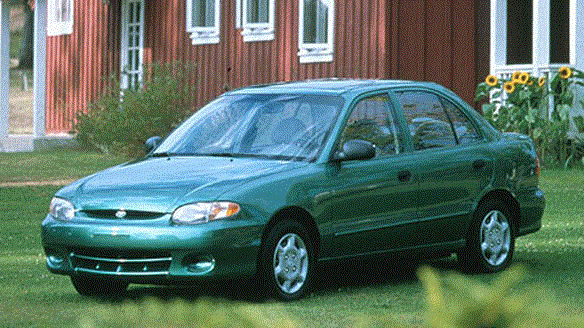
The first is the Hyundai Excel. Economy car choice for thousands of Australians. Economical, reliable and inconspicuous. The car to own for the budget conscious. Own one of these and, if asked, none of your friends will be able to say what car you drive. Continue reading

124 – The butcher, the baker and the candlestick maker. Our councillors?

Posted by Whistler                                                                                          800 words

butcher baker candlestick maker

Image

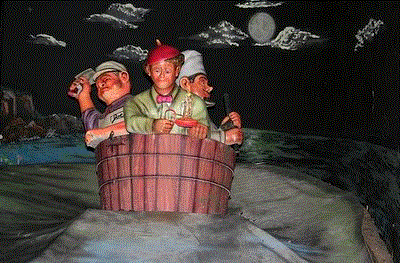
The original version of the rhyme ‘rub-a-dub-dub’ supposedly tells of three townsfolk watching a dubious sideshow at a fair. Later versions talk of them being ‘all put out to sea’, perhaps a reference to being ‘at sea’ or puzzled or bewildered (thanks Wikipedia). I think either version could work for some of our councillors today.

Councils usually have greater gender balance and occupational representation than in the rhyme. My question is, who are the people who become councillors? What attracts them to the role? Why do they do it? What do they offer? Do they really reflect the communities they represent? Continue reading

122 – Are we really that ‘special and different?’ The answer: ‘No’.

Posted by Whistler                                                                                          340 words

the same

Really, what is all this nonsense? (more nonsense here and here) Ratepayers pay their money for efficient and effective services. They don’t care about all the other stuff and they don’t want a relationship with the Council, council officers or their councillors. They just wish that it all worked really well. For me, this Thinkpurpose.com post says it all.

While councils mess around wasting time exploring their differences and putting effort into looking different to their neighbours – nothing like a new livery and big signs at all city entrances to add value for the ratepayers – and not agreeing with neighbours about regional initiatives just for the sake of it (‘we can’t share their facilities, they’re from the other side of the river!’), they will never get it right.

People just want consistent services, wherever they live. When you move homes to another suburb, why should you have to learn a whole lot of new systems to get your rubbish collected, or pay your rates, or register your pet? Surely once your pet has been registered, you should be able to live anywhere with it? Why do there need to be different systems for taking rubbish away? The bins all look the same (actually, they are often different colours to show they are from somewhere special!).

Even within councils, more emphasis on being similar and the same instead of special and different would help. How many people at the council do you have to contact to register your name for paying rates, joining a club, registering your dog, paying a fine? Every department seems to have its own register of people it deals with. How many times has someone from the council come to your home for one purpose and when asked about something else they say ‘I am sorry, I can’t help you with that. That’s another department’.

Come on. People at the council are just more faceless people in the life of most residents. They don’t want a relationship. They don’t want to spend money on frills. They just want services to be delivered efficiently and effectively. The two eff words we don’t like to use.