159 – Making a local government service catalogue. Part 1: Where do you start?

Posted by Colin Weatherby                                                                                         740 words

service catalogue food images

Across local government in Victoria councils are starting to discuss core and non-core services and the need to make a service catalogue – in other words, list of all the services they provide. In part this interest has been sparked by rate capping and the need to better understand where revenue is going. Any council attempting to increase rates above the Essential Services Commission cap will need an argument that is supported by their community. So what is a service catalogue?

In its simplest form it is a list of all the services a council offers, and by default, anything not on the list is not offered. It doesn’t mean that other services can’t be offered but there will need to be consideration of the costs and benefits before committing to do so. The list will need to be controlled once it has been made.  Deciding what services you will and won’t offer (and who will and won’t receive them) is at the heart of strategy. Continue reading

157 – Captive customers. Why are they so special?

Posted by Colin Weatherby                                                                         850 words

captive

The idea that our customers (i.e. the ratepayers, residents, businesses and citizens in the community) are captive to our services is not new, however the implications are seldom discussed in local government. What does it really mean for service providers when their customers are forced to pay for services they may not use, or for service levels that may not meet their specific needs?

The idea that we will have choice in matters affecting our lives has become sacrosanct in western society, especially if we are paying. Customer service standards today are unrecognisable from those of the last century. Nobody expects to wait. If what they want isn’t available, they expect the service provider to get it – and quickly. If service falls below the normal standard they expect compensation. Social media is giving voice to unhappy customers and putting pressure of organisations.

In this environment, getting customers to pay for services in quarterly instalments and then receive standard services designed to suit ‘everyone’, leads to obvious conflicts. Continue reading

150 – ‘Muzzle on council rates’. The Age, 31 July 2015.

Posted by Colin Weatherby                                                                         800 words

muzzle

The pressure is on. The Essential Services Commission has released its draft report on the proposed rate capping for councils in Victoria. It has a number of interesting elements and some significant implications for local government. The report sets out which revenues are proposed to be capped, how the rate cap could be calculated, the current forecast for rate increases to 2018/19 under the proposed system (see below), and the impact of the application of an ‘efficiency factor’ to provide an incentive to pursue efficiencies.

The article in The Age describes the major impacts.

“Victoria’s 79 councils had an average rate increase of 3.8 per cent this year. Several councils increased their rates by more than 6 per cent.

The draft report includes indicative forecasts for an annual rate cap of 3.05 per cent in 2016-17, dropping to 2.85 per cent in 2017-18 and 2.8 per cent in 2018-19.

In addition to the cap, the review calls for a new “efficiency” deduction to be introduced from 2017-18 where councils would need to reduce their rates bill by 0.05 per cent because of efficiencies (increasing by 0.05 percentage points each year). Jason Dowling, The Age, 31 July 2015.

So, what are the likely implications for councils?

There have been some previous posts on this topic (see  Council rates capped from mid-2016’, The Age, 21 January 2015 and Labor’s rate cap to hurt services and infrastructure, ratings agency warns’, The Age, 27 February 2015.). That thinking still stands. Councils will have to say ‘no’ louder and more often. Difficult choices will need to be made about what services to offer or not offer, and what the levels of service will be. Some people will no longer be eligible for services as councils start to distinguish more strongly between those who are or are not customers. Expect much more customer segmentation for services delivery. All of this will be difficult for our politicians who succeed by pleasing their constituents.

In many ways this is the easy bit Continue reading

145 – The deep web and local government recruitment.

Posted by Colin Weatherby                                                                                         1100 words

deep web

Local government executive recruitment is a game. Often recruitment is not genuinely based on competence and ability. In many cases, relationships are far more important. I have heard it described as the ‘deep web’ – what you see isn’t all there is. So, how does it work?

Councils recruiting a new CEO tend to go for ‘tried and true’ or ‘shiny and new’.  I think analysis will show an alternating pattern from one to another. It is almost as though councilors become bored with their CEO, or, more likely, the CEO refuses to do what they tell them to do. Once a CEO stands up and says ‘no’, they are likely to be on the way out.

Councilors know that they can demand that a CEO does what they want – whether or not it is in their or the community’s best interests. I think that once a council has dismissed a CEO and they have a ‘taste of blood’ they are more likely to do it again and a cycle of CEO non-reappointments and appointments begins (with all the disruption this brings).

When councils are recruiting a CEO, they rely on assistance from the recruiters – companies that specialise in helping councils to recruit executives. These companies can be highly influential. Continue reading

143 – Developing a dashboard for performance measurement. A case study – Part 3.

Posted by Colin Weatherby                                                                                         750 words

the score

In the first two posts (see here and here) I discuss the requirements for a performance dashboard for my unit, the sources of performance measurement ideas, and the thinking behind creation of that dashboard. This post has the final dashboard.

At the outset I will remind you that purpose of the dashboard is to provide the performance information that I need in real time to be able to drive my unit. It is not intended to measure everything that might be relevant to understanding the performance of the unit. There will need to be other measures. The objective is to have no more than ten ‘dials’ ion the dashboard.

The performance questions that I have selected that are relevant to real time understanding and management of performance are: Continue reading

142 – A question. If I was the CEO what would I do? Answer: Focus the change effort.

Posted by Colin Weatherby                                                                                            740 words

boat builder CEO

I am sure being a CEO isn’t easy. The political environment in Australia is difficult and even more so in local government where the politicians are unpaid and not supported by political parties. There are many other pressures from the external environment – i.e. changing State government legislated responsibilities and increasing oversight of council operations; contentious urban growth and renewal planning decisions; inadequate State services for transport, education and health; and changing community expectations of service. So, if it was me, what would I do?

To begin I would not let the limitations and problems of the political and external environments dominate my management of the organisation. They are both urgent and sometimes important. However, they are not easily influenced and can take all of top management’s time and energy for little return. By all means be engaged and influence where you can but my approach would be to put my effort where no one else can and where I will get the best return.

By doing this, I think there would also be an improvement in the political environment and a stronger position to tackle the external pressures.

What do I mean? I would get my house in order. I would ensure that the resources at my disposal are used to create the maximum value for the community that has provided them. My goal would be for every ratepayer and resident to love living in my municipality. They would love it so much that they would tell all of their friends about it. They would offer to pay more for the services that they or their neighbours need. Every day social media would have stories of the great experiences people have had dealing with the council and the surprisingly good value they received.

Expectations would be met for basic service and exceeded where the value is visible and appreciated. This is the value capture that Sayan Chatterjee  talks about – councils don’t want people to value the services they provide and to offer to pay more so that the council can make a profit. Councils are not in that business. Instead, councils want them to be loyal customers who enjoy the value they get from paying their taxes. That enjoyment and loyalty is the value capture.

I wouldn’t ignore the outside world but I would want to be leading an organisation that redefines community expectations and delivers outstanding value. Here is how I would do that in order.

  1. Provide a more inclusive and less autocratic management style that suits local government culture and organisations expected to work that way with their customers.
  2. Set clear strategy – who are/are not customers; what service will/will not be provided to them; and how will it be done efficiently using available resources.
  3. Improve the customer focus by putting customers first (I mean really putting them first, not just saying it) through understanding the value they expect and designing services to provide it within available resources, now and in the long-term.
  4. Create better processes to make decisions and delegate more decision making and empower staff throughout the organisation so that more decisions are made and faster.
  5. Establish greater accountability by setting expectations and measuring performance so that feedback is provided to support achievement and create a performance-orientated culture.
  6. Focus innovation on areas of the organisation where significant change is required and set up systems to so that everyone continuously improves.
  7. Simplify the complexity inherent in local government by identifying and eliminating process constraints that have developed over time.
  8. Focus on productivity by ‘unlocking’ the capacity of people and resources to ensure that the required services are being provided as efficiently as possible.

I have been told (by a CEO) that a world where ratepayers and residents enjoy the value they get for the taxes is unrealistic and unachievable.  If that is what our leaders think, what hope is there?

I have used an image of a boat builder for a reason. I have a relative who owns and builds wooden sailing boats. After talking to him, I think that leading an organisation is a lot like building a boat. You need to design the boat to optimise the performance required – does it have to be safe in all conditions, will it have to make fast passages, or will it carry burdensome loads? One boat can’t do them all.

Then materials must be selected and the builder needs to understand the properties of those materials – how they are worked to make the boat, how they will perform under load, how they will fail, and how they can be repaired.

A boat must be made with care. There is a right and a wrong way to do it, and doing it the wrong way could lead to failure and loss of life. Finally, the boat needs to be beautiful.

This is an important point for local government.  In the same way that there is no joy in building or owning an ugly boat, success in local government must also include a sense of pride and achievement in having contributed to something worthwhile.

Chatterjee, Sayan 2013. Simple Rules for Designing Business Models, California Management Review, Winter.


140 – Developing a dashboard for performance measurement. A case study – Part 2.

Posted by Colin Weatherby                                                                         810 words

aircraft cockpit

Some time ago I posted on my approach to developing a dashboard for my unit. I set out the ‘performance questions’ that I could need to answer at any point in time as I ‘drive’ my unit. In this post I apply the ideas of Geary Rummler, Alan Brache, Mark Moore and Christopher Stone to determine measures and lead indicators.

The performance questions identified in my first post are intended to get to the heart of the ‘performance logic’ underpinning performance management of the unit. Understanding the performance logic is an idea from Rummler and Brache. Seeing the performance logic as a series of ‘performance questions’ comes from a handy paper by Bernard Marr on the Advanced Performance Institute website, ‘What are key performance questions’  and how they can be used to engage people in dialogue about performance and guide the design of meaningful performance indicators. Continue reading

137 – EPM, PMO or JACI. What are our CEO’s talking about now?

Posted by Colin Weatherby                                                                         1180 words

project flow diagram

I recently attended a presentation on enterprise portfolio management or project management offices in Victorian local government. It seems to be the latest idea that has caught the attention of CEO’s in their search for solutions to problems they can see.

I must have been working in local government for too long. I have seen management by objectives, evidence-based decision making (or decision-based evidence making as I like to more accurately describe it), total quality management, reengineering, and more recently, lean and high performance teams. It is as though we look out our window and see someone doing something that looks like what we think we should be doing and we just copy them.

In two of the long reads (here and here) the shortcomings of copying the private sector are dissected by Peter Drucker and Henry Mintzberg. Continue reading

135 – A question: What would you do if you were the CEO?

Posted by Colin Weatherby                                                                         180 words

woman

A colleague working at a council with a new CEO sent me a list of the organisation’s woes as identified by that CEO with their summary of the situation. It started me thinking, ‘what would I do if I was the CEO?’

Here is the list:

  • Strong autocratic and bureaucratic style on the part of the previous CEO.
  • People fearful to make decisions and comfortable not making them.
  • Strong avoidance of accountability.
  • A very conventional approach – ‘we have always done it like this’.
  • Low level of achievement – ‘if we don’t get it done today, there is always tomorrow’.
  • A low level of self actualisation and self worth.
  • Younger staff desperate for change.
  • Older staff scared of change.
  • A number of senior staff complacent in believing that all is perfect.

All of this led to a realisation that as a council with a demanding community and limited resources, the current culture would not support the future.

What would you do?

Please comment below or send your response to localgovernmentutopia@gmail.com

130 – Another Giant for the Squire – David Maister.

Posted by Colin Weatherby                                                                                         1400 words

david maister

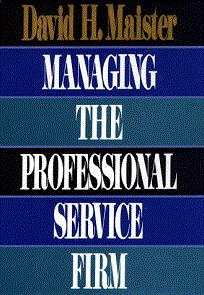
This post continues a series started by Squire to the giants about his giants. David Maister will be best known to anyone responsible for running a professional services firm. In the late 1990’s when he visited Australia his seminars were expensive and quickly sold out. ‘The Professional Service Firm’ and ‘True Professionalism’ are still must reads. Maister retired in 2009 and much of his material is still available from his website.

maister managing the professional service firmDavid Maister was born in Great Britain where he completed his Bachelor’s degree in Mathematics, economics and Statistics at the University of Birmingham (England), his Master’s in Operations Research at the London School of Economics. Continue reading