247 – The New Human Movement – Bill Anderson.

1250 words (12 minutes reading time) by Lancing Farrell

Gary Hamel and Michele Zanini wrote Humanocracy – Creating organisations as amazing as the people inside them in 2020. It examined the way organisations have become over-burdened with bureaucracy, which stops workers learning and contributing, and destroys productivity. In it they produced a blueprint for creating organisations that are more resilient, and improve worker’s jobs and productivity at the same time.

Hamel and Zanini describe the legacy of bureaucracy as ‘top-heavy power structures and rule-choked processes that make organisations timid, inertial and incremental’ in the face of disruptive change. This triggered my interest because of the problems facing councils in Victoria who are starting to deal with the spending gap arising from the State imposed rate cap.

The book followed an influential essay in the Harvard Business Review by Hamel and Zanini in 2016 that estimated bureaucracy in the US costs $3 trillion each year, or 17% of GDP. 

From this thinking, the New Human Movement was born through a Youtube channel, where Hamel and Zanini speak to the ‘bold thinkers and radical doers who are reimagining work, leadership and organization for a new age.’ There are now 29 episodes online and they are all worth watching.

I have selected one episode to discuss because I think it has particular relevance to local government in Victoria. It provides a transformation example all councils could follow.

Continue reading
245 – Council BI – some more thinking.

880 words (7 minutes reading time)  by Lancing Farrell

Source: Qlik

Summary

Australian local governments make decisions on a range of issues that impact their communities, such as planning, zoning, environmental management, infrastructure, waste management, community services, traffic management, and economic development. The decisions they make are influenced by legislative requirements, public input, and deliberation among elected officials. The specific responsibilities and decision-making processes of local governments can vary depending on the state or territory in which they are located. The decision-making process typically includes planning and preparation, public consultation, council meetings, decision-making, implementation, and review and evaluation.

In Colin Weatherby’s post on BI, he looked at how it is used by companies and how it might be used by councils. With some assistance from ChatGPT (I am becoming quite a fan), I have tried to drill down to the actual decisions councils make where BI would be useful.

Continue reading

243 – Ken Miller – Myth Buster.

1350 words (12 minutes reading time) by Lancing Farrell

Summary

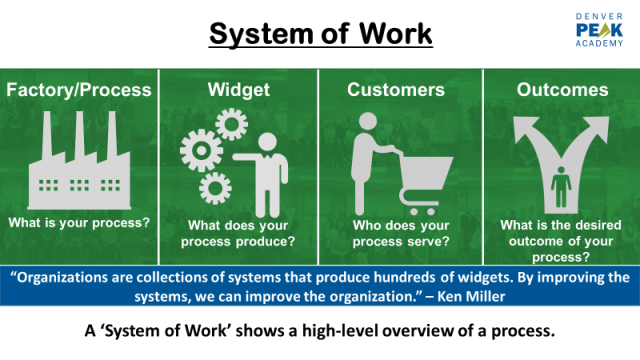
Ken Miller’s book, “We Don’t Make Widgets: Overcoming the Myths That Keep Government from Radically Improving,” presents the author’s experiences of working in government and his insights on the three myths that hinder the improvement of government services. The first myth is that government services are intangible and cannot be measured or managed, unlike widgets in the manufacturing industry. The second myth is that the people receiving government services cannot be considered customers, as they are hostages who cannot make choices about the provider and have competing interests. The third myth is that governments are not here to make a profit, which Miller defines as the private sector’s way of measuring return on investment.

Thank you to Adam Thompson from Zen Organisations for heading me in the direction of Ken Miller and his book ‘We Don’t Make Widgets’, subtitled, Overcoming the Myths That Keep Government from Radically Improving. It is an interesting read from the viewpoint of someone who has worked in government and spent their life trying to improve it.

Ken Miller was an original myth buster.

Continue reading

242 – A Grand Strategy.

850 words (10 minutes reading time) by Colin Weatherby and ChatGPT

A passage from The Book of Local Government:

“And lo, the Local Government was filled with aspirations for the community. But when the State government imposed a rate cap, limiting their capabilities, the leaders knew they must align their aspirations with their limitations through strategy. And Richard Rumelt, a wise strategist, spoke unto them saying “A good strategy addresses the most important and high stakes challenges through a coherent set of analyses, concepts, policies, arguments, and actions.” But many Local Governments strayed from this path, with strategies that lacked a clear central idea and failed to address important problems or opportunities. And Rumelt warned them “If thou fail to identify and analyze the obstacles, thou doth not have a strategy, but instead a stretch goal, a budget or a list of things thou wish would happen.” And the leaders heeded his words, and developed a good strategy to overcome their challenges.”

Source: ChatGPT

I have been inspired for the title of this post by John Lewis Gaddis, who says strategy is necessary for ‘the alignment of potentially unlimited aspirations with necessarily limited capabilities’.  It is strategy that aligns our most important aspirations with our capabilities so that we can achieve them. It is especially important when capabilities are being limited.

Local government is full of aspirations. We deliberately ask the community what they want to create a list of things to do. We don’t wait for them to tell us. Our workers are expert at identifying new needs. We like to say that we really understand community needs and expectations. I suppose, this is where the problem starts when a State government disagrees and decides that people are being charged too much for councils to meet their needs and they introduce a rate cap.

Worse still, is when the State thinks some of those needs should not be met by the council at all or they are being met in ways that are inefficient or frivolous.

“The days of ratepayers footing the bill for Arnold Swarzeneggar impersonators are over.”

Labor leader, Daniel Andrews, 2014

I have recently re-read Richard Rumelt’s book ‘Good Strategy/Bad Strategy’. It is over 10 years old now and remains a classic on strategy. I also read his new book, ‘The Crux’. He has recently described his ideas about strategy as ‘challenge-based strategy’, which is useful when thinking about them in the context of local government. We have challenges.

Continue reading

232 – Coronavirus and local government – Financial Impact

1400 words  (reading time 11 minutes)                                                          by Lancing Farrell

Coronavirus financial impact

The focus of local governments has been on employee protection, service continuity, managing disruptions to cash flow and supply chains, and trying to understand the new risks emerging with Coronavirus. It is a whole new operating environment. This post explores some of the financial and operational impacts of the Coronavirus.

Physical distancing has reduced the capacity of facilities by half or more, making appointments and providing concierges has increased staffing requirements at facilities, and there is demand to retain new services like ‘click and collect’ and tele-services introduced in response to the Coronavirus, at the same time as regular services resume.

This is all happening as revenue is impacted by loss of fees and charges, additional expenses in relief packages offered to businesses, and citizens seeking deferral of rates because of financial hardship. Some councils are planning not to index their rates, which is a revenue reduction next financial year and every year thereafter.

At the same time, councils in Victoria are expected to maintain the employment of all staff without financial support from the Federal or State government. Councils adding to unemployment will not help and they need to work out how to live within their means.

What have councils been doing and what do they need to consider doing? Continue reading

226 – Frog or bicycle? The Vanguard Method at work.

2250 words (8 minutes reading time)                                                   Colin Weatherby

frog on bike

Some time ago Tim Whistler wrote a brief post on the Vanguard Method in Australia. Since then I have been talking to a colleague who has been using the Vanguard Method. Their experience has highlighted aspects of the Vanguard Method that are different to other system thinking approaches. The originator of the Vanguard Method, John Seddon, has also written a new book (‘Beyond Command and Control’) that discusses some of the differences between the Vanguard Method and other popular approaches to organisational change. This is rather a long post but worth the effort to read it if you are interested in systems thinking and the Vanguard Method.

Continue reading

207 – Mills, mines, refineries and networks – what do they have to do with local government asset management?

Posted by Lancing Farrell                                                                          1000 words

disruption

I was talking to a colleague who recently attended a well organised and highly informative national conference on asset management. It was a pity that only three people of the three hundred attending came from local government. The rest were from sugar refineries, steel mills, manufacturing, energy supply, defence, food production, mining, ports, railways, airlines, telephony and numerous other organisations from across Australia. Apparently there was a lot to be learned. So why was local government absent?

Part of the explanation lies in the competing asset management conference run annually by the sector in Victoria. They are well attended by staff from many councils as part of their professional development and to support a sector initiative. I suppose councils don’t see any value in sending staff to a conference that doesn’t focus specifically on local government assets or the way councils have chosen to manage their assets.

A conference theme was disruption. Often it is outsiders who create disruption because they see things differently.  Sometimes it happens when insiders are frustrated by the status quo and they venture outside the organisation’s comfort zone.  Unfortunately, many organisations and industries are incapable of disrupting themselves.  Attending conferences run by your industry is much more comfortable.

It was interesting to hear from my colleague about how other industries view their assets and what they expect from them in the way they are managed. One key difference is that private sector has productive assets that are owned and managed to create shareholder value (i.e. make profits). The value created by those assets is captured by the organisation that owns them. It is different for most public sector assets. Continue reading

205 – ‘We don’t need to be clever – just less stupid’, The Age 23 February 2016.

Posted by Colin Weatherby                                                                         700 words

Dont need to be clever just less stupid image

Image

I read this article and though it was fortunate that the writer, author and polymath Satyajit Das, hadn’t been dealing with his council. No doubt a greater attempt would have been made to feign ‘one stop’ service but if it was anything but a simple matter, he would have come across the same dysfunction. His acuity is evident in his analysis.

Das’s dealings with his bank highlighted how the quest for efficiency and lower costs has achieved the opposite result. This is a recurring theme in the writings of John Seddon about the public sector. Das lists six sources of ‘unproductive and inefficient’ failures that he believes are now common in many organisations.

  1. Tasks have been fragmented across different locations and the simplest activity is now complicated.
  2. There is no continuity. ‘One person is not accountable for the complete activity. Workers lack any idea of how what they are doing, or not doing, affects the whole process overall’.
  3. Staff lack the skills and knowledge required.
  4. Performance measurement has lowered, rather than improved, performance. Staff actions detract from results instead of helping achieve them.
  5. Leadership is lacking in ‘domain knowledge’ (i.e. valid knowledge in a particular area).
  6. There is a tendency to see history as old and irrelevant. The latest technological wizardry is the best solution to any problem. Valuable lessons from the past are routinely ignored.

There have been a number of posts on these very topics. Continue reading

196 – Making local government organisations simpler to manage – why is it necessary?

Posted by Colin Weatherby                                                                         1700 word

complexity knotted rope

I was at a meeting recently where the team charged with conducting an organisational self assessment (OSA) and preparing an organisational improvement plan (OIP) using the Australian Business Excellence Framework were evaluating progress. It was an interesting meeting of a diverse group of people. By the end of the meeting we had reached a common conclusion – a council organisation is complex and systems need to be disentangled and simplified so that it can be managed effectively.

The OIP actions were developed independently from the outcomes of the OSA. It was only after 12 months of effort to implement the actions that the high level of congruence between them became apparent. Very few actions relating to core organisational systems could be implemented without impacting on each other – they overlapped. Attempting to deal with them one by one wasn’t going to work but joining them all together would create a large and very complicated action.

There is an earlier post on complexity which describes some of the sources of complexity in local government. It helps to know what you are dealing with but that doesn’t make it any easier. This was reinforced by reading former Victorian Premier John Brumby’s excellent memoir ‘The Long Haul – Lessons from Public Life’. In reflecting on the last four years in which he has viewed politics as an outsider, Brumby comments on the lack of trust that ‘permeates almost everything we see and hear about politics today’.

He believes that part of restoring trust and credibility in politics is to give the public a better understanding of the complexity of the issues.

“When I first sat in the federal parliament, an older and wiser member told me: ‘For every complex problem there is a simple solution … and it’s always wrong’. We live in a world where the questions are becoming more complex, while the public appetite is for ever simpler answers: the kind that can be summed up in 140 characters or less”

My question is, do you think that people want to be bothered by the complexity involved in getting what they want through political processes? Continue reading

194 – Essay No. 4 – Local government and customer service.

Posted by Lancing Farrell                                                                              4500 words

basil fawlty

Customer service is, and should be, a major concern for local government. After all, councils are service organisations. Sometimes there is confusion about exactly what customer service means, how it relates to public service delivery, and what aspects of service are most important to get right in local government.

This essay focuses on three hypotheses:

  1. That ‘customers’ in local government are different to the customers described in most customer service literature and encountered by most service organisations.
  2. There are six main opportunities for local government to improve service to customers.
  3. There are simple tools available that can assist councils in getting service delivery and customer service right.

Continue reading