189 – Essay No. 2 – Local government, effectiveness and efficiency.

Posted by Lancing Farrell                                                                              3300 words

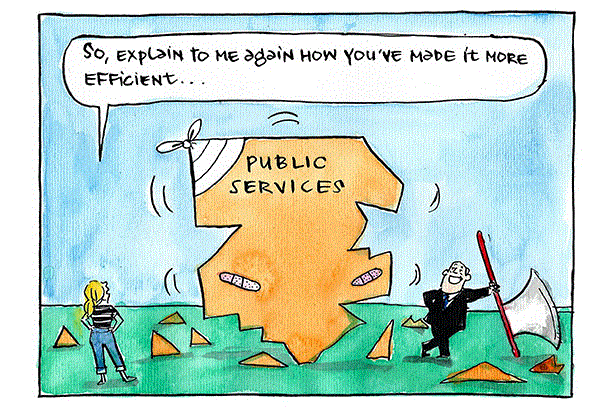
false economy cartoon

Image

People in local government regularly discuss effectiveness and efficiency. Often this happens in relation to pressure on revenues, such as rate capping. Most of the discussion centres on efficiency rather than effectiveness, and opportunities to stop delivering those services that are seen as ‘cost shifting’ from other government. The efficiency discussion is often not well informed. Frequently it focuses on inputs while ignoring outcomes and public value. Any savings are usually equated with cost cutting, not creating the same value at lower cost.

Australian researcher and writer Christopher Stone has published several papers on ‘false economies’. Each addresses a different aspect of productivity and efficiency in the public sector.

“Everyone has the right to know that money is not being wasted; that it is being spent as efficiently as is possible.” Christopher Stone, Decoding Efficiency, April 2013.

So, what is efficiency and how does it differ from effectiveness? Continue reading

181 – Applying the public value concept in local government using systems thinking

Posted by Colin Weatherby                                                                                         1100 words

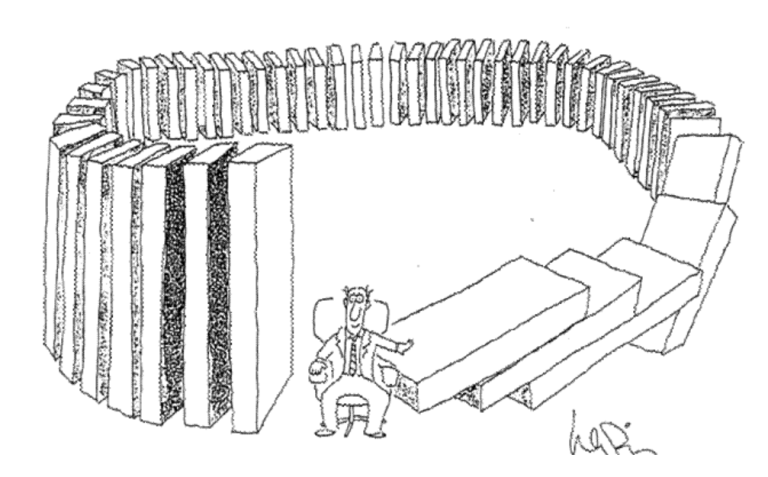
dominoes

Image

Systems thinking is potentially a great lever for improvements in the design and delivery of local government services. However, it will require a major shift in thinking about how work is designed and managed because the systems thinker is focussed on the purpose of a service from the customer’s point of view.   This is a change from the needs of the organisation and the people working in it driving the design of work and delivery of services. Here are some thoughts building on the earlier post by Parkinson.

Local government needs to work harder to put the needs of customers first despite the realities of multiple and conflicting accountabilities, limited potential for increased income from rates, difficulty defining who the customer is, and increasing expectations of service levels, reliability and speed.

The principal focus of systems thinking is designing and managing the organisation with the customer mind. Continue reading

179 – Some thoughts on local government and public value.

Posted by Parkinson                                                                       1400 words

common good

A number of posts written have been written about public value by others (see Why do we provide the services that we do in local government?, Customer, client, citizen, resident or ratepayer. Who are we dealing with?, Applying the public value scorecard in local government services. Part 1. , Applying the public value scorecard in local government services. Part 2., Public value gap analysis. A tool., Public value gap analysis. Some actions., Making high performance happen through value-led management., and Value-led management in local government. Some further thoughts). This post is an attempt to provide a context for further thinking about public value in local government.

Common good and public value

The political philosopher Michael Sandel has identified that rising social inequality is leading to a separation in ways of life between the rich and the poor. He believes that when this happens there is no longer a common way of life because “they don’t use the same public institutions, don’t inhabit the same civic spaces, and don’t avail themselves of the same public services”. As a result, Sandel believes that we can cease to think that we are ‘in it together’ enough to even deliberate together as members of a political community to determine common good.

The gap between the rich and poor is growing in Australia. According to the Oxfam report ‘Still the Lucky Country?’, the wealthiest Australian are disproportionately influential and the poor are at risk of being marginalised and unheard. Extreme wealth provides the power to influence government policies that favour those with wealth, regardless of what would work best for the whole of society.

The common good is the ‘large’ form of public value. Continue reading

178 – The Prime Minister’s mini summit – is there a lesson for local government leaders?

Posted by Colin Weatherby                                                                                                         500 words

malcolm turnbull

Image

Some time ago, I posted on what I would do if I was the CEO. This post is in a similar vein.

The new Australian Prime Minister Malcolm Turnbull called a mini summit last week and invited leaders from the worlds of business, unions, community organisations and think tanks to discuss the state of the economy and the best way forward for economic reforms.

Reporting about the planned summit reflected the openness of the new national leader to discussing ideas other than his own. It was a move that his predecessor failed to make. The Sydney Morning Herald described the summit as suggesting that the new Prime Minister is keen to discuss big ideas and ‘send a message of creative optimism’ to the leaders invited. The Prime Minister is quoted as saying that the summit is a ‘rare opportunity to achieve consensus on the most pressing economic and social issues’ facing the country.

I am not sure whether the summit reached consensus or whether it will really influence government thinking and action. It has certainly signalled a new approach by Malcolm Turnbull.

It occurred to me that local government leaders could take a similar approach. Continue reading

160 – Making a local government service catalogue. Part 2: What to do with it?

Posted by Colin Weatherby                                                                                      630 words

service category

In the first post I described a service catalogue and looked at where (and how) to start making one. This post discusses what to do next to refine the service catalogue and use it to improve organisational performance. I have no doubt that a service catalogue is essential to starting a discussion with the community about services required in a rate capped operating environment, however it should also drive continuous improvement by providing a focus for service reviews.

The ‘first cut’ service catalogue that defines services from the customer viewpoint and links that view to organisational structure, is really just the start.

Further analysis is required to determine the link between the service catalogue and organisational strategic plans (especially the council plan). This can be achieved by coding the spreadsheet of cost centres with the themes or key objectives or themes in the plans. This will allow further analysis by pivoting on different criteria. What is the link between council plan objectives, customer defined services and cost centres? Continue reading

158 – Customer perception. Why is it important in local government services?

Posted by Lancing Farrell                                                                              670 words

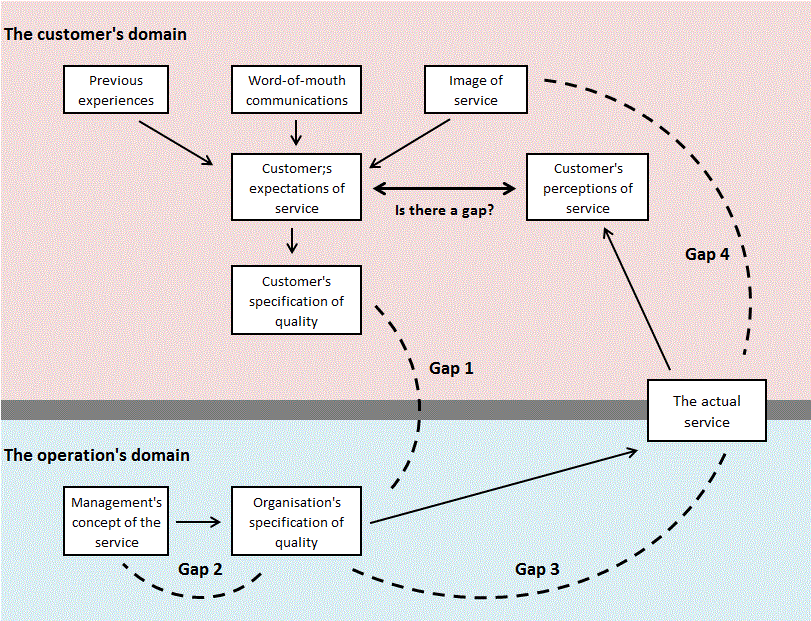
customer service gaps

Image adapted from Slack, Chambers, Harland, Harrison, and Johnston 1998, Operations Management, 2nd Edition.

There have been a number of posts on aspects of customer service – who are our customers, customer-introduced variability, how do you listen to the ‘voice of the customer, internal customers , what Gordon Ramsay might think about council customer service, and captive customers. If there has been a thread through these posts, it has been the need to look at services from the customers’ viewpoint and to understand constitutes value for them.

The posts on value have discussed how to understand both private and public value – why do we provide the services that we do, the private-public value continuum, applying the public value scorecar , public value gap analysis, local government and commodity services, value-led management, and a series on a new theory of value creation in local government. The idea that people seek private value and councils set out to create public value is at the heart of a lot of customer service problems.

One aspect of customer service that hasn’t been discussed is the role of perception. Continue reading

126 – ‘A new theory of value creation for local government’. Do we need one? Part 1 – Strategy.

Posted by Lancing Farrell                                                                              850 words
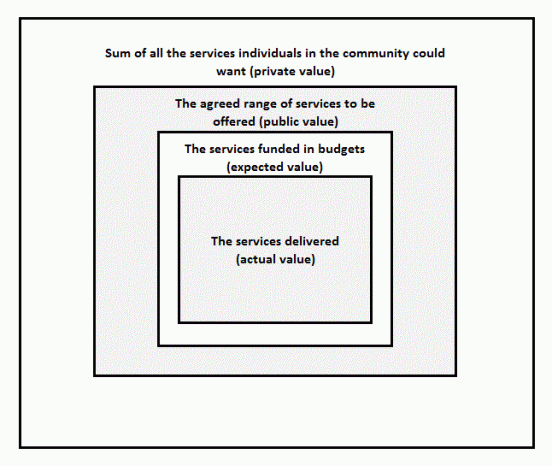
value diagram shaded

This is the first post in a series  exploring the relationship between business strategy, the business model and operations strategy. It is an attempt to pick up on the ideas in Colin Weatherby’s previous post discussing Henry Mintzberg’s ideas about different models for government organisations. Hopefully the series of posts will make my case for a local government theory of value creation.

I will begin with business strategy. To set the scene, I have chosen the following quotations from management consultant and academic David Maister  to highlight the strategy problem for local government.

“A strategy is not just choosing a target market, but is about actually designing an operation that will consistently deliver the superior client benefits you claim to provide.

However, each decision you make to be more effective at delivering the preferences of those you target will (inevitable, inescapably, unavoidably) make you less attractive to clients or market segments that look for different benefits.

You could try to design your operations to meet a wide variety of preferences and needs, serving each client or customer group differently, according to their individual wishes.

Your market appeal will then come down to ‘tell us what you want us to do for you and we’ll do that. We’ll do something different for other people tomorrow!’

The very essence of having a strategy is being selective about choosing the criteria on which a firm wishes to compete, and then being creative and disciplined in designing an operation that is finely tuned to deliver those particular virtues.

An operation designed to provide the highest quality is unlikely to be the one that achieves the lowest cost, and one that can respond to a wide variety of customized requests will be unlikely to provide fast response and turnaround. Any business that tried to deliver all four virtues of quality, cost, variety and speed would be doomed to failure.”

Maister may not have had local government in mind when he wrote this piece, but he provides an insight into the challenges in determining what provides value to people receiving services. He calls it ‘superior client benefits’. In the public service context, academic Mark H. Moore has called it public value. It is the same idea Continue reading

121 – Squire to the giants. Who are the giants in common?

Posted by Colin Weatherby                                                                                                 830 words

squire

I recently found a new and interesting blog called ‘Squire to the Giants’. Much like thinkpurpose.com this blog site is aimed at people who have an interest in improving their organisation through systems thinking. A recent post talks about the ‘giants’ that have influenced the Squire’s thinking. I am familiar with some of the ‘giants’ and have others of my own.

The Squire lists the following giants:

Regular readers of this blog will be familiar with the work of Peter Scholtes  and John Seddon. Both have influenced the thinking of writers. The biographical pieces written by the Squire  are worth a look.

I have decided to produce a blog on one of my giants.


mark h moore picProfessor Mark H. Moore

First some background. Mark H. Moore is the Hauser Professor of Nonprofit Organisations and director of the Hauser Centre for Nonprofit Organisations, at the John F. Kennedy School of Government at Harvard University.

His research interests include public management and leadership, civil society and community mobilization, and criminal justice policy and management. Continue reading

118 – Improving service operations. Why it doesn’t happen in local government.

Posted by Whistler                                                                                          500 words

 walking the plank

I have read Lancing Farrell and Colin Weatherby’s posts on characteristics of demands, redesigning operations and improving service operations through action plans and service redesign, with some interest. It is all good stuff and not too difficult to understand or do. The question I ask myself is why I don’t see it happening everywhere across the sector. The ‘special and different’ posts partially explain it but I think there is more to it.

To begin with, the motivation to make improvements doesn’t really exist. People say they want to improve the quality of services to their community, and in response to threats like rate capping they say they want to be more efficient. But they don’t really want to do either.

Most councils have the potential to improve productivity by 10-15% (more in some councils). Continue reading

103 – Classic paper – ‘Managing Government, Governing Management’. Henry Mintzberg.

Posted by Colin Weatherby                                                                         1850 words

In 1996 Henry Mintzberg published a paper in the Harvard Business Review entitled ‘Managing Government, Governing Management’. In the paper Mintzberg covers four broad topics relevant to local government:

  1. Private, public, cooperative and non-owned organisations.
  2. The roles of people in society as customer, client, citizen and subject.
  3. The management myths that activities can be isolated, performance can be fully evaluated using objective measures, and activities can be entrusted to autonomous managers responsible for performance.
  4. The machine model, network model, performance-control model, virtual model and normative-control model available to organise government.

What relevance does it have for local government today?