239 – Zombie councils

500 words (5 minutes reading time) by Tim Whistler

I have read Lancing and Colin’s posts with some interest. As a long-term, self-appointed local government pundit, I don’t think the rate cap can be an existential threat to local government, but it is going to turn councils into zombies. Like zombie companies, councils will become dependent on others for their survival. They will be alive but unable to think or act for themselves. Despite what people would like to think, ultimately, they will be simply the local branch of the state government delivering the services the state decides they must. This is at odds with what many councils currently think they are doing.

“Councils have autonomy to provide services that meet the needs of their local community, and will establish a range of discretionary processes, including local laws, to guide certain activities that can occur within their municipality.”

Municipal Association of Victoria, ‘Vic Councils’ website
Continue reading

238 – Il comune povero- ‘The poor municipality’

1600 words (15 minutes reading time) by Colin Weatherby                                                                                                                

Great post by Lancing Farrell. I like the link to the creative and enduring solutions people have devised in response to food scarcity. Human ingenuity can be a marvellous thing.

The impact of declining financial sustainability on asset management is disturbing. As anyone directly responsible for council assets knows, for many years the biggest challenge for local government in Victoria has been the cost of caring for assets. The Institute of Public Works Engineers (IPWEA) has been advocating for better asset management for years. I would argue that the principal council service is to own and care for assets on behalf of the ‘community. The rate cap has rapidly made this much more difficult, and as Lancing showed, the challenge is not spread evenly across councils.

What can councils do in response to funding scarcity? Will our commitment and creativity help us find new ways to provide the services the community needs and expects? Our own il comune povero.

Continue reading

237 Di necessità virtù – ‘Need gives rise to virtue.’

1500 words (14 minutes reading time) By Lancing Farrell                                                                                     

I was reading an article about la cucina povera, the cuisine created in Italy over centuries based on the food prepared by poor and sometimes starving people. Throughout history, people have experienced food insecurity and famine and they have adapted, but none have done it as well as the Italians.  In Italy, love, ingenuity and scarcity combined to give birth to a new and delicious cuisine that has become mainstream.

I wondered, can a similar thing happen to local government as it is starved of funds and impoverished by the Victorian government’s rate cap?

Continue reading

236 – Organisation design in local government

1000 words (9 minutes reading time)                                      by Colin Weatherby

I am intrigued by the thinking behind council organisational restructures. It seems that every new CEO feels the need to redesign the organisation to make it work better. Are they successful? The question on my mind is, how can a restructure make the organisation perform better?

I recently came across a useful publication on the topic that has been provided by the Victorian Public Sector Commission. It is entitled ‘Organisational Design’  and is part of the Leading Public Organisations’ series. The intention is to provide ‘prompts, thought starters, practical ideas, and reminders for leaders and managers working in Victorian public sector organisations’.

There were certainly some useful reminders. In the first section on ‘the basic concepts’, the reminder is that organisational design is a consequence of the organisation’s goals, the work it needs to undertake, how that work is divided up (and how the bits are then connected, especially information flows), and how the work will be authorised and governed. The design is communicated through formal documents (e.g. the organisation chart, position descriptions, instruments of delegation) and informally through workplace practices (i.e. ‘the way things are done around here’). The design is also dynamic and changes in response to formal decisions (e.g. work allocation) and evolutions in practice (i.e. the workarounds that develop over time).

Continue reading

234 – My experience of management thinking in local government – Part 2: The wasted years.

1200 words (10 minutes reading time)                                                      by Lancing Farrell

management experience pt 2

This second post continues my management journey back into local government. This time into the wasted years – time spent trying different management ideas without success.

Some 10 years later I re-entered local government in a management role. Now we had new management ideas, some even described to me as ‘fads’. In the time I had been out of the sector, the idea of management had gained more currency. I came across Evidenced-Based Decision Making, although as some colleagues pointed out, in practice it was more commonly ‘decision-based evidence making’.

Evidence-based management is an emerging movement to explicitly use the current, best evidence in management and decision-making. It is part of the larger movement towards evidence-based practices.

I found a very interesting sounding book at this time called The Knowing Doing Gap by Jeffrey Pfeffer and Robert Sutton. The title seemed to say it all – why don’t organisations put their knowledge into action? I would like to say this book changed my life, but unfortunately it didn’t. Before I could read it thoroughly, I lent it to a colleague who never returned it. That closed a knowing doing gap for me – don’t lend other people your new books! I did learn that knowing what needs to change, doesn’t mean it will change.

I found that Employee Surveys had now become common place. Councils were now being managed by CEOs who ‘took the temperature’ of organisational culture and then developed plans to improve it. I was never too clear on the connection between culture scores and value for customers or the community.

Employee surveys are tools used by organizational leadership to gain feedback on and measure employee engagement, employee morale, and performance.

These surveys tended to show very little change from one survey to the next, even over a decade. It suggested to me that it wasn’t helping (or relevant) but we still did it. Once I looked at a book produced by one of the big culture survey firms and I noticed that our organisational culture resembled the culture of every industry they surveyed in Australia (except industries with lots of international firms). The differences between industries were at the margins. It seems Australian culture dominates in all Australian workplaces.

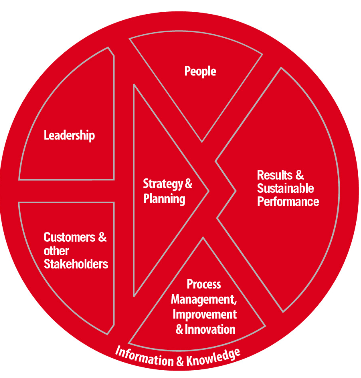
After a while, I started working at a council that was implementing the Australian Business Excellence Framework (ABEF). As someone who by now was quite interested in what local government thought was good, or even better, excellent management, this seemed like a useful idea. There were lots of other councils using it (some were Gold medallists) and it was an idea developed in the private sector, which had appeal to me after returning from working in my own business. So, I joined the strategy and planning group. The CEO had decided ABEF implementation would start with that category.
abef

The EBEF framework and categories.

I found this interesting because I would have started with Leadership, simply because of its potential to effect change and improvement. Since then I have learned that you can start with any of the seven categories. My question today would be why not start with the customer?  In this time I was able to travel and meet with officers at award winning Australian councils and spent hours studying organisational strategy.

Examining how council strategy and planning works only highlighted for me the dysfunction in council strategy development, with various types of plans in a hierarchy (you guessed it, a triangle) with different plans or strategies created at different times and in different ways. None of it was connected in the way the triangle suggested, and, in a surprise to everyone, the group worked out that one of the key plans linking political and organisational actions, didn’t actually exist except in the triangle picture used by the CEO to explain how it worked.

The Australian Business Excellence Framework (ABEF) is an integrated leadership and management system that describes the elements essential to organisations sustaining high levels of performance. It can be used to assess and improve any aspect of an organisation, including leadership, strategy and planning, people, information and knowledge, safety, service delivery, product quality and bottom-line results.

I then discovered Lean and found that it was the new version of TQM or BPR. It seemed to embody similar thinking ideas. I never bought a book on Lean but I started working at a council with a Lean practitioner. He (and many others) spent a lot of time analysing services that weren’t working. Hours were spent collecting data and mapping processes. Days trying to understand what the data was saying and where change might make it better. In the end, while chnages were made, the problems remained unsolved.

My involvement with cross-organisational business processes led me to Karen Martin’s book The Outstanding Organisation, and then her next book Value Stream Mapping. It seemed simple, we just had to learn to understand services as a value stream and then articulate and deliver the value proposition!

A value stream depicts the stakeholders initiating and involved in the value stream, the stages that create specific value items, and the value proposition derived from the value stream. The value stream is depicted as an end-to-end collection of value-adding activities that create an overall result for a customer, stakeholder, or end-user.

Around this time there seemed to be a ‘wave’ of people-based change programs. Leading Teams and The Colloquium are examples. CEOs were clearly searching for ways to act on culture and improve survey results. No doubt these programs were useful, but building people skills wasn’t making the difference CEOs expected. I participated in one of these programs and learned a lot. It was extremely useful to me as a person responsible for managing other people. However, it didn’t help me or my organisation to produce better services.

As an aside to my management journey, in 1995 I had discovered Public Value (yes, I bought Mark Moore’s book Creating Public Value) and the idea appealed to me enormously. Of course, council services are intended to produce the value agreed by people in the community, after all, they are the ones who are paying. In 2013 I bought Mark Moore’s second book (Recognising Public Value) where he illustrates the creation of public value using case studies and describes a way of measuring it (the Public Value Scorecard (PVS)). There is no arguing with the logic of Moore’s strategic triangle, but I couldn’t work out how to use it. Even the PVS was a lagging measure – you would only know if you had succeeded or failed, when you had either succeeded or failed.

I will mention one last management fad that swept local government here recently – User-Centred Design (UCD – there always seems to be an acronym). The council I was working at made a commitment to ‘customer first’ and commenced the analysis and re-design of services using the UCD methodology. We developed personas, customer apps, online forms. It really should have been called ‘digital first’. The problem that emerged was lack of integration between these new and easier ways for customers to deal with us and the actual service delivery systems. It had become easier for customers to make their needs known to us, and to place a demand on one of our service systems, but we were just as slow to respond, and just as likely to fail to satisfy their need.

The upshot of all my thinking and doing was a level of dissatisfaction with the way things are and a determination to find a way to deliver better services. I felt a compulsion to do this as rate capping was reducing our revenues and making it harder to make ends meet. A better way was needed.

Another pattern had emerged – I was now interested both in services as a cross-organisational process, and how you help an organisation to change and improve services.

It was at this time that I recalled some earlier reading I had done on systems thinking and the application of systems thinking in organisations. It started with Alistair Mant and his excellent book, Intelligent Leadership, that I had purchased in the late 90s. I also bought and read David Wastell’s book Managers as Designers in the Public Sector, and through that book came across John Seddon’s book, also from the Triarchy Press stable, on Systems Thinking in the Public Sector. The idea that systems thinking could provide a solution to service improvement became clear in my mind.

I also became convinced that Command and Control thinking (a term used by John Seddon) was a barrier to service improvement. Councils are highly siloed organisations. We like functional specialisation. Each discipline focuses on their work and excelling at what they do. Hierarchy is critical for decision making and it is often the only way that the silos become linked. Senior management have the ‘umbrella’ jobs that integrate work across silos, or at least that is where it can and must happen in a Command and Control hierarchy.

I started looking for more information about systems thinking. At some stage I came across David Stroh’s book Systems Thinking for Social Change. By then I was hooked. There had to be a way of applying systems thinking to improve local government performance in delivering services that provides public value. The challenge was to find a method to do it. The ideas were interesting and well-articulated, but how do you use them to do the work differently?

By now I had begun blogging to communicate with others experiencing the same frustrations as me. It helped me to learn.


233 – My experience of management thinking in local government – Part 1: The formative years.

1000 words  (9 minutes reading time)                                      by Lancing Farrell

management experience pt 1

I was talking to a colleague recently, and I was asked about the management thinkers that have influenced me. It started me thinking back to my early days as a manager in my mid-20s and later when I completed a MBA in my mid-30s. And the lessons I had from starting and then managing my own business for a decade. Many management thinkers influenced me, and, equally, so did my opportunities to practice different ways of managing. This is quite a long essay, so I have split it into three parts.

I recall that before I was a manager, I had an interest in management. I wasn’t too sure what it was but I had read The Peter Principle as a student, and I knew that management was important in organisations if they were to be effective. For some reason I also remember that someone at the council where I started working was talking about Value Management. Now I know that they had obviously been to a course. Then I got a job as a manager. Continue reading

229 – Coronavirus and local government – time for a new O/S?

800 words (4 minutes reading time)                                                           by Colin Weatherby

A new city operating system cover Goldsmith

This is the first in a series of posts requested to discuss the Coronavirus and local government services.

I recently read ‘A New City O/S – The Power of Open, Collaborative and Distributed Governance‘ by Stephen Goldsmith and Neil Kleiman. Some time ago I read ‘A Responsive City‘ by Stephen Goldsmith and this latest book takes Goldsmith’s thinking about cities and their governance to a new level. As a former Mayor (Indianapolis), deputy Mayor (New York) and the current Daniel Paul Professor of the Practice of Government at Harvard’s Kennedy School, Stephen Goldsmith is well credentialled to discuss local government.

It is timely to read Goldsmith and Kleiman’s book as local government services adapt to the Coronavirus, react to ensure the safety of staff and the community, seek to understand emerging service demands, and start to look ahead at recovery and the best way to deliver services post-Coronavirus. Continue reading

225 – Why do we struggle to achieve capital expenditure targets?

By Lancing Farrell                                                                                                      1250 words

the planning fallacy.png

I was reaching into the archives to re-run a popular post on how councils fail to complete their targeted amount of capital works each year when a colleague pointed me in the direction of a recent podcast on Freakonomics Radio. The podcast, Here’s Why All Your Projects Are Always Late — and What to Do About It,  provides insights into the nature of the problem facing councils and provides some practical solutions.

You might want to start by reading that post from the archives.

In the podcast several key reasons for projects not being completed on time and within budget are discussed. Those most relevant to local government include the planning fallacy, optimism bias, overconfidence, and strategic misrepresentation.

Let’s start with the planning fallacy.

There are a lot of reasons why that project you planned can take way longer than you anticipated, and cost way more. Outright fraud, for instance — the lying, cheating, and stealing familiar to just about anyone who’s ever had, say, a home renovation … There’s also downright incompetence; that’s hard to plan for. But today we’re talking about the planning fallacy, which was formally described a few decades ago by the psychologists Daniel Kahneman and Amos Tversky.

This quote sets the scene nicely. Lots of things can contribute to a project not being completed on time but our inability to accurately estimate the time required to complete a project sets it up for failure. Continue reading

224 – Risk taking in local government

By Colin Weatherby                                                                                               900 words

opportunity.png

Image

Lancing Farrell raised several important issues in providing advice to a colleague regarding risk management. How does a council balance the pressure not to take risks and fail, with the competing pressure (often from the same sources) to take risks and meet demands to create new value?  

Risk is an interesting concept and there are various definitions. I like to think of it simply as the uncertainties related to achieving your goals. It is about the hazards along the pathway as you make your way towards your destination.

Businesses that don’t take risks will fail. They become uncompetitive or customer satisfaction drops. Either way, they lose business to competitors taking risks to create value that customers want and will pay for. We can all think of the companies that have taken big risks in redefining a service or product to create a new market.

You are probably wondering what this might have to do with local government. Aren’t we just doing what we have always done?

Many councils are. Whether they should be, or whether they will be able to continue to do so, should be questioned. We now live in the ‘age of the customer’ – residents want personalisation, mobility, self-service, rapid response, and efficiency (efficiency for them, not the council). The variability introduced by customers must be quickly and effectively absorbed by the organisation. Complexity, by its very nature, creates risks.

In conjunction with mandated limits on prices (the rate cap) and growing numbers of customers (as Lancing points out, Melbourne is growing rapidly), the rising expectations of residents means that councils must do things differently. Different usually involves risk taking.

I recently attended a training session on developing an organisational risk appetite. It showed me how councils could identify hazards and manage risks differently, yet still satisfy the pressure to stop things going wrong while meeting the demand to create new value. It needs a re-think and a more sophisticated approach to risk and compliance. Continue reading

221 -The Vanguard method in Australia.

By Tim Whistler                                                                                                         1000 words

Progressive leaders

The summit offered an opportunity for those who are unfamiliar with the Vanguard method to hear about work that has been done in Australia by IOOF (a superannuation fund manager) and the County Courts Registry using the Vanguard method. Vanguard team members presented public service case studies from the UK.

It was an interesting event and it highlighted the potential for leaders to think differently and better understand how work is being performed in their organisation, what is happening in delivering value to customers, and how improvements can be made.

There were several issues relevant to local government in Victoria. Continue reading