63 – ‘The more experienced the managers, the more they trust simple intuition’. Or do they?

Posted by Colin Weatherby                                                                         700 words

intuition

Some time ago I posted on an idea from Richard Farson’s book, Management of the Absurd – Paradoxes in Leadership. This post has been inspired by another chapter in that book.

Farson says that the one quality that top executives say separates them from their less successful colleagues is their intuition. Their ‘immediate visceral reactions’ to people and events are usually accurate, which makes their judgements valuable. Farson defines intuition as the ‘accumulation of many learning experiences that have sensitised them, making them able to read situations quickly’. It is a quality that allows top management to make fast decisions that are effective. However, when top management starts to lack confidence, they start to apply formal processes to make decisions. They replace their immediate visceral reaction with complicated analytical thinking. Continue reading

62 – “The way to make it in local government is to forget ambition and pigeon hole yourself before someone else does”.

Posted by S. Dogood                                                               1000 words

pigeon hole

This was the advice I received during a discussion with a colleague this week.  Pigeon hole yourself he advised and local government becomes a good place to work.  In some ways he is right.  The discussion started me thinking about why that is the case and how it could be different.

The ambitious face a number of challenges.  First and foremost they can’t be threatening to the Executive.  Secondly, they need to be realistic about their skills and value.  Lastly, regardless of their own role breadth or experience, they run the recruitment gamut as there is always a hierarchy of preferred candidates for any role.  Hiring traditionally take the following hierarchy seeking to recruit someone who Continue reading

61 – Public value gap analysis. Some actions.

Posted by Colin Weatherby                                                                         280 words

gaps

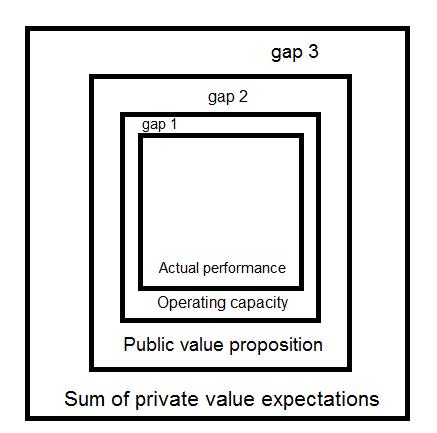
I posted on a tool that can help to identify gaps in public value creation. This post briefly suggests some actions for each gap.

The first gap between actual performance and operating capacity, or potential performance, is best addressed though organisational processes to improve productivity. Recognising the gap is important and then it is in the hands of the organisation to justify its performance or improve it. Utilising all available operating capacity efficiently is the responsibility of organisational management.

Gap 2 requires something new to happen. It isn’t simply a matter of being more efficient and productive. Continue reading

60 – Public value gap analysis. A tool.

Posted by Colin Weatherby                                                                         790 words

private public operation actual

One of the challenges in local government is understanding public value – what it is for your community and how you can create it. It can  be difficult to separate it from private value expectations and to see the relationship with the operating capacity of the organisation. This post explores a conceptual tool to understand public value and gaps that need to be addressed in achieving it.

Many years ago when asked to be the officer leading a community advisory committee I developed a model to help the group understand what we were talking about and to focus on gaps where we could be most effective in making a difference. It worked very well. At the time I didn’t really understand why. Now I think it was because is identified the public value gap that the group could work on. Here it is. Continue reading

58 – Performance appraisal in local government 4/4. What else could we do?

Posted by Lancing Farrell                                                                              650 words

optimus prime transformer

This is the last post in this series. It is also where things start to get interesting. There are alternatives to performance appraisal the way we have always done it. The difficulty is that most are quite different to the current approach and pursuing them will involve the risks that always accompany change. Are we up for it?

We could just stop using performance appraisals. As Peter R. Scholtes writes in The Leaders Handbook, this would require us to start thinking differently. In essence, this would involve adopting a ‘systems thinking’ approach to managing the organisation. This is likely to require systems to support employee development and promotion, providing feedback for improvement, determining training needs, and performance managing the poor performers.

Scholtes proposes what he calls ‘debundling’ of performance appraisal to focus on each benefit that the performance appraisal system supposedly provides. Continue reading

54 – The four decision hats. What are your councillors wearing?

Posted by Whistler                                                                          630 words

I was in a workshop about Edward De Bono’s six thinking hats recently when it occurred to me that we could do with some decision hats in local government. Councillors could wear a different hat for each of their roles. This way they would be clear about what capacity they are acting in, and any onlookers would know as well.   Alternatively, a different hat could be worn to signal the type of decision being made. Here is how it could go.

Let’s start with hats representing the role or capacity that the councillor is acting in. Obviously, gender will influence hat selection for some councillors. I will do my best to select hats with universal appeal.

george washigtonWhen acting as politician, part of the local government to make decisions affecting constituents, a range of hats are potentially available. Continue reading

53 – Coffee, basketball and privatisation. What significance could they have for Australian local government?

Posted by Colin Weatherby                                                                                    1000 words

the barista economy

Image from The Age, 11 March 2015

On the 11 March 2015 there were three articles in the Melbourne Age newspaper on different topics that each held a message of potential relevance for local government.

The first was ‘Welcome to the barista economy. The article is based on a speech by Christopher Kent from the Reserve Bank of Australia (RBA) who looked at changes in household expenditure patterns over the past 30 years.

One thing is clear: we are spending a lot more on ‘services’ than we are on ‘stuff’. The share of household spending on services is up from 53 per cent to 65 per cent of household consumption.

The RBA explains the increased spending on services as a result of cheaper goods because of better productivity and more goods coming from ‘emerging economies’. The world has become better at producing goods and people now have more money to buy services, which in effect is buying time. We can afford to employ someone to perform tasks when our time is better spent on other activities, we don’t have the skills, or it improves our quality of life (e.g. leisure).

The barista connection highlights the growth in service industry jobs. Coffee shops are everywhere. Having a coffee has become part of every outing.

I think that the significance for local government is twofold. Continue reading

52 – Local government performance appraisal 1/4. What are the issues? (or 5 reasons it doesn’t work)

Posted by Lancing Farrell                                                                             700 words

performance - rowing

This is the first in a series of four posts on performance appraisal. The central idea is that current performance appraisal systems are not effective.

To begin with, the annual performance appraisal process (sometimes called the performance development plan (PDP) or staff development scheme (SDS)) is often not carried out in local government. When it is, people have usually been compelled to do so or they are simply ‘ticking the boxes’ and being compliant. I have often thought that this is important evidence that the process is not helpful. People ‘vote with their feet’ – if they thought that performance appraisal was useful and that it added value, they would be doing it.

Continue reading

50 – The last 23 posts (26 to 49). What have you missed?

Myer music bowl - banner crop

The crowd is building – almost 1000 views.  This post, along with Post 26, provides an overview of topics discussed by writers so far. It is an index and a chance to quickly catch up with what you have missed.

Post 26 provides a brief overview of the first 25 posts. Key themes were local government services, complexity, defining customers, productivity, some emerging characteristics of people and councils, changes in Victorian local government since the 1990’s, integrated planning (several posts), policies and strategies, some books you should read, rate capping, the role of the Council Plan, the role of councillors, what a high performing local government organisation might look like, how to make high performance happen, and local government budgeting. Phew.

Post 27 discusses ‘risk farming’ – the practice of top management spreading risk around the organisation in the name of good governance to avoid personal accountability. Tell me you have never seen it happen. Continue reading

46 – Labor’s rate cap to hurt services and infrastructure, ratings agency warns’. The Age, 27 February 2015.

Posted by Colin Weatherby                                                         900 words

 slices of cake
Image from http://www.that-is-good-crap.com

This article follows an earlier piece in The Age,  ‘Plan to cap council rates at inflation could lead to service cuts and job losses in Victoria’ on 23 February 2015. Both articles are about the planned legislation in Victoria to restrict councils to rate increases at or below the Consumer Price Index from 2016 unless they seek an exemption from the Essential Service Commission. Some councils have already started to cut jobs to reduce expenditure ahead of rate capping. Others are forecasting cuts to their services and reduced maintenance or renewal of community infrastructure.

This is occurring at the same time that the State government is shifting more costs onto councils and national grants to councils are being frozen. I have previously posted on rate capping (see here , here and here). As you can imagine, rate capping is dominating talk within local government circles. Continue reading