102 – Reflections on the first 100 posts.

my wordle

After discussion with writers, this post is an assessment of what has happened so far. It is about half way through the 52 week life of the blog. Here goes.

At the start of 2015 blog club members weren’t sure about the amount of material we would have to blog. As it turns out, there has been ample. Enough for a post each working day and 70,000 words so far. This is thanks to the writers and their colleagues who have contributed ideas and feedback (sometimes unwittingly). Thank you to everyone who has contributed in some way.

The readership has been unexpected. Given it is a niche topic and focussed on Australian local government, the fact that most readers are from overseas has been a revelation. I am not sure whether it is the topics attracting attention or whether there is genuine interest in Australian local government. Most overseas readers have come from the US or UK where there are some similarities in the way local government works. The lack of comments posted by readers (there have been lots of ‘likes’ and small band of ‘followers’) was a surprise. Maybe this is common for new blog sites.

The topics that have emerged have also been a surprise. Continue reading

101 – Index post – posts 76 to 100.

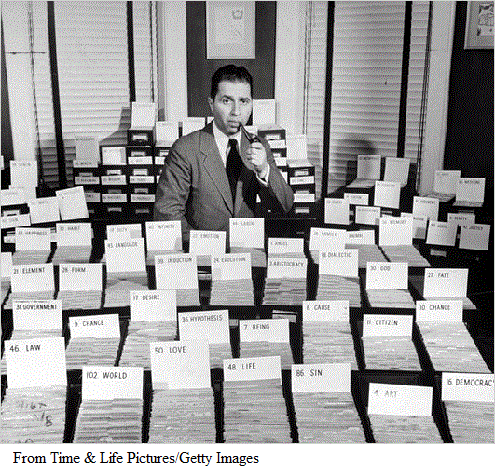
syntopicon

It is a century in posts and about the half way mark in our 52 weeks in the life of local government downunder. Again the index post follows themes in alphabetical order.  An upgrade of the current index page to a more comprehensive syntopicon, or collection of topics, is planned.  Stay tuned.

Budgeting post 76 discusses capital expenditure targets and creative ways to achieve them, or at least appear to have achieved them. Have a go at the test and see whether you are equipped to manage your council’s capital program.

Classic paperpost 88 is the first in a new series looking at classic papers and examines Peter F. Drucker’s thoughts on managing public services.

Cost shiftingpost 93 looks at State government services required to be delivered by local government, which are often identified as ‘cost shifting’, implying that the State is forcing local government to do something that it should be doing. The question is whether this is the best way to look at it when council rates are a highly efficient way to tax people to pay for the services they use.

Culturepost 86 provides ten sayings that define local government culture and attempts to interpret them. Post 100 follows an earlier post on managers as the ‘scrapers of burnt toast’, to look at how risk and workload is being shifted to managers continuously by making them sign-off on everything.

Decision makingpost 82 looks at whether a decision is strategic or not. The article ‘How to Tell which Decisions are Strategic’ by Ram Shivakumar is discussed in relation to his matrix connecting decision making to their impact on ‘degree of commitment’ and ‘scope of the firm’. Post 98 examines the role of the functional organisation structure (common to local government) in impeding collaborative decision making, and the involvement of the Executive in re-managing, in the context of benefits available from a greater focus on cross-functional processes.

EsotericaPost 91 continues a them established by Tim Whistler looking at esoteric ideas that he somehow connects to local government. How are phenomenology, cautery and augury relevant concepts to local government today?

Internal servicespost 96 asks whether the ‘productivity’ improvements made at the centre of the organisation are always a genuine improvement. Sometimes they reduce centralised delivery costs for a few people but pass on greater costs to many times more new decentralised service deliverers. In post 97 Tim Whistler parodies corporate service cost savings using the analogy of cost savings in external service being made in a similar way. Why do we have different standards?

Operational excellencepost 77 describes what is it, how you achieve it, and why it should matter to be an excellent organisation. Post 78 discusses the organisational comfort zones where leaders are most at home and aligns those comfort zones with stages in operation improvement. Does your community want you to move out of their comfort zone and towards operational excellence?

Operations managementpost 94 reviews the minor forms of civil insurrection becoming evident in local government with guerrilla gardening, depaving, and, now, comedy penis graffiti. Is it just a way for people and communities to signal their dissatisfaction with councils that are out of touch with their needs?

Performance managementPost 80 provides advice on designing a performance management system based on the ‘nine performance variables’ described by Geary Rummler and Alan Brache. What types of measurements do you need? Post 81 then takes a detailed look at a process for managing performance, including worked examples, based on the work of Geary Rummler and Alan Brache.

Professional development – In post 79 the local government reading test is explained. Designed to determine whether leaders learn by reading it has produced interesting results.

Strategy implementationPost 83 introduces a series of posts about the article ‘Why Strategy Execution Unravels – and What to Do About it’ written by Donald Sull, Rebecca Homkes and Charles Sull in which they discuss how organisations can implement strategy more effectively by addressing five myths.

Post 84 looks at the first myth is that strategy implementation relies on organisational alignment and effective ‘line of sight’ from corporate mission to each individual and their work. Post 85 is about the second myth that effective strategy implementation requires sticking to your plan, not matter what happens. In post 87 the third myth covered is that communication is effective in achieving the understanding necessary to implement strategy.

Post 89 covers the fourth myth that an organisation with a strong performance culture will naturally be effective in strategy implementation. The fifth and final post about ‘Why Strategy Execution Unravels – and What to Do About it’, discusses the myth that strategy implementation should be driven from the top by senior management.

In post 92 Tim Whistler provides a further word on failure to implement strategy in local government based on his experiences.

Value-led management (and high performance) – post 95 discusses an approach to helping organisations fundamentally re-think what they are doing rather than continue to optimise what they are currently doing. Viewing a service as a value chain enables the demand and supply chains to be separated and joined by a ‘value proposition’ to focus operations design on creating specific value required by customers. Post 99 looks at the need to redesign council operations to deliver better value. The ideas of Mark H. Moore, and David Walters and Mark Rainbird are linked to provide an integrated approach to understanding value.

78 – Organisational comfort zones in local government. Where is yours?

Posted by Colin Weatherby                                                                         730 words

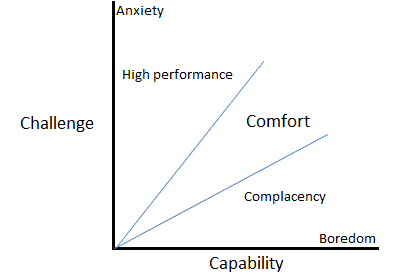
Challenge capability diagram
The idea that people are often in their comfort zones and that learning and improvement occurs when you move out of it has currency in local government today. The concern is that when people find their comfort zone they settle in and thereafter resist change, even beneficial change. Individuals are regularly being asked to leave their comfort zone and accept challenges. Does an organisation also have a comfort zone?

I think many organisations do – and they stay in them. It will usually be the zone that the organisational leaders, the council or the CEO and Executive, allow it to be in. Frequently, it is a place that they understand and there will be a level of challenge and change activity that the leaders are comfortable to support. The question is what is that level at your organisation? Continue reading

77 – Operational excellence in local government. Does it matter?

Posted by Lancing Farrell                                                                        600 words

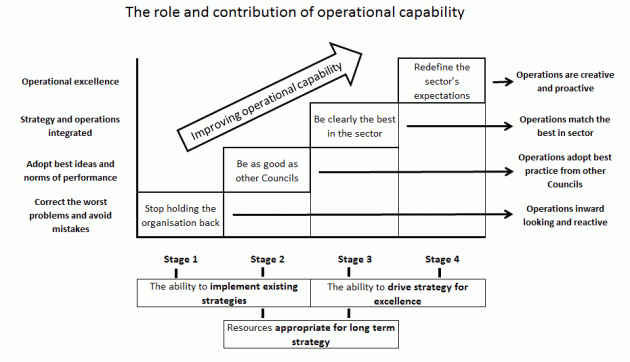
operational capability

In a recent discussion with a colleague she mentioned that in her previous employment outside local government they had set organisational performance goals for leadership, finances, relationships, safety and operational excellence.   Each area of performance was rated equally. It started me thinking about how little you hear about operational excellence in local government. Is that because it doesn’t matter?

I am sure that operational performance matters. Whether councils want to be excellent or not, I am less sure. I think that the reason it is seldom discussed is that few people have a real understanding of operations management or what excellence would look like or how to achieve it. Continue reading

75 – Posts 51 to 74. What has been discussed?

Interest in the blog is growing with a small and persistent group of followers and over 1500 views from people in countries across the globe (see map). In earlier index posts I have listed posts or groups of posts, pretty much in the order posted, that related to a theme. This time I have listed the themes (alphabetically) and grouped posts beneath them. I hope it makes sense.

blog interest 11042015

Culture.

Post 62 introduces a new writer on the theme of ambition and local government. The post discusses the difficulties for the ambitious or those who don’t fit into the dominant culture or comply with senior management’s wishes. In a post 64 Tim Whistler links career ambition with local government culture drawing on the parable of the three stonemasons and linking it to culture surveys, the Executive, and the desire for compliant behaviour, not performance. Tales of thwarted ambition?

Customer service.

Post 73 discusses a recent article on the use of social media by disgruntled customers and the implications for customer service. This trend presents challenges for councils to improve service delivery and broaden customer service channels. Vive la révolution informatique!

Decision making.

Post 54 is a slightly tongue in cheek look at hats that councillors might wear to signal the capacity in which they are acting when they make decisions, or the type of decision they are making. Hats have long been both a fashion statement and a symbol of status or role in society. Have a read and see what you think. In a similar vein, post 59 looks at hats that middle managers might wear for similar reasons. When can you see yourself donning one?

Post 71 discusses the ‘People’s Panel’ appointed by Melbourne City Council to make recommendations on their budget for the next 5 years. It is the latest version of participatory budgeting and potentially a harbinger of things to come for major council decisions. What do you think?

High performance.

In post 51 Colin Weatherby discusses what you can expect to find if you carried out an organisational self assessment (OSA) using the Australian Business Excellence Framework. He poses the question ‘Do you need an OSA?’ I think the answer is yes and what you will find out when you do one will be enlightening. Read on.

Job design.

In post 66 Lancing Farrell begins a series of posts on the idea of high performance jobs. Based on an article by Robert Simons, Designing High Performance Jobs, the first post provides a diagnostic tool for your own job. Has it been designed for high performance? The next two posts discuss how to design a high performance management job in local government. Post 67 covers some theory and in post 68 the theory is applied to three local government management roles.

Learning

Post 74 discusses two more books relevant to management in local government. Terry Leahy’s book ‘Management in 10 Words’ and Jay Greene’s book ‘Design is how if works’ are previewed. Read them and think about how you can focus more on truth, loyalty, courage, values, act, balance, simple, lean, complete, and trust. Learn how to create experiences that your customers crave (or at least get it right most times)!

Management observations.

Post 63 revisits Richard Farson’s great book, ‘Management of the Absurd – Paradoxes in Leadership’, to discuss the reliance on intuition by experienced managers – and the fact that this isn’t always the case in local government. Maybe we just don’t trust ourselves?

News stories.

In March three articles were published on the same day in the Melbourne Age newspaper that have significance for local government. Post 53 discusses growth in the service economy, restructuring of the national basketball league and privatisation of government assets. You will have to read it to see how they are connected.

Organisational change.

Post 72 raises the issue of ‘revolutionisation’, the term given by Tim Whistler to CEO’s who come into councils and radically transform them. If you have worked in the sector for ten years I am pretty sure it has happened to you at least once. What do these CEO’s do, why is it so predictable, and does it make a lasting difference? You decide.

Performance appraisal.

Post 52 starts a series on performance appraisal in local government, which includes posts 55, 56 and 58. The first post presents the view that what is currently happening doesn’t work. Nobody does it unless they have to. The second post talks about why it is done. What do we think we are going to achieve? The third discusses what can be done in response to the shortcomings of the current performance appraisal system. The fourth post puts forward an alternative.

Later, in post 70 Tim Whistler relates a performance appraisal story – what does ‘meeting expectations’ really mean?

Suppliers.

Post 65 the differences in operations between councils and their suppliers is discussed. Why do major suppliers invest in integrated management systems when councils don’t. It is a good question.

Thinking.

In post 57 Tim Whistler describes four types of thinking seen in local government, some more often than others. Many would see the first two as related and a progression in thinking, from their convenience to the potential consequences, and would be comfortable to stop there – you can pat yourself on the back because you have started thinking ahead.

The two latter types of thinking, integrative and systems, move decision makers from their personal needs towards the good of the organisation. How often do you find yourself thinking that way?

Value.

In posts 60 and 61 Colin Weatherby discusses a tool he has developed to focus discussion on different types of value. It helps to separate private value expectations from public value considerations for the purpose of analysis and discussion. Once the relationships are understood and have been debated, the tool facilitates discussion about how different value is related and facilitates planning for how it can be integrated in services. It is the ‘multi-tool’ for value planning.

Post 69 discusses local government and milk. What do they have in common? Milk producers have been redefining the value of their product and differentiating between different suppliers of different milk products to add value to a commoditised product. Why can’t local government do the same and avoid being a supplier of low cost commoditised services?

 

72 – Revolutionising local government. How long is it since you were last revolutionised?

Posted by Whistler                                                                          600 words

merry go round

I was talking to an experienced consultant who works with numerous councils recently and she commented about some of the councils currently undergoing ‘revolutionisation’. New CEO’s, in two cases new to the sector, were busily implementing their kitbag of management ideas. They seem to hit the ground running with a program of change. What are some of the features of revolutionisation and how effective is it?

I will start with effectiveness first. It depends on the measure. I can think of a few. Is it delivering on a promise to the councillors who appointed them to shake things up and create change? Is it is improving the performance of the organisation in meeting community needs sustainably in the longer term?

If it is the former, I would think they are mostly successful. Continue reading

71 – ‘Melbourne People’s Panel makes bold decisions where politicians fear to tread’, The Age, 1 April 2015.

Posted by Colin Weatherby                                                                         550 words

Peoples panel

“The public is smart if given the time and information necessary to work through an issue. And this has been demonstrated by a people’s “jury” which has delivered its verdict in a bold experiment in democracy by the Melbourne Town Hall.

The results should give hope to people despairing that Australia has lost its reform mojo, as it provides a new way for government to get hard but necessary things done.”

I read this article by Nicholas Reece, a Principal Fellow at Melbourne University, with some interest. Involving the community in budgeting is not new. Continue reading

69 – Local government and milk. What do they have in common?

Posted by Colin Weatherby                                                                         660 words

cow

I recently drove past a car sign-written with advertising for milk available direct from the farm. It promoted the virtues of buying milk from the producer. I had earlier heard a radio advertisement for milk available from an inner urban Melbourne dairy where I am sure there are no cows. The advertisement talked about local milk from local people.

There may be some difference in the milk each company is selling. And it is probably different from the milk I can buy at my supermarket. So what is happening with milk and why might it tell us something that is relevant to local government? Continue reading

65 – Service suppliers to local government. What do they do differently and why?

Posted by Parkinson                                                                                       350 words

integrated systems

It has always intrigued me that the major suppliers of services to local government operate quite differently. What are some of the differences and why?

The first difference that is obvious is the investment in enterprise management systems. Some are better developed and more integrated than others but all have a third party accredited quality (ISO 9001), safety (AS4801), and environment (ISO 1400) systems. They will also have a corporate operations manual and a management manual setting out company policy and requirements. Continue reading

64 – Ambition, culture and performance. A tale of middle management in local government.

Posted by Whistler                                                                                          750 words

cathedral

I was recently involved in a discussion where the metaphor of the three stonemasons came up. The person telling the story described the response of the three stonemasons to the question ‘what are you doing?’ You may know it.

The first stonemason said ‘I am making a stone’. The second said ‘I am making a wall’. The third said ‘I am making a cathedral’.

The purpose in telling the story was to illustrate the various motivations of people at work in local government and that, hopefully, we are all here to make a cathedral and we know it. Well, I started thinking about how many of the workers cleaning the same public toilets every day, or mowing the same parks, or emptying the same bins, think they are making a cathedral. The chances are that they are just diligently making a stone. Whether it is used to make a cathedral or not is probably not important to them and never will be.

Then my thinking moved on to thinking about myself and the other middle managers I deal with. Surely we are all making cathedrals? Continue reading