134 – ‘A new theory of value creation for local government’. Do we need one? Part 4 – Integrating the thinking.

Posted by Lancing Farrell                                                                              1600 words

cutting diamond

This last post in this series (see here, here and here for previous posts) is an attempt to synthesise a new theory of value creation for local government using the ideas discussed in the previous posts.

First, a quick recap on strategy, business models and operations stratgey.

  • The strategy is the position that an organisation takes in relation its market, the value it decides to create, and how it decides to create that value and operate at a surplus.
  • Every organisation explicitly or implicitly employs a business model that describes the design or architecture of the value creation, delivery, and capture mechanisms it will use.
  • The operating strategy then guides decisions about vertical integration, capacity planning, facilities planning, services technologies, and process technologies.

A new theory of value creation for local government will need to integrate these concepts into a cohesive and repeatable approach. Continue reading

129 – ‘Postformal’ leadership. Are you the leader simply because you, or others, say that you are?

Posted by Parkinson                                                                      700 words

mattang

Mattang image

Colin Weatherby posted a long read on three recent reports about leadership in local government. The first looked at research into best practice leader development, the second the results of leadership at a capital city council and the third at the role of leadership in preventing corrupt or inappropriate behaviour in council works depots. I don’t think anyone would argue that we don’t need good leadership, even though we seem to survive well without it.

A colleague recently attended a lecture by Australian adventurer and leadership researcher Earl de Blonville. The focus of the talk was ‘postformal leadership’,  a new way of thinking about leadership that he has developed from thinking in postformal psychology. Continue reading

128 – Council superheroes. Some feedback from readers.

Posted by Lancing Farrell                                                                              300 words

reader feedback

Editorship has some privileges. I have enjoyed Linda Perkin’s posts on Captain Council and look forward to what will unfold in future posts. Captain Council has generated some interest, with a few people ‘connecting some dots’ and telling us about them.

Apparently western suburbs local print media shock jock Kevin Hillier has commented that councillors in his community have a ‘cloak of invisibility’. It seems they haven’t been as publicly accountable as he would like.

It was suggested that Captain Council might need this superpower. If he did, I am sure it would not be to hide from his constituents!

Another colleague pointed out a scholarly article written a few years ago about whether CEO’s in local government are superheroes or puppets. In the introduction, the author comments that:

“… CEO’s are required to operate across multiple dimensions simultaneously.”

This sounds like ‘shape shifting’ to me. A quick check on Wikipedia reveals that this superpower is more likely to be ‘dimensional travel’ (i.e. the ability to travel between two or more dimensions, realities, realms) or ‘omnipresence’ (i.e. the ability to be present anywhere and everywhere simultaneously). Secretly, I think many CEO’s do aspire to omnipotence.

I should probably take this article more seriously. It concludes with the view that:

“Successful CEOs share several common characteristics which reflect the ability to effectively manage along the three edges+. These CEO’s tend to possess transformational, charismatic, and almost superhuman qualities.”

It is all starting to sound a bit eerie to me, but my confidence was restored by a more thorough perusal of the article, which revealed that the research was strictly scholarly and involved nothing supernatural.

+ The concept of the ‘three edges’ was developed by Henry Mintzberg to describe the work of the public sector manager. The edges are the ‘operating edge’, the ‘stakeholder edge’ and the ‘political edge’.

Jones, Stephen 2011. ‘Superheroes or Puppets? Local Government Chief Executive Officers in Victoria and Queensland’, Journal of Economic and Social Policy, August.


 

126 – ‘A new theory of value creation for local government’. Do we need one? Part 1 – Strategy.

Posted by Lancing Farrell                                                                              850 words

value diagram shaded

This is the first post in a series  exploring the relationship between business strategy, the business model and operations strategy. It is an attempt to pick up on the ideas in Colin Weatherby’s previous post discussing Henry Mintzberg’s ideas about different models for government organisations. Hopefully the series of posts will make my case for a local government theory of value creation.

I will begin with business strategy. To set the scene, I have chosen the following quotations from management consultant and academic David Maister  to highlight the strategy problem for local government.

“A strategy is not just choosing a target market, but is about actually designing an operation that will consistently deliver the superior client benefits you claim to provide.

However, each decision you make to be more effective at delivering the preferences of those you target will (inevitable, inescapably, unavoidably) make you less attractive to clients or market segments that look for different benefits.

You could try to design your operations to meet a wide variety of preferences and needs, serving each client or customer group differently, according to their individual wishes.

Your market appeal will then come down to ‘tell us what you want us to do for you and we’ll do that. We’ll do something different for other people tomorrow!’

The very essence of having a strategy is being selective about choosing the criteria on which a firm wishes to compete, and then being creative and disciplined in designing an operation that is finely tuned to deliver those particular virtues.

An operation designed to provide the highest quality is unlikely to be the one that achieves the lowest cost, and one that can respond to a wide variety of customized requests will be unlikely to provide fast response and turnaround. Any business that tried to deliver all four virtues of quality, cost, variety and speed would be doomed to failure.”

Maister may not have had local government in mind when he wrote this piece, but he provides an insight into the challenges in determining what provides value to people receiving services. He calls it ‘superior client benefits’. In the public service context, academic Mark H. Moore has called it public value. It is the same idea Continue reading

123 – Reinventing Management – Architecture and Ideology. Gary Hamel.

Posted by Colin Weatherby                                                                         1300 words

inertial incremental insipid

Gary Hamel starts his dissection of large organisations with a series of descriptors; inertial, incremental, and insipid. Reading his paper made me feel like returning to small business. I once heard the Chief Executive Officer of the Australian Industry Group talking about a poll of his members. He asked them what they would like from government and they said that they wanted government to be positive, intelligent, and credible – the antidote to the inertial, incremental and insipid.

Hamel is describing what he calls the congenital disabilities of large organisations. By inertial, Hamel means that they are ‘frequently caught out by the future and seldom change in the absence of a crisis’.

 “Deep change, when it happens, is belated and convulsive, and typically requires an overhaul of the leadership team.”

By incremental, Hamel means that despite their resource advantages, incumbents are seldom the authors of game-changing innovation.

“It’s not that veteran CEOs discount the value of innovation; rather, they’ve inherited organizational structures and processes that are inherently toxic to break-out thinking and relentless experimentation. Strangely, most CEOs seem resigned to this fact, since few, if any, have tackled the challenge of innovation with the sort of zeal and persistence they’ve devoted to the pursuit operational efficiency.”

By insipid, Hamel means they are emotionally sterile. He says that managers know how to command obedience and diligence, but initiative, imagination and passion can’t be commanded—they are gifts.

“Every day, employees choose whether to bring those gifts to work or not, and the evidence suggests they usually leave them at home. In Gallup’s latest 142-country survey on the State of the Global Workplace, only 13% of employees were truly engaged in their work. Imagine, if you will, a car engine so woefully inefficient that only 13% of the gas it consumes actually combusts. That’s the sort of waste we’re talking about. Large organisations squander more human capability than they use.”

Hamel is excoriating in his examination of the supposed ‘remedies’ advanced over the years Continue reading

120 – Captain Council discovers a superpower – BFV.

Posted by Linda Perkin                                                                                                  750 words

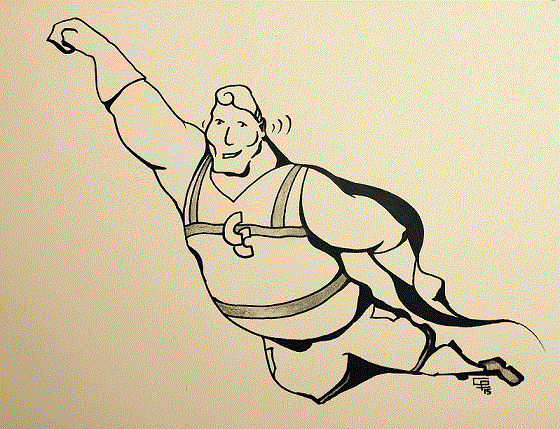
Captain Council flying

In the first instalment, Captain Council cast the management alchemy spell, only to immediately fall unconscious to the ground. Awakening some time later, he rushes to that evening’s council meeting ….

Taking his seat, Captain Council looked around the chamber. The usual crew were present. All of the councillors were in their usual positions, watching each other warily. The CEO and officers were sitting nervously waiting for business to commence.   Perched on chairs at the front of the auditorium were the two regular attendees – like Statler and Waldorf. Continue reading

118 – Improving service operations. Why it doesn’t happen in local government.

Posted by Whistler                                                                                          500 words

 walking the plank

I have read Lancing Farrell and Colin Weatherby’s posts on characteristics of demands, redesigning operations and improving service operations through action plans and service redesign, with some interest. It is all good stuff and not too difficult to understand or do. The question I ask myself is why I don’t see it happening everywhere across the sector. The ‘special and different’ posts partially explain it but I think there is more to it.

To begin with, the motivation to make improvements doesn’t really exist. People say they want to improve the quality of services to their community, and in response to threats like rate capping they say they want to be more efficient. But they don’t really want to do either.

Most councils have the potential to improve productivity by 10-15% (more in some councils). Continue reading

117 – ‘Captain Council’. A local government superhero.

Posted by Linda Perkin                                                                                       670 words

Captain council

Introducing our newest superhero ‘Captain Council’. When writing something recently, I found myself asking ‘What would Arnie do?’ Arnold Schwarzenegger’s response to a situation has become something of a yardstick. It made me think that what we really need in local government is our own yardstick – what would ‘Captain Council’ think or do?

There is always a back story. Here goes.

Captain Council is a former council manager who sought election to his local Council to improve services.

In his job he had been marginalised for constantly focussing on how work could be done better. His continual efforts to get everyone else to think differently and challenge the status quo created enemies amongst those in the organisation who were threatened by change. These people criticised him to higher authority (behind his back) and diminished his career prospects to limit his influence. Higher office seemed the only way forward.

Elected at his first attempt, Captain Council (not yet a superhero) relished the opportunity to make things better. Continue reading

107 – Separate, relate and integrate. Redesign operations to meet services demands.

Posted by Lancing Farrell                                                                              570 words

good cheap fast

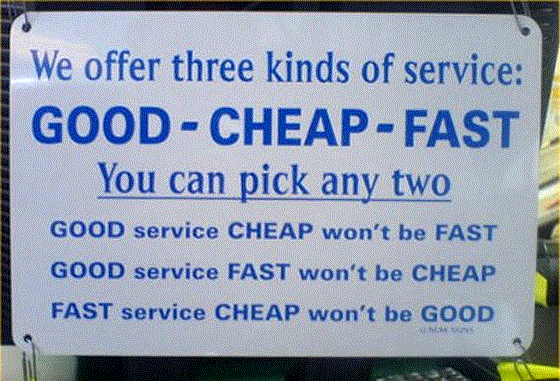
Some basic tools are needed to redesign operations to improve performance. Many people charged with responsibility for managing services have limited skills in how to redesign and improve them. Here is a simple and effective approach – just separate, relate and integrate.

The separate bit is about understanding the different demands being placed on the system. Usually, a performance problem is masked by a mess of different demands that have been mixed in one or two delivery processes. The important characteristics of services demand are the expectations of people creating the demand and how the demand is presented. It is essential to separate each type of demand according to its performance objectives and characteristics. Continue reading

103 – Classic paper – ‘Managing Government, Governing Management’. Henry Mintzberg.

Posted by Colin Weatherby                                                                         1850 words

In 1996 Henry Mintzberg published a paper in the Harvard Business Review entitled ‘Managing Government, Governing Management’. In the paper Mintzberg covers four broad topics relevant to local government:

  1. Private, public, cooperative and non-owned organisations.
  2. The roles of people in society as customer, client, citizen and subject.
  3. The management myths that activities can be isolated, performance can be fully evaluated using objective measures, and activities can be entrusted to autonomous managers responsible for performance.
  4. The machine model, network model, performance-control model, virtual model and normative-control model available to organise government.

What relevance does it have for local government today?