163 – Decision making: Decision-focussed strategic planning in local government.

Posted by Lancing Farrell

more better faster

Image

This is the sixth post in a series.  Michael Mankins and Richard Steele propose an alternative model of strategic planning. They believe that strategic planning can’t influence organisation performance if it doesn’t drive decision making. And it can’t drive organisational decision making while it is focussed on individual business units and limited to an annual planning process. They describe some of the changes that organisations can make to their strategic planning to produce more, better and faster decisions.

They separate – but integrate – decision making and planning. Decisions are taken out of the planning process into a parallel process for developing strategy. Executives can identify the decisions that they need to make to create more value over time. The output of this process is a set of decision that management can codify into future business plans through the planning process. Continue reading

160 – Making a local government service catalogue. Part 2: What to do with it?

Posted by Colin Weatherby                                                                                      630 words

service category

In the first post I described a service catalogue and looked at where (and how) to start making one. This post discusses what to do next to refine the service catalogue and use it to improve organisational performance. I have no doubt that a service catalogue is essential to starting a discussion with the community about services required in a rate capped operating environment, however it should also drive continuous improvement by providing a focus for service reviews.

The ‘first cut’ service catalogue that defines services from the customer viewpoint and links that view to organisational structure, is really just the start.

Further analysis is required to determine the link between the service catalogue and organisational strategic plans (especially the council plan). This can be achieved by coding the spreadsheet of cost centres with the themes or key objectives or themes in the plans. This will allow further analysis by pivoting on different criteria. What is the link between council plan objectives, customer defined services and cost centres? Continue reading

159 – Making a local government service catalogue. Part 1: Where do you start?

Posted by Colin Weatherby                                                                                         740 words

service catalogue food images

Across local government in Victoria councils are starting to discuss core and non-core services and the need to make a service catalogue – in other words, list of all the services they provide. In part this interest has been sparked by rate capping and the need to better understand where revenue is going. Any council attempting to increase rates above the Essential Services Commission cap will need an argument that is supported by their community. So what is a service catalogue?

In its simplest form it is a list of all the services a council offers, and by default, anything not on the list is not offered. It doesn’t mean that other services can’t be offered but there will need to be consideration of the costs and benefits before committing to do so. The list will need to be controlled once it has been made.  Deciding what services you will and won’t offer (and who will and won’t receive them) is at the heart of strategy. Continue reading

158 – Customer perception. Why is it important in local government services?

Posted by Lancing Farrell                                                                              670 words

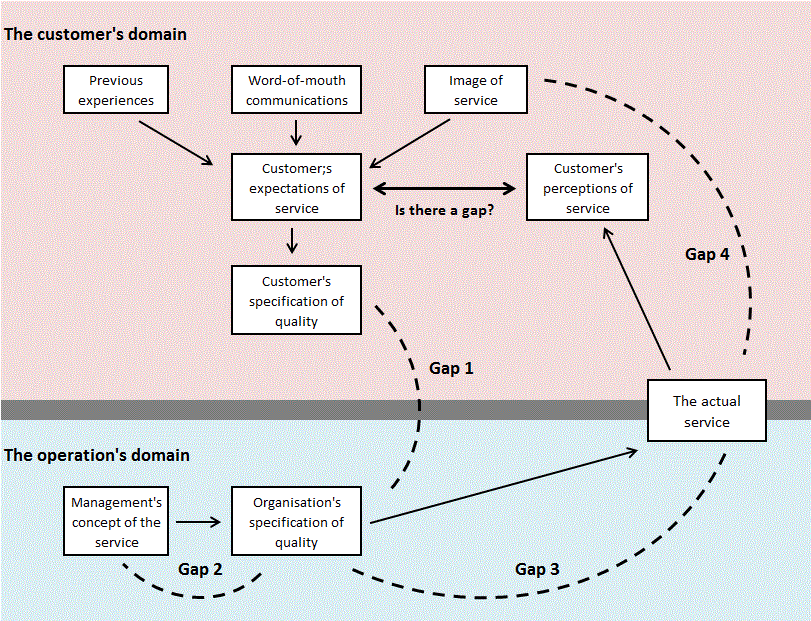
customer service gaps

Image adapted from Slack, Chambers, Harland, Harrison, and Johnston 1998, Operations Management, 2nd Edition.

There have been a number of posts on aspects of customer service – who are our customers, customer-introduced variability, how do you listen to the ‘voice of the customer, internal customers , what Gordon Ramsay might think about council customer service, and captive customers. If there has been a thread through these posts, it has been the need to look at services from the customers’ viewpoint and to understand constitutes value for them.

The posts on value have discussed how to understand both private and public value – why do we provide the services that we do, the private-public value continuum, applying the public value scorecar , public value gap analysis, local government and commodity services, value-led management, and a series on a new theory of value creation in local government. The idea that people seek private value and councils set out to create public value is at the heart of a lot of customer service problems.

One aspect of customer service that hasn’t been discussed is the role of perception. Continue reading

157 – Captive customers. Why are they so special?

Posted by Colin Weatherby                                                                         850 words

captive

The idea that our customers (i.e. the ratepayers, residents, businesses and citizens in the community) are captive to our services is not new, however the implications are seldom discussed in local government. What does it really mean for service providers when their customers are forced to pay for services they may not use, or for service levels that may not meet their specific needs?

The idea that we will have choice in matters affecting our lives has become sacrosanct in western society, especially if we are paying. Customer service standards today are unrecognisable from those of the last century. Nobody expects to wait. If what they want isn’t available, they expect the service provider to get it – and quickly. If service falls below the normal standard they expect compensation. Social media is giving voice to unhappy customers and putting pressure of organisations.

In this environment, getting customers to pay for services in quarterly instalments and then receive standard services designed to suit ‘everyone’, leads to obvious conflicts. Continue reading

156 – Decision making: The calendar effect and local government planning.

Posted by Lancing Farrell                                                              700 words

calendar

This is the fourth post in a series. Most councils prepare their plans in a very conventional way. All of the councils where I have worked have been the same. The planning process is frequently criticised but seldom challenged. There is a better way.

Despite the effort put into strategic planning by many organisations, it can actually be a barrier to decision making. Michael Mankins and Richard Steele believe that difficulties in strategic planning are attributable to two factors:

  1. The calendar effect – it is usually an annual process.
  2. The business unit effect – it is usually focussed on individual business units.

This is completely at odds with the way executives actually make important strategic decisions. They make the decisions that really shape organisational strategy and determine the future direction of the organisation outside the formal planning process. And they often do it in an ad hoc way without rigorous analysis and debate. Continue reading

155 – Decision making: Policy and decision making in local government.

Posted by Lancing Farrell                                                              750 words

menu

This is the third post in a series. Policy should guide local government managers and their teams in making most decisions with the confidence that if the decision is challenged it can be assessed against the policy and shown to be justified.

Some decisions won’t be able to be made this easily and a ‘one up’ escalation or other simple decision review processes should enable a decision to be made quickly and efficiently. There will be some decisions that are outside existing strategy or policy that will need to be referred to more senior management for new thinking about the decision that is required.

In a high performing organisation, making decisions that are consistent with organisational strategy, policy and plans should be straightforward for the majority of decisions. Continue reading

154 – “If it is easy or there is a budget, councils are probably doing it”.

Posted by Whistler                                                                                                          400 words

easy peasy lemon squeezy

The flip side of this statement is that if it is difficult or there is no budget, councils probably aren’t doing it. This is one of my most common bits of advice to residents. The reality is that councils can really struggle to do difficult things. It isn’t that they don’t want to. It is just that the system militates against it. It is worth thinking about the hallmarks of something that is difficult for local government.

It is often something that is new – something that the council hasn’t done before that has to be learnt. This takes time and effort, and can be risky. Someone could be upset by it. You might make a public mistake. I once worked for a council that wanted to be recognised as a leader, but only by doing things that other councils had already proven would work. Continue reading

153 – Decision making: Some challenges for local government.

Posted by Lancing Farrell                                                                              580 words

face butt towel

This is the third post in a series.  Sometimes making decisions is difficult and a guide is helpful. Local government has some particular types of decision making that frequently present challenge. These decisions need to involve the right people at the right level in the organisation. Often they cut across functional areas.

Two of the key challenges for local government in becoming a decision-driven organisation are whether or not to centralise decision making and how to ensure cross-functional cooperation in decision making. I will start with centralisation. Continue reading

150 – ‘Muzzle on council rates’. The Age, 31 July 2015.

Posted by Colin Weatherby                                                                         800 words

muzzle

The pressure is on. The Essential Services Commission has released its draft report on the proposed rate capping for councils in Victoria. It has a number of interesting elements and some significant implications for local government. The report sets out which revenues are proposed to be capped, how the rate cap could be calculated, the current forecast for rate increases to 2018/19 under the proposed system (see below), and the impact of the application of an ‘efficiency factor’ to provide an incentive to pursue efficiencies.

The article in The Age describes the major impacts.

“Victoria’s 79 councils had an average rate increase of 3.8 per cent this year. Several councils increased their rates by more than 6 per cent.

The draft report includes indicative forecasts for an annual rate cap of 3.05 per cent in 2016-17, dropping to 2.85 per cent in 2017-18 and 2.8 per cent in 2018-19.

In addition to the cap, the review calls for a new “efficiency” deduction to be introduced from 2017-18 where councils would need to reduce their rates bill by 0.05 per cent because of efficiencies (increasing by 0.05 percentage points each year). Jason Dowling, The Age, 31 July 2015.

So, what are the likely implications for councils?

There have been some previous posts on this topic (see  Council rates capped from mid-2016’, The Age, 21 January 2015 and Labor’s rate cap to hurt services and infrastructure, ratings agency warns’, The Age, 27 February 2015.). That thinking still stands. Councils will have to say ‘no’ louder and more often. Difficult choices will need to be made about what services to offer or not offer, and what the levels of service will be. Some people will no longer be eligible for services as councils start to distinguish more strongly between those who are or are not customers. Expect much more customer segmentation for services delivery. All of this will be difficult for our politicians who succeed by pleasing their constituents.

In many ways this is the easy bit Continue reading