97 – A question: What if we treated the community the way we treat internal customers?

Posted by Whistler                                                                                          400 words

bins in street

Colin Weatherby’s post about corporate services reminded me about a video clip that I saw some time ago showing what life might be like if the airlines ran like the health service. It was an interesting way to challenge accepted standards and made the whole system look out of touch. Colin’s post about our corporate services colleagues made me think that a similar parody might be needed to highlight the lack of respect internal service providers within councils often show for their customers.

Here goes.

Customer Service Officer (CSO) sitting in call centre answers the telephone to incoming call from a resident.

CSO:                      Hello, how can I help you?

Resident:             Hello. I put my bin out for collection on Monday and it hasn’t been collected. It is now Wednesday and I am wondering what is happening.

CSO:                      Did you put it out the front?

Resident:             Yes. I put it where I always put it on the nature strip.

CSO:                      Ah. There is your problem.

Resident:             I don’t understand.

CSO:                    Well, we no longer collect bins from out the front of houses. It is a new cost saving measure that will save lots of money. We won’t have to increase your rates by nearly as much this year. It will save at least $5 a week per household.

Resident:             But no one told me.

CSO:                     That’s because it would have cost us a lot of money to tell people. We don’t want to waste money.

Resident:             So what will happen now?

CSO:                      That depends. Do you still want your bin emptied? Continue reading

96 – A corporate services productivity initiative. Are you sure?

Posted by Colin Weatherby                                                                         360 words

lawn mower

How long is it since your corporate services team decided to make some improvements to their productivity? Maybe they had to take a budget cut o show some leadership when their Group Manager was asking everyone else to make cuts. Maybe they genuinely think they have produced the same or more value at less cost. Sometimes they aren’t seeking to improve productivity, they are simply complying with the recommendations of yet another internal audit and the opportunity has come up for what seems like greater efficiency. After all, isn’t being more efficient hard to argue with?

Whichever way it happens, the flow on effects are always the same. Someone downstream gets to do more work. Continue reading

94 – ‘An interview with Wanksy, Penis Doodler and Pothole Avenger’, The Atlantic CITYLAB, 1 May 2015.

Posted by Colin Weatherby                                                                                         430 words

Wanksy image

Image from CITYLAB.

The sub title to this article says it all – ‘How an English construction worker is fighting for better road infrastructure by scribbling on the streets like a third-grader’. What is it that reduces people to this behavior? Why do they feel compelled to break the rules to get something done? There have been various articles on guerilla gardening, depaving and other aspects of DIY urbanism, but this is the first ‘guerilla maintenance’ article I have seen.

According to the article, Wanksy is a surveyor and professional artist who became fed up with the numerous potholes in his hometown, so he started drawing penises around them. And it seems to be working Continue reading

93 – ‘Cost shifting’, or ‘State services paid for by rates’? It is our choice.

Posted by Colin Weatherby                                                                         670 words

townhall 2

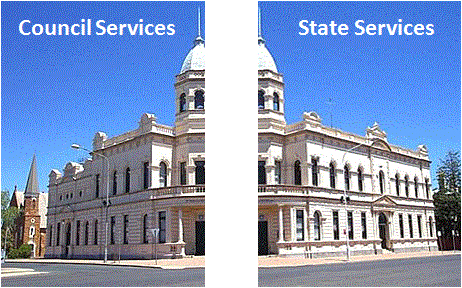
In local government in Victoria middle maangers are often asked to identify ‘cost shifting’ at budget time to identify the portion of the planned rate increase that is needed to cover additional costs in delivering services prescribed by the State government. A little bit of whinging usually goes along with it. Councils often feel as though they are victims being forced to do something against their will. I think it is a mindset problem.

What is really happening is that the State government is choosing to have its services delivered through local councils and for those services to be paid for by the people who receive them through their rates (property tax). Continue reading

91 – Phenomenology, cautery and augury. What relevance do they have for local government?

Posted by Whistler                                                                                          500 words

bats flying

Phenomenology is the study of ‘that which appears’. It attempts to create ‘objective conditions for the study topics usually regarded as subjective’ (thanks Wikipedia). You can read quite a lot about it if you are interested. I came across the term listening to a comedian who said that his joke wasn’t in poor taste; it only became poor taste if you attached that meaning to it in your own mind. You create the offence to yourself. Yes, it did my head in a bit too. I guess he wasn’t intending to offend, just to confuse.

I am pretty sure that he was referring to the branch of phenomenology known as ‘intentionality’, which says that our ‘consciousness is always conscious of something’.   The object of our consciousness doesn’t have to be real – it can be a fantasy or memory. Apparently, it is a medieval idea. That somehow seems fitting. In the 1100’s the ‘scholastics’ used it to defend dogma.

You are probably wondering about the connection with local government today. Continue reading

86 – Ten sayings that define local government culture.

Posted by Whistler                                                                          970 words

grass dreaming

In local government we talk a lot about culture and forces that shape it. Often these forces are evident in the things that people say each day. This post explores ten of the sayings heard daily in local government and attempts to translate them.

  1. ‘We have set a goal on this issue, it is an aspirational goal’.

This type of goal has no basis in reality. It is an idea of what might be good if it happened. At best it is a ‘guesstimate’. No one knows whether or not it is feasible. Mostly, it is just frustrating because someone powerful has effectively avoided making a decision or creating conflict by setting a goal that everyone can agree to because it means nothing. An aspirational goal makes ‘motherhood’ statement seem like a specific and readily measurable output. I think we do it because it gets us out of a difficult situation at the time or it makes us feel as though we are setting meaningful goals under difficult circumstances.

  1. ‘Never mind if you can’t get it done today, there is always tomorrow’.

This statement is often heard when planned work has not been completed. It reflects the low value placed on time in local government. When available capacity doesn’t easily match demand, jobs are just deferred. It takes the pressure off managers to be organised and ensure that operations are well managed. The customer just has to wait. Given they have no other choice of supplier, why not?

  1. ‘Let’s just park that’.

This is what happens when you can’t find the answer to the question the meeting was called to answer in the first place. This regularly happens because meetings are seen as potential circuit breakers for intractable organisational problems. The cross-functional decision that no one has the right to make. The escalated decision that no one seems to have the responsibility to make. Whatever. Parking it is a nice way to say we will just wait and see how long it takes before it either resolves itself or explodes.

  1. ‘This issue needs some ‘blue sky thinking’.

This is how we describe the generation of visionary ideas that don’t always have a practical application. Some people call it dreaming. It usually happens when past approaches have not worked and there is pressure to be ‘innovative’ and come up with a ‘creative’ solution – dangerous territory for all involved. Whilst people in local government like to say they are ‘thinking outside the box’, or thinking ‘laterally’, in reality we really just like to think the way we always have (but be seen to be doing otherwise). Hence, the popularity of ‘blue sky’ thinking – it is all care, no responsibility.

  1. ‘If it is not broken, don’t fix it’

This is a favourite. It is premised on the idea that things break suddenly and without any warning. No one could have anticipated it or prevented it happening.   The idea that it might be ‘breaking’ doesn’t enter into it. We are not looking for signs that something isn’t working and might fail. No. Everything that goes wrong in local government couldn’t have been foreseen and anything that seems to be working should be left alone. Makes sense doesn’t it?

  1. ‘This will have to go upstairs; you’ll need to run that past (write name of senior manager)’.

I quite like this one. It implies that we are getting on with business by sending something to someone more important to make a decision. The fact that you might already have the decision rights, and they really don’t have time to make the decision, is irrelevant. It is going upstairs to more senior people. That has to be better.

  1. ‘Let’s look for the low hanging fruit’.

Usually, this means just choose the simplest option to accomplish a task. Who can argue with that? It has a resemblance to efficiency. If the outcome is not what you expected or need, at least you have acted. It is related to another old local government saying, frequently heard in depots, – ‘just keep moving; you don’t have to do anything, just don’t stop’. Anyway, the cockatoos always get the high fruit.

  1. ‘We need to get a helicopter view of this’.

This implies that a higher altitude view will yield some information not currently available from the ground. There is really no arguing with this idea, but in practice, the altitude sickness that seems to ensue once senior management leaves the ground limits the potential. You often hear about executives seeking a helicopter view but seldom see any benefit from it.

  1. ‘We really need a burning platform if change is going to happen’.

I don’t think people have arson in mind when they voice this view. It is more metaphorical. It really means that they need a crisis to justify making sensible management decisions – someone has to set fire to something before we have a reason to fix it (enter rate capping).   Without an imminent crisis, the Executive can’t work out how to explain to people that they need to change and put customer needs ahead of their own. I get it.

  1. ‘You need to run that past the Admiral’.

This refers to the senior manager nicknamed the ‘Admiral’ because they regularly say that they will have to ‘take it on board’. It could as easily be the ‘Window’ or the ‘Mirror’ – they need to look into it before they can make a decision on what to do. The ‘Grasshopper’ is another nickname – this is the manager who needs to find out about something before deciding (a reference to disciple in the television series Kung Fu). Everyone in local government has worked with an Admiral, a Mirror or a Grasshopper. It really just reflects the difficulty managers have in making a decision quickly. I wonder why?

Have you got others?  Contribute them via a comment.


79 – The local government reading test. Would you pass it?

Posted by Whistler                                                                                          710 words

books 2

Image from a friend – some books it wouldn’t hurt everyone in local government to read.

I am a reader, as are most people posting on this site. This has been identified as an annoying trait. I can testify to that. I am convinced that, unfortunately, it makes people feel insecure and inferior when you actively read and try to talk to them about what you are learning. Thank goodness for blogs. Over the years I have developed a reading test. This is how it goes.

When I start at a new organisation or someone new starts at the organisation I work at, I make a point of having a chat and saying hello. I am not highly extroverted but I like to make people feel welcome and to build a working relationship as soon as I can. When I get to know them, especially if they are in top management, I try to find out what their interests are and establish an intellectual connection. This is when the test starts. Continue reading

76 – Creative ways to make your capital expenditure target. Some ideas.

Posted by Whistler                                                                          570 words

capital expenditure graph

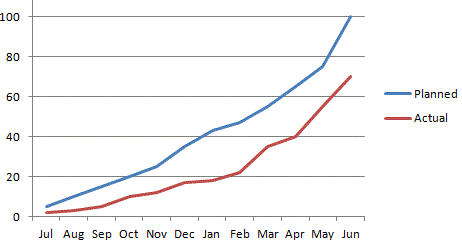
Yes, it is that time of the year when our engineers and accountants become highly creative.   By June 30 they will need to explain whether or not the targeted amount of capital works has been completed. Often the target is expressed as simply as ‘90% capital program completed’. Usually it is a KPI for the CEO and senior managers. That makes it an important target.

So, why the need for such high levels of creativity? Continue reading

75 – Posts 51 to 74. What has been discussed?

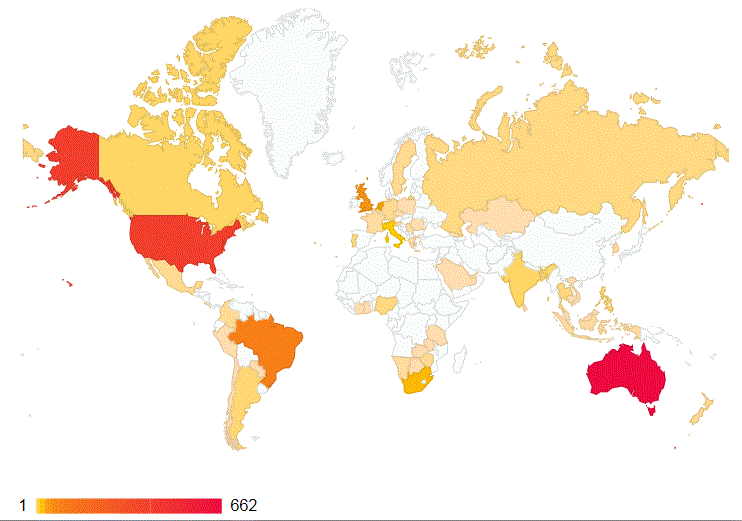
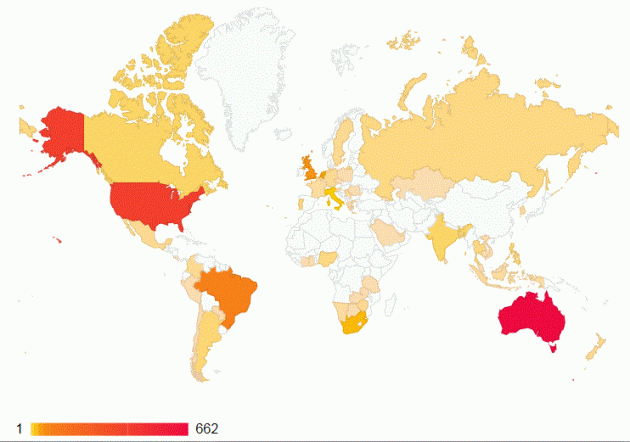
Interest in the blog is growing with a small and persistent group of followers and over 1500 views from people in countries across the globe (see map). In earlier index posts I have listed posts or groups of posts, pretty much in the order posted, that related to a theme. This time I have listed the themes (alphabetically) and grouped posts beneath them. I hope it makes sense.
blog interest 11042015

Culture.

Post 62 introduces a new writer on the theme of ambition and local government. The post discusses the difficulties for the ambitious or those who don’t fit into the dominant culture or comply with senior management’s wishes. In a post 64 Tim Whistler links career ambition with local government culture drawing on the parable of the three stonemasons and linking it to culture surveys, the Executive, and the desire for compliant behaviour, not performance. Tales of thwarted ambition?

Customer service.

Post 73 discusses a recent article on the use of social media by disgruntled customers and the implications for customer service. This trend presents challenges for councils to improve service delivery and broaden customer service channels. Vive la révolution informatique!

Decision making.

Post 54 is a slightly tongue in cheek look at hats that councillors might wear to signal the capacity in which they are acting when they make decisions, or the type of decision they are making. Hats have long been both a fashion statement and a symbol of status or role in society. Have a read and see what you think. In a similar vein, post 59 looks at hats that middle managers might wear for similar reasons. When can you see yourself donning one?

Post 71 discusses the ‘People’s Panel’ appointed by Melbourne City Council to make recommendations on their budget for the next 5 years. It is the latest version of participatory budgeting and potentially a harbinger of things to come for major council decisions. What do you think?

High performance.

In post 51 Colin Weatherby discusses what you can expect to find if you carried out an organisational self assessment (OSA) using the Australian Business Excellence Framework. He poses the question ‘Do you need an OSA?’ I think the answer is yes and what you will find out when you do one will be enlightening. Read on.

Job design.

In post 66 Lancing Farrell begins a series of posts on the idea of high performance jobs. Based on an article by Robert Simons, Designing High Performance Jobs, the first post provides a diagnostic tool for your own job. Has it been designed for high performance? The next two posts discuss how to design a high performance management job in local government. Post 67 covers some theory and in post 68 the theory is applied to three local government management roles.

Learning

Post 74 discusses two more books relevant to management in local government. Terry Leahy’s book ‘Management in 10 Words’ and Jay Greene’s book ‘Design is how if works’ are previewed. Read them and think about how you can focus more on truth, loyalty, courage, values, act, balance, simple, lean, complete, and trust. Learn how to create experiences that your customers crave (or at least get it right most times)!

Management observations.

Post 63 revisits Richard Farson’s great book, ‘Management of the Absurd – Paradoxes in Leadership’, to discuss the reliance on intuition by experienced managers – and the fact that this isn’t always the case in local government. Maybe we just don’t trust ourselves?

News stories.

In March three articles were published on the same day in the Melbourne Age newspaper that have significance for local government. Post 53 discusses growth in the service economy, restructuring of the national basketball league and privatisation of government assets. You will have to read it to see how they are connected.

Organisational change.

Post 72 raises the issue of ‘revolutionisation’, the term given by Tim Whistler to CEO’s who come into councils and radically transform them. If you have worked in the sector for ten years I am pretty sure it has happened to you at least once. What do these CEO’s do, why is it so predictable, and does it make a lasting difference? You decide.

Performance appraisal.

Post 52 starts a series on performance appraisal in local government, which includes posts 55, 56 and 58. The first post presents the view that what is currently happening doesn’t work. Nobody does it unless they have to. The second post talks about why it is done. What do we think we are going to achieve? The third discusses what can be done in response to the shortcomings of the current performance appraisal system. The fourth post puts forward an alternative.

Later, in post 70 Tim Whistler relates a performance appraisal story – what does ‘meeting expectations’ really mean?

Suppliers.

Post 65 the differences in operations between councils and their suppliers is discussed. Why do major suppliers invest in integrated management systems when councils don’t. It is a good question.

Thinking.

In post 57 Tim Whistler describes four types of thinking seen in local government, some more often than others. Many would see the first two as related and a progression in thinking, from their convenience to the potential consequences, and would be comfortable to stop there – you can pat yourself on the back because you have started thinking ahead.

The two latter types of thinking, integrative and systems, move decision makers from their personal needs towards the good of the organisation. How often do you find yourself thinking that way?

Value.

In posts 60 and 61 Colin Weatherby discusses a tool he has developed to focus discussion on different types of value. It helps to separate private value expectations from public value considerations for the purpose of analysis and discussion. Once the relationships are understood and have been debated, the tool facilitates discussion about how different value is related and facilitates planning for how it can be integrated in services. It is the ‘multi-tool’ for value planning.

Post 69 discusses local government and milk. What do they have in common? Milk producers have been redefining the value of their product and differentiating between different suppliers of different milk products to add value to a commoditised product. Why can’t local government do the same and avoid being a supplier of low cost commoditised services?


74 – More books to read if you are interested in local government management.

Posted by Lancing Farrell                                                                              660 words

Leahy and Greene books

I have previously posted on books every local government manager should read (see here and here). Again I will acknowledge the difficulty in getting people in local government to read and learn especially senior management. My earlier posts started with what I call ‘bread and butter’ reading. This post looks at some more focussed reading on specific aspects of management relevant to local government. Continue reading