122 – Are we really that ‘special and different?’ The answer: ‘No’.

Posted by Whistler                                                                                          340 words

the same

Really, what is all this nonsense? (more nonsense here and here) Ratepayers pay their money for efficient and effective services. They don’t care about all the other stuff and they don’t want a relationship with the Council, council officers or their councillors. They just wish that it all worked really well. For me, this Thinkpurpose.com post says it all.

While councils mess around wasting time exploring their differences and putting effort into looking different to their neighbours – nothing like a new livery and big signs at all city entrances to add value for the ratepayers – and not agreeing with neighbours about regional initiatives just for the sake of it (‘we can’t share their facilities, they’re from the other side of the river!’), they will never get it right.

People just want consistent services, wherever they live. When you move homes to another suburb, why should you have to learn a whole lot of new systems to get your rubbish collected, or pay your rates, or register your pet? Surely once your pet has been registered, you should be able to live anywhere with it? Why do there need to be different systems for taking rubbish away? The bins all look the same (actually, they are often different colours to show they are from somewhere special!).

Even within councils, more emphasis on being similar and the same instead of special and different would help. How many people at the council do you have to contact to register your name for paying rates, joining a club, registering your dog, paying a fine? Every department seems to have its own register of people it deals with. How many times has someone from the council come to your home for one purpose and when asked about something else they say ‘I am sorry, I can’t help you with that. That’s another department’.

Come on. People at the council are just more faceless people in the life of most residents. They don’t want a relationship. They don’t want to spend money on frills. They just want services to be delivered efficiently and effectively. The two eff words we don’t like to use.

121 – Squire to the giants. Who are the giants in common?

Posted by Colin Weatherby                                                                                                 830 words

squire

I recently found a new and interesting blog called ‘Squire to the Giants’. Much like thinkpurpose.com this blog site is aimed at people who have an interest in improving their organisation through systems thinking. A recent post talks about the ‘giants’ that have influenced the Squire’s thinking. I am familiar with some of the ‘giants’ and have others of my own.

The Squire lists the following giants:

Regular readers of this blog will be familiar with the work of Peter Scholtes  and John Seddon. Both have influenced the thinking of writers. The biographical pieces written by the Squire  are worth a look.

I have decided to produce a blog on one of my giants.


mark h moore picProfessor Mark H. Moore

First some background. Mark H. Moore is the Hauser Professor of Nonprofit Organisations and director of the Hauser Centre for Nonprofit Organisations, at the John F. Kennedy School of Government at Harvard University.

His research interests include public management and leadership, civil society and community mobilization, and criminal justice policy and management. Continue reading

118 – Improving service operations. Why it doesn’t happen in local government.

Posted by Whistler                                                                                          500 words

 walking the plank

I have read Lancing Farrell and Colin Weatherby’s posts on characteristics of demands, redesigning operations and improving service operations through action plans and service redesign, with some interest. It is all good stuff and not too difficult to understand or do. The question I ask myself is why I don’t see it happening everywhere across the sector. The ‘special and different’ posts partially explain it but I think there is more to it.

To begin with, the motivation to make improvements doesn’t really exist. People say they want to improve the quality of services to their community, and in response to threats like rate capping they say they want to be more efficient. But they don’t really want to do either.

Most councils have the potential to improve productivity by 10-15% (more in some councils). Continue reading

116 – Are we really that ‘special and different?’ Another answer: ‘Yes, of course’.

Posted by Parkinson                                                                                       450 words

fingerprint

It has been a while since I posted but I couldn’t resist this topic. I appreciate the views put forward by Lancing Farrell and they have merit. But, from my point of view it is obvious why councils are different and should remain different.

Councils need different capabilities to serve their communities. These capabilities have often been developed over time in response to drivers evident to community leaders. For example, provide excellent customer service in delivering basic services to an affluent and demanding community; be able to build new infrastructure quickly and well to meet the needs of a rapidly growing peri-urban council – with limited resources; make sure that ageing facilities are cared for to protect their cultural values in a heritage place.

The leadership of every community will be different. Continue reading

114 – Classic paper: ‘Forget your people – real leaders act on the system’. John Seddon.

Posted by Colin Weatherby                                                                         2200 words

john seddon

John Seddon won the first Harvard Business Review/ McKinsey Management Innovation Prize for ‘Reinventing Leadership’ in 2010 for this paper. The prize was awarded for:

“ … the best story (a real-world case study of management innovation) or hack (a bold idea for tackling a critical management challenge) around … redefining the work of leadership, increasing trust (reducing fear), and taking the work out of work.”

As the title suggests it is a provocative paper. In his usual way, Seddon provides challenging ideas supported by practical evidence.

The context for the story is Owen Buckwell, the head of housing at Portsmouth City Council in England. Over 40,000 people rely on him for warm, safe and comfortable homes. Each year he is responsible for dealing with 17,000 blocked toilets and 100,000 dripping taps in the 17,000 council houses.

Owen has been managing housing for 6 years. Seddon describes him as a curious man who likes to get to the bottom of things.

What does Owen do?

112 – Are we really that ‘special and different?’ An answer: ‘Yes, but’.

Posted by Lancing Farrell                                                                              400 words

peas in pod

This question was posted a week or so ago and readers and writers were asked to respond.  One reader responded (see comments below original post).  Here is my go at a response.

I am not a big fan of ‘yes, but’. In this case it is a useful way to respond to this question.

‘Yes’, of course every community is different – different people, different landscape, different housing. I could go on. These differences are important in determining the exact nature of the role each local government should play and the services they should provide. I wrote about this some time ago. Understanding these differences is critical to getting the public value proposition right and creating the value expected by the community.

I suppose the ‘but’ bit is about how the organisation responds to these differences. Because each community is different, does each organisation serving them need to be different? Continue reading

107 – Separate, relate and integrate. Redesign operations to meet services demands.

Posted by Lancing Farrell                                                                              570 words

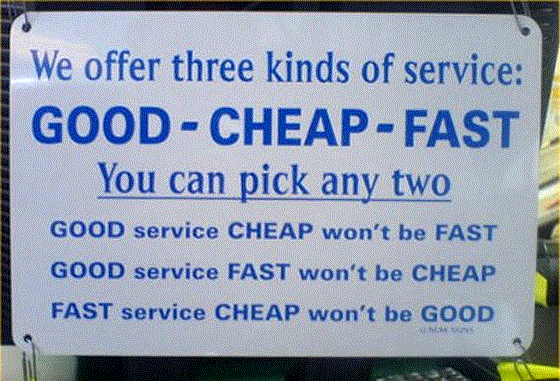
good cheap fast

Some basic tools are needed to redesign operations to improve performance. Many people charged with responsibility for managing services have limited skills in how to redesign and improve them. Here is a simple and effective approach – just separate, relate and integrate.

The separate bit is about understanding the different demands being placed on the system. Usually, a performance problem is masked by a mess of different demands that have been mixed in one or two delivery processes. The important characteristics of services demand are the expectations of people creating the demand and how the demand is presented. It is essential to separate each type of demand according to its performance objectives and characteristics. Continue reading

106 – Some of the seldom asked questions in local government. What are they?

Posted by Whistler                                                                                          390 words

the thinker

I am sure these are not the only great unasked questions. But they are questions that frequently come to mind when you are in one of those interminable meetings talking about the same old topics.

  1. How does this add value? This is a question that often runs through my mind but it never seems appropriate to ask it. It just doesn’t seem relevant. As much as we say that we are serving the community, we choose to do it in our own way. What the community sees as value, and how they want it to be delivered, isn’t something we question enough.
  2. Am I the best person to do this? I like this question and have regularly asked it of my direct reports and encouraged them to ask it. My Group Manager has never asked it. As officer, we seem to like spending time doing things that we know how to do well, or that make us feel good because we have ‘saved the day’, or because it is just easier than the effort required in getting someone else to do it properly. Looking for the work that only you can do, and then doing it, can take you out of your comfort zone.
  3. What can we do to act on the customer survey? Each year, councils in Victoria participate in sector wide customer satisfaction monitoring. The survey results are made public and daily media report on the state wide results. Through this process it is possible to be identified as the worst performing council and this places a high level of pressure on councils. But does it lead to serious questioning of what can be done to act on the survey and really make a difference? Not often. There will be discussion about the results. A lot of time will be spent discussing the shortcomings of the methodology. But really trying to understand the results and act to improve customer or community satisfaction by taking some risks to improve value? I don’t think so.

After writing them, I found that there was a theme to these questions – we need to question what we are doing to make sure that we are adding value by doing what needs to be done to satisfy purpose or meet need or create value. Call it what you like, just do it.

105 – Some characteristics of services demands that are important.

Posted by Lancing Farrell                                                              1100 words

operations typology 2

Image from Operations Management, 1998.

Some time ago I posted on high performance job design using four characteristics or spans; control, accountability, influence and support. At the time I linked the concept to the operations typology describing four characteristics of design of operations for high performance. This post picks up that discussion to look at the characteristics of demands that it is essential to understand if you want to design and manage your operations for high performance or excellence in local government.

A number of recent books on public sector management have discussed demands and how it is essential to understand them in public services because payment is not made at the time of service consumption and, therefore, price does not directly influence the amount and nature of demands placed on the system.

In his Vanguard Method John Seddon describes the importance of fulfilling purpose if failure demand is to be avoided. He also talks about understanding flow in relation to how work enters a system. Both of these ideas relate to demands. If purpose (i.e. the value sought by someone or their demand on the system) is not correctly understood the work system will not meet their need. They will come back.

Mark H. Moore includes operational capacity in his ‘strategic triangle’ concept linking decisions from the authorising environment to the public value provided. An organisation must have the operating capacity (or capability as Moore describes it in his earlier book Creating Public Value) to deliver on the political commitment to create particular public value. Continue reading