290 – The Capability Trap: How Budget Cuts Damage Councils Long Before Anyone Notices.

3100 words (15 minutes reading time) by Colin Weatherby

Podcast option:
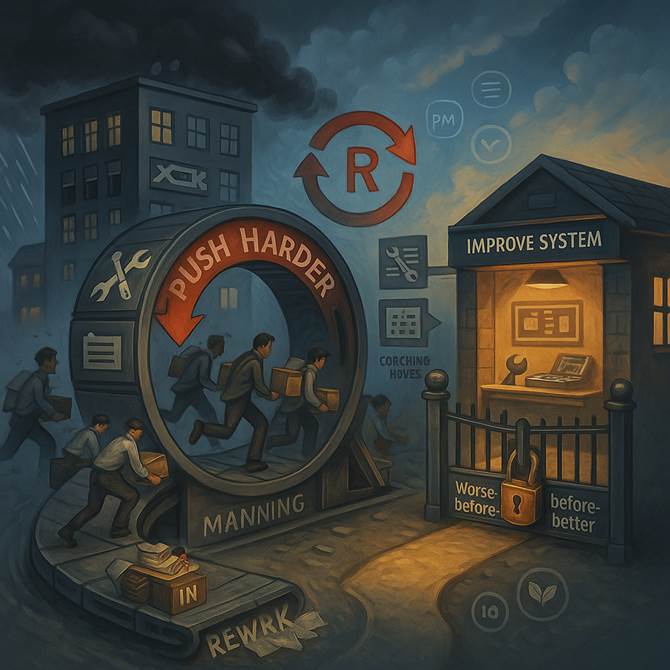
Credit: ChatGPT

Summary

  • Councils under rate caps are being pushed into a capability trap: cutting investment in how work is done, while demanding the same (or more) output.
  • Doing more with less works for a while, then it quietly destroys the ability to deliver safe, reliable services.
  • Escaping the trap means shifting from “work harder” to “work smarter” – investing in process capability, not just pushing people to do more.
  • This piece explains the trap in plain language and offers advice to avoid it.

Introduction

After ten years of “doing more with less”, many council roads managers describe their world like this:

“Today, I barely recognise our roads program. Every budget cycle we cop another efficiency dividend, another round of ‘temporary’ cuts to inspections, reseals, heavy patches and drainage repairs. On paper the program still looks coherent thanks to some clever rephasing and optimistic assumptions, but out on the network the cracks are literal.

We’ve gone from renewing assets at the right time to stretching them well past their use-by date. Crews that used to do planned maintenance now spend most of their time chasing potholes and complaints. We’ve sweated the plant so hard that breakdowns are normal, and cut training and supervision to the point where we’re relying on a few old hands to hold everything together.

What hurts most is knowing this was avoidable. Every ‘saving’ we booked was borrowed against the future condition of the network. We’ve lost capability in quiet ways – trainees we didn’t take on, engineers who left and weren’t replaced, inspectors who no longer have time to inspect, relationships with contractors hollowed out by always taking the lowest price.

The community still expects the same level of service, but we’re no longer set up to deliver it. We’ve traded investment in capability for short-term budget wins, and now the bill is arriving as risk, backlog and a network that’s deteriorating faster than we can look after it.”

This isn’t a story about lazy workers or bad managers. It’s what it looks like when a council slides into what Repenning and Sterman call the capability trap – without realising it.

Unfortunately, this is an all-too-common council story. Problems are clear to the workers, but their managers are hard at work on the organisational treadmill.

Why is service improvement so difficult?

Repenning and Sterman have studied organisational improvement efforts to understand why they are not sustained. Their research (grounded in more than a dozen case studies across industries and multiple formal simulations) suggests:

  • Identifying and learning about improvement methods is not the main barrier to improvement.
  • Implementing improvement methods presents the biggest challenge.

They say that the inability of organisations to get the full benefits of improvements has little to do with the method selected. It has much more to do with “how any improvement method interacts with the physical, economic, social and psychological structures in which the implementation takes place”- it is a systemic problem, not a people problem.

Their research provides useful insights for those contemplating service improvement in local government.

The capability trap

Repenning and Sterman describe the capability trap as the situation that arises when:

  • Managers think that the gap between desired and actual performance is attributable to the effort level of workers.
  • Managers put pressure on workers to do more or better work.
  • This continues until the limits of working harder are reached and damaging workarounds occur.

The alternative is to see the performance gap as the result of the inevitable decay in capability resulting from lack of investment in creating and maintaining capability. Rather than blaming workers and putting pressure on them to do more work, the other choice is to spend time improving the capability of the process workers are using. This avoids the capability trap, but for reasons I will explain, it is also frequently avoided by organisations.

As Repenning and Sterman point out, once you see this structure, you’ll notice it everywhere – in IT projects, asset maintenance, and even your own exercise or learning habits.

Figure 1 – Capability as a ‘stock’ requiring investment to prevent erosion (Repenning and Sterman, 2001).

Before going any further, it is worth noting that Repenning and Sterman view capability as a ‘stock’ that is created and accumulates, and then decays in a dynamic system. They say capability has a lifecycle, and without ongoing investment, especially if the organisation’s services are changing, it will erode.

How does this affect councils?

Rate capped councils are vulnerable to the capability trap described by Repenning and Sterman because:

  • Demand is increasing through population growth.
  • Performance gaps are becoming more apparent as community needs and expectations change.
  • Councils can’t increase rates to get more resources.

In many rate-capped councils, the dominant belief is:

If we can’t raise more revenue, the only thing left to do is cut costs and push workers harder.”

Repenning and Sterman say that in the absence of extra resources, reducing the gap between desired performance and actual performance requires council managers to make one of two choices:

  1. Put pressure on workers to put in more hours and work harder to increase their output (i.e. produce more with the same resources) – the ‘work harder’ balancing loop (B1).
  2. Put effort into improving process capability to increase output from each hour worked – the ‘work smarter’ balancing loop (B2).

Figure 2 – The work harder and work smarter balancing loops (Repenning and Sterman, 2001)

How does working harder compare with working smarter?

Working smarter gives you more capable processes that deliver more in the same amount of time. The following comparison shows the effect of an increase of 25% in time spent working versus the same increase in process capability when the performance required is collect 1000 bins a day.

More time working

A kerbside waste collection truck can collect 100 bins each hour worked and a working day is 8 hours with a maximum of 10 hours with overtime. This allows 800 bins to be collected in the working day and a further 100 bins in each of the additional 2 hours that can be worked as overtime (i.e. max 1000 bins total). Ten hours of labour is required for every 1000 bins collected.

More capable process

If the process is improved so that 125 bins can be collected each hour, in an 8-hour day 1000 bins can be collected. If overtime is worked, each hour would result in another 125 bins being collected for a maximum of 1250 bins. Eight hours of labour is required for every 1000 bins collected.

You might ask how councils put their workers under pressure to do more work. It is not always obvious. A common way is to arbitrarily cut budgets and require workers to continue delivering the same service with less resources. This is sometimes dressed up as getting ‘back to black’, or as an annual efficiency dividend applied to all budgets. It also happens when recruitment freezes stop staff replacement, or there are vacancy holds to delay recruitment.

Why is working harder so popular with managers?

Leaders like the immediate and unambiguous increase in output that comes from working harder:

  • The cause and effect are close in time.
  • It feels responsible under budget pressure.
  • It produces numbers that look good on a dashboard – for a while.

None of this means managers are stupid or uncaring. Under rate caps, they are rational actors in a bad system:

  • The budget rules punish visible overspending, not the invisible erosion of capability.
  • Short-term results are rewarded, while long-term risk is someone else’s problem.
  • Doing more with less is welcomed by councillors and the community.

The capability trap is a systemic problem that smart, committed people fall into. The risk in using pressure to do work (B1) to overcome performance problems is that the reinvestment loop (R1) will lock it in as the permanent way of working. If this happens, the natural limits to finding more time to do the work will eventually be reached. Paid overtime will reach the limits of budgets or the EA. Unpaid overtime will reach the limits of tolerance of workers and their families.

Repenning and Sterman say workers are unlikely to let their supervisor know when they are unable to work any harder and they will start finding more of their work time to produce outputs by missing breaks, avoiding training sessions or meetings, deferring vehicle servicing and repairs, keeping incomplete work records, and not following all the steps in a procedure. They will cut corners, game the system to achieve targets, and spend less time learning and improving. Workarounds will become the norm as the shortcut loop (B3) kicks in.

Figure 3 – The reinvestment reinforcing loop and the shortcuts balancing loop (Repenning and Sterman, 2001).

In councils, the workers are no different. A common response to pressure to do more with less is to reduce time-intensive preventative programs and wait for reactive service requests. For example, it takes less time to patch the potholes reported by road users than to inspect and maintain all roads to avoid potholing.  It has the added benefit that it is cheaper in the short-term and gives you something to measure (remember the title of Repenning and Sterman’s paper is ‘Nobody Ever Gets Credit for Fixing Problems That Never Happened’).

This approach gives several years of benefit before failing roads pothole so badly that they have to be renewed. A worse problem is if workers stop creating safety when they trade-off time, cost, quality, and safety to get more work done. It is easy for both psycho-social and physical injuries to increase when workers are under put under pressure to do more work without extra resources or better processes.

How do you get caught in the capability trap?

The capability trap emerges when managers:

  • Choose the ‘work harder balancing loop’ (B1).
  • It is made permanent by the ‘reinvestment loop’ (R1).
  • Then the ‘shortcut balancing loop’ (B3) takes effect when the limits of working harder are reached.

Getting out of the capability trap is difficult for managers because they seldom realise they are in it and the feedback they are getting reinforces their behaviour. After all, there was a performance gap, they applied pressure, and more output was produced.

When the limits are reached and there is no further improvement in performance, Repenning and Sterman say the managers blame lazy workers, difficult unions, faulty equipment, fickle customers – all factors beyond their control. It is easy for managers in councils to blame insufficient resources, unrealistic community expectations and poor culture for performance gaps.

When they do, it reflects a common mindset, which is reinforced by their experience in working harder. Psychologists call this fundamental attribution error: assuming performance is mainly about individual effort instead of the system. Then experience adds self-confirming attribution error: because pushing harder worked in the short term, we “learn” that pressure is the answer – even when it will eventually make things worse.

For many council managers, it is the only way of working they have ever known, and many leaders have been very successful working in this way. After all, if you move on every few years the damage from the working harder balancing loop is unlikely to be evident.

How do you get out of the capability trap?

Repenning and Sterman start running out of definite advice at this point. They explain why it is hard to get out of the capability trap, and what needs to happen, but have few examples of how companies have managed to do it.

Organisations that have become dependent on firefighting and working harder to solve performance problems caused by low process capability, are in a difficult situation. Their performance is low, work pressure is intense, and making time for improvement quickly overloads workers. This leads to a short-term drop in output and performance.

Observing that performance is not immediately improving, as they are accustomed to seeing by working harder, managers think the improvement method is not working and they abandon it and look for an alternative. This leads to ‘flavour of the month’ programs. I once started a new job as a manager and was asked by the office coordinator what new method of improvement I had in mind. I had never had that question before. Her cynicism was obvious.

After working at the council for over 20 years, she was able to show me the ‘FISH! A Proven Way to Boost Morale and Improve Results’ book, two Australian Business Excellence Framework booklets (two different CEOs), the ‘Who moved my Cheese’ book, and a handout from the ‘Colloquium’ training provided by the Australian School of Applied Management. No doubt all methods could improve services but none had been sustained.

Repenning and Sterman suggest that experiences teach managers the wrong lessons, and new mental models are needed to remove barriers to implementing improvement and then sustaining it. They give examples of normative processes using models to allow all stakeholders to see and understand inter-relationships. My experience has been that this sounds easier than it is in practice. For it to work, leaders must be open to new ways of thinking and curious to learn about different ways on managing.

Shifting a leader from a successful career seeing performance problems as the result of workers needing more pressure to do work, and then successfully applying more pressure and getting improved performance is challenging. Often, they have moved jobs before the erosion of capability becomes obvious. When they do move on, often to another council where the erosion of capability is starting to show, they still blame people – the previous leader didn’t do something that they should have done!

Some suggestions from Repenning and Sterman

Repenning and Sterman say:

  • Working harder creates the ‘better-before-worse’ paradox because improvement is immediate.
  • However, eventually working harder erodes capability and reduces performance.
  • In comparison, working smarter leads to ‘worse-before-better’ because there is a delay between time spent on improvement and increased capability.
  • However, eventually working smarter increases capability and performance.
  • The delay from working smarter is a deterrent.  

They go on to say that performance = effort x capability and show the difference between working harder and working smarter in the following diagram.

Figure 4 – Simulations of the working harder and working smarter strategies (Repenning and Sterman, 2001).

Based on these comparisons, it is hard to see how any leader could think working harder is the best solution to their problems. There is obviously something else needed to convince leaders to take practical steps to avoid or escape it. They need an argument to overcome the rewards from instant gratification.

Repenning and Sterman give two examples of organisations that have broken out of the capability trap and sustained improvement. Both feature the same experienced manager, Winston Ledet, who worked for Du Pont before moving to British Petroleum. He used the same method at both organisation.

Both organisations had been cutting costs, which resulted in reduced preventative maintenance with flow on impacts to operations through increased breakdowns, reduced uptime, and higher costs. It also impacted on sales when reliability to supply went down. Ledet developed a model to understand what was happening and determine the changes were needed.

The model was developed by Du Pont staff with help from an experienced modeler. It became a ‘laboratory’ to design and test new ideas. It showed how performance would deteriorate then improve. The challenge was now how to implement it across a company with thousands of workers. They had an added complication – Ledet and his team realised that their understanding had changed as a result of their involvement in creating the model. For implementation to be successful, they needed to facilitate a similar normative learning experience for workers in their plants.

To do this, they turned the model into an interactive role-playing game, which was embedded into a 2-day workshop called a ‘learning laboratory’. This workshop was run at all their plants, sometimes multiple times, to support implementation. Ledet repeated this process later at British Petroleum.

Both organisations continued to be challenged by the need to reinvest gains from improved capability. Locking in gains through downsizing or budget cuts is an ongoing risk and needs senior management commitment to working smarter for it to be avoided. Repenning and Sterman say the Du Pont and British Petroleum examples show the power of a shift in mental models.

Ledet and his colleagues did two things worth copying in councils:

  • They made the system visible – using a model that showed how cuts to preventative work would reliably produce breakdowns, higher costs and lost sales later.
  • They let people “fly” the system safely – turning the model into a game so thousands of workers could experiment and see, for themselves, why working smarter beat working harder.

The interactive game developed by Winston Ledet (and still going after 40,000 participants) demonstrates a way that councils could use to reduce risks from learning in the real system, enable everyone to learn about the system, and for them to see it from each other’s perspective to encourage systems thinking. These are all valuable outcomes.

My question is whether it is enough to avoid the capability trap.

Conclusion

At this point, I must thank two colleagues who gave me the benefit of their thoughts about the paper. Neither did that with the knowledge that I might use their comments in a post, so they will remain anonymous.

The first gave me insights based on their work in helping organisations move beyond command-and-control management. They saw this paper as a cautionary tale but not a solution. In a nutshell, they said if leaders still think they are responsible for implementing improvement, and that this can be done without studying demand and understanding customer purpose, then they won’t ever work smart enough to get out of the capability trap and stay out of it.

The second looked at the paper through the lens of W. Edwards Deming’s work. They saw the search for ‘instant pudding’ and the focus on the short-term as leading people into the capability trap and keeping them there. They thought that the paper highlighted how lack of understanding of the system led to poor decision making.

In conclusion, I agree with them both. It is alarming to see so many councils simply cutting budgets and asking workers to do more without understanding the work as a system. Many councils seem to be running headlong into the capability trap.

Escaping is not about heroics. It calls for a different kind of courage:

  • The courage to admit that “do more with less” is degrading your organisation.
  • The courage to protect time and money for improvement when budgets are tight.
  • The courage to be remembered as the leader who left behind a more capable council, not just a balanced budget.

If you’re willing to entertain that possibility, the first step is simple: stop asking only “How can we squeeze more out of this year’s budget?” and start asking “What will this decision do to our capability five years from now?”

References

Nelson P. Repenning and John D. Sterman, Nobody Ever Gets Credit for Fixing Problems That Never Happened, California Management Review, Vol. 43, No. 4, Summer 2001.

Winston J. Ledet, Engaging the Entire Organisation – The Key to Reliability, The Oil and Gas Journal, Vol. 97, Issue 21, 1999. More information is available here.

Note

The podcast was created using Notebooklm.

284 – The Public Service Chain Reaction.

1700 words (18 minutes reading time) by Carole Parkinson

The Deming chain reaction

Tim Whistler cuts straight to the chase. In the case of his latest piece, I think he could do with a little nuancing of what he is proposing. His description of the disruption to ensue if councils can’t manage their finances with a rate cap is probably accurate, but also, avoidable.

I have been talking to executives at councils and it is true that they are grappling with defining and agreeing on what they need to do. Everyone involved in leadership seems to be pulling in a different direction – Finance wants direct funding cuts to balance budgets now; Directors want efficiency drives to fit services into budgets as soon as possible; Councillors want to cut services they think the State should provide and avoid electoral backlash when they stand for re-election in 2028. It is a vicious cycle.

I have a more immediate approach, which neatly fits with Whistler’s focus on infrastructure as the big service, allocating capital first, and, most importantly, reducing expenditure where you should, not just where you think you can.

Continue reading

276 – Synchronicity, systems, facts and accidents…

1300 words (14 minutes reading time) by Lancing Farrell

I have been doing some diverse reading recently, some of it inspired by world events. Serendipitously, it has led me to an insight that I thought I would share.

Why we’re Polarized

The first book is Ezra Klein’s international bestseller ‘Why we’re Polarized’. He says the book is an examination of the American political system and that it is unlike most books on American politics, which he says tend to focus on the individuals.

“Let me be clear from the beginning: This is not a book about people. This is a book about systems.”

Ezra Klein, ‘Why we’re Polarized’

Klein is an American and says two decades of reporting on American politics has shown that it has predictable cycles and patterns that repeat. He sets out to explain the failure of the political system, which he says occurs despite it being ‘full of rational actors making rational decisions given the incentives they face’. He describes it as a collection of functional parts that combine into a dysfunctional whole.

Continue reading

274 – The Wigan Deal and Value for Money

1500 words (17 minutes reading time) by Carole Parkinson

The Wigan Value for Money Statement

Lancing Farrell’s post on Wigan and the Deal 2030 explains how a council has successfully decided to make a radical change in the relationship with its community in response to austerity measures imposed by central government. By all accounts the Deal 2030 has been successful in reducing the resources needed for the council to deliver its services, in large part by reducing demand for those services by helping people to do things for themselves or to access services provided by the VCFSE (voluntary, community, faith and social enterprise) and private sectors.

It is 10 years since the Deal 2030 was launched. As with any big organisational change, it is hard to evaluate its success from the outside. To help us, there have been several reviews of the Deal 2030 since it was implemented, including the King’s Fund (2019), the Centre for Policy Impact (2019), and a Corporate Peer Challenge (2017). All have reported favourably on both the success in implementing actions in the Deal, and the impact of those actions on the Wigan community. Therefore, it was with some interest that I saw Wigan Council has recently released a Value for Money Statement.

Perhaps everything is not what it appears?

Continue reading

271 – Victorian government enquiry into local government

1000 words (11 minutes reading time) by Colin Weatherby

The Victorian state government’s Legislative Council Economy and Infrastructure Committee has started an enquiry in to the funding and service delivery of local government in the state, which will look at:

  • The effects of cost shifting from the state and federal governments to local councils in an examination of vertical and horizontal fiscal imbalances.
  • Whether local councils are adequately delivering on their core service delivery objectives.
  • The overall revenue structure of local government.
  • Whether the existing revenue structure is sustainable and appropriate or if alternative models of funding would be more sustainable and appropriate.
  • Any other related matters.

This is a timely review and comes at the same time that the national government is also holding an enquiry into the financial sustainability of local government. It seems that the other levels of government have become concerned about whether councils are able to meet community needs and expectations now and in the future.

Unsurprisingly, the Local Government Finance Professionals (FinPro) have made a submission to the Victorian enquiry . They make a number of interesting points in their submission.

Continue reading

264 – ‘What on earth is a paradigm shift?’ – Centre for Public Impact

400 words (5 minutes reading time) by Colin Weatherby

I have been experimenting with Microsoft’s ‘everyday AI companion’, called Copilot. I asked it to analyse the podcast ‘What on earth is a paradigm shift?’ by the Centre for Public Impact.  I am not trying to second guess the great work by Lancing Farrell, simply to show how some new technology works!

This is what it came back with:

The podcast ‘What on earth is a paradigm shift?’ by the Centre for Public Impact (CPI), is a  conversation between Adrian Brown and Professor Toby Lowe, who are both part of the CPI team. They discuss the concept of paradigms and how they apply to public service and systems change.

Here is a brief summary of the podcast:

Continue reading

263 – System governance is the key to shifting the local government paradigm

850 words (9 minutes reading time) by Lancing Farrell

The need for a new paradigm in local government in Victoria has been mentioned in a few posts recently (see 241 – Rate capping – the final words (from our future), 253 – Minds Change: My Journey to Transform Local Government Performance, and 261 – Reinventing Local Government). Model collapse, as described by Carole Parkinson and Tim Whistler, signals the end of an existing paradigm. This raises critical questions about the current paradigm in local government and the need for change. A recent podcast in the Reimagining Government series by the Centre for Public Impact, ‘What on earth is a paradigm shift?’, discusses paradigms and provides insights and practical tips for those wanting to bring about transformative change.

Defining Paradigms

The podcast features host Adrian Brown and Professor Toby Lowe from the Centre for Public Impact, Henk-Jan Dekker from the International Centre for Environmental Research and Development, and Jessica Studdert from think tank ‘New Local’. Drawing on the work of Thomas Kuhn and Margaret Masterman, a paradigm was defined as a ‘grand explanatory narrative for how a part of the world works’.  It operates on metaphysical, sociological, and exemplar levels, shaping perceptions of what exists and what should be valued. Understanding how paradigms work is crucial for those seeking systemic change in local government.

Continue reading

257 – Austerity and Victorian local government

800 Words (9 minutes reading time) by Colin Weatherby

I was reading the latest Local Government Information Unit (LGIU) newsletter from the UK and the news item in the image above caught my attention. Although the cause of the problem is central government cutting funding to councils, not imposition of a rate cap, it has the same effect on council finances and reinforces the view I expressed in my posts about the effects of the rate cap (‘Il comune povero- ‘The poor municipality’ and ‘Rate Capping – the final words (from our future))’. Councils in Victorian can respond by trying to improve current services and increase revenue, find efficiencies and reduce waste in operations, and they will still be unable to meet community needs and expectations within their available resources.

In Victoria, councils cannot issue a section 114, which in the UK means that all spending, apart from on protecting vulnerable people and providing statutory services, will be suspended. Instead, the Victorian government sends in Monitors to oversee council decisions, and then, if the council doesn’t respond as the State requires, they can dismiss the council and appoint Administrators to run the council. In the past, this has resulted in decisions being made by the unelected Administrators to sell community assets, cut services and make whatever changes they think are necessary to get the council back in the black. This tends not to meet community needs and expectations either.

Continue reading

253 – Minds Change: My Journey to Transform Local Government Performance

600 words (7 minutes reading time) by Lancing Farrell

Have you ever had that eureka moment where something you were trying to understand is suddenly made crystal clear to you? That’s exactly what happened to me after reading David McRaney’s thought-provoking book, ‘How Minds Change – The New Science of Belief, Opinion, and Persuasion.’ This enlightening read gave me reason to revisit some past posts on improving local government performance. In reading the book (and this is deliberate by the author) I was led through Piaget’s stages of assimilation and accommodation, before eventually reaching a Kuhnian paradigm shift. My epiphany was realising why organisational change is so hard.

When I looked back at my earlier posts, I realised that my growth as a leader accelerated when I first saw work as a system. At the same time, I genuinely believed that I needed to become the architect of better approaches. I had an academic background, experience of travelling overseas to broaden my outlook, and a relentless passion for my work. I thought that if anyone could revolutionise services, it would be me.

However, this view eventually transformed into a more holistic and community-oriented perspective as I started to see the work as a ‘frog’ system, not a ‘bike’ system. You’ll need to read my previous posts to grasp the analogy, but in essence, I transitioned from a thinking I needed to be a one-man show and lead others by giving them better ways, to a more participatory approach where everyone is engaged in finding improvements.

Continue reading