193 – ‘Losing my importance’ (with apologies to R.E.M).

Posted by Whistler                                                                                          350 words

feather duster

I was talking with a colleague recently about a matter that I believed was important that wasn’t being addressed and my thoughts on why this was happening. He made a salient comment – the longer resolution is delayed, the less important the matter becomes. Over time it will lose its importance. 

How often have you heard people say ‘if it was important, it would have been done by now’. Working in local government is a constant battle between the urgent and the important, and finding out what is really both urgent and important. Social media has injected a definite sense of urgency into political problems, but are they really important?

I have often wondered why managers have such difficulty seeing the difference. The following matrix can be a helpful way to focus your attention.

important and urgent matrix

If a distant fire front is left burning it is understandable if it ceases to become important. Either people become accustomed to it or they don’t see the need for action. Far more attention is generated by the spot fires started by embers from the fire front and generating lots of busy work. They are usually at your feet and visible to everyone and there is immediate heat if they are left unattended.

In comparison, better planning and decision making is always deferred when distractions present themselves. I know many managers whose daily work is driven by the emails that they receive throughout the day – they continually scan their inbox for the next thing to do.  It is easier than getting their minds around the hard stuff of management.

On the flip side, I once had an experience when I was the acting Group Manager and I was unsure of the importance of a document I had received. I asked the Personal Assistant to the Group Manager whether or not she knew if the document was important. Her response was an insight into her 20 years as a personal assistant to Group Managers. She said ‘that’s your job – make it important’. So I walked down the hall and handed it to a manager and asked him to act on it.

Instant importance.

192 – Boundaries, interfaces and thresholds. Why do we love them so much?

Posted by Whistler                                                                                         450 words

stile over fence boundary

I was at a meeting recently where officers were discussing who is responsible for different maintenance activities. They had developed a ‘demarcation information guide’ for the managers of facilities so that they could try and work out who to contact for different maintenance tasks. It told you who looked after fences, paths, lights, floor coverings, broken windows, etc. It started me thinking about local government’s penchant for boundaries (nobody suggested that an alternative could be service integration).

I think we like to set boundaries because it lets us focus on what is special about ourselves as a point of differentiation from other local governments. I once worked at a council where the CEO said that we should act as though the world ended at the municipal boundary. We were different to everyone else. He said to imagine that if you left the municipality you would fall off the edge of the world. As a leadership ‘device’ it certainly focussed attention on the municipality. It was a simple and effective way to differentiate the council – pretend there is nowhere else!

This approach reinforces the view that each council is ‘special and different’, rather than accepting that we have more in common than we have that is different . This view is evident when councils are reluctant to share systems or services. In Victoria we resisted municipal amalgamations and many councils still complain about them. I think it is part of our culture to resist ideas from outside our sector or organisation. This creates a safe and reliable place.

We also like interfaces. If we didn’t, why would we design our organisations around town planners, engineers, social workers and accountants? The functional structure of councils creates lots of interfaces between units, departments and divisions in the processes that actually deliver services. It is these interfaces that result in service failure and the resultant ‘failure demand’ identified by John Seddon. Work flows across interfaces, not up and down within silos.

And thresholds abound. There are the tiered levels of authority delegated by the CEO. The typical council ‘command and control’ structure, so criticised by John Seddon, puts in place lots of hierarchical thresholds. We have entry levels for employment. Anyone unsuccessful in applying for a senior role will be familiar with the response ‘we had other applicants already at the required level’ when you seek feedback.   We like to employ people based on what they have done rather than what they can do. Suppliers and contractors who are new to local government struggle to get a customer. Once you have worked for a council, the others will open their doors. Getting the first council is the hard bit.

I think that the attachment to boundaries, interfaces and thresholds comes from our desire to limit things –  the extent of our responsibilities; the extent of authority; the amount of risk we will take.

190 – Micro managing and macro directing. A local government phenomenon?

Posted by Whistler                                                          600 words

macro manager

I was reading about ‘macro managers’ and the five signs that you could be one when it occurred to me that the divide between the Executive and managers in local government can be partly explained by this idea.

We are all aware of ‘micro managers’ and the problems associated with managers who constantly get right into all the details. Wikipedia describes it as ‘a manager who closely observes or controls the work of subordinates’ and comments that it generally has negative connotations. I agree. But how often do you see it in local government?

Some of the ‘symptoms’ of micro management are low levels of delegation, requests for unnecessary reports, taking credit for others’ results (particularly the more narcissistic micro managers), blaming others, and denying their behaviour by describing themselves as ‘structured’. I would add the disempowering effect it has on people.

In contrast, at the next level up in the organisational hierarchy macro management tends to occur. Continue reading

189 – Essay No. 2 – Local government, effectiveness and efficiency.

Posted by Lancing Farrell                                                                              3300 words

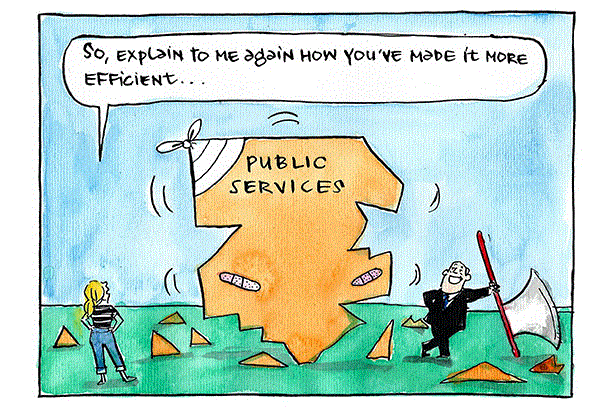
false economy cartoon

Image

People in local government regularly discuss effectiveness and efficiency. Often this happens in relation to pressure on revenues, such as rate capping. Most of the discussion centres on efficiency rather than effectiveness, and opportunities to stop delivering those services that are seen as ‘cost shifting’ from other government. The efficiency discussion is often not well informed. Frequently it focuses on inputs while ignoring outcomes and public value. Any savings are usually equated with cost cutting, not creating the same value at lower cost.

Australian researcher and writer Christopher Stone has published several papers on ‘false economies’. Each addresses a different aspect of productivity and efficiency in the public sector.

“Everyone has the right to know that money is not being wasted; that it is being spent as efficiently as is possible.” Christopher Stone, Decoding Efficiency, April 2013.

So, what is efficiency and how does it differ from effectiveness? Continue reading

187 – A high functioning Executive. What would it take?

Posted by Colin Weatherby                                                                                         1100 words

awesome

This is a question I was asked recently by a reader. Having read several posts critical of the behaviour of the Executive (What can a culture survey, an organisational self assessment, and your Executive’s risk appetite tell you?, The Executive. What exactly is their role? , Does your Executive suffer from altitude sickness?, and The Executive: filters, traffic controllers or drivers? ) she wanted to know whether I had a solution. Knowing that it is easier to be critical than creative, I cast my mind to thinking about the nature of the problem and some potential solutions.

I think the starting point is to understand the problem. In a nutshell, I think the following issues illustrate the problem:

  1. The Executive is overloaded with the small stuff handed to them by councillors (not the council). Much of it has to do with the personal idiosyncrasies of councillors and behaviours arising from their inability to work together as a group. It is dysfunctional, urgent and produces little value for the community. There are better ways for potholes to be reported.
  2. The Executive has to deal with high level relations with external organisations and strategic external pressures. These are often CEO to CEO relationships and cannot be readily delegated.
  3. The Executive is not putting enough time and effort into leading the organisation. Their focus on councillors and the external environment takes most of their time and energy. At the same time, they worry about problems 1 and 2 being made worse so they try to control organisational communication and decision making. When this is done ‘efficiently’ by time poor leaders it drives dysfunctional management behaviours.
  4. The Executive operates independently of managers and participates in the Senior Management Team (SMT) episodically. There is frequently no genuine and continuous engagement with the SMT in strategy and decision making. Managers are included in decision making when it suits the Executive – which is usually when they have the time and energy to do it. Managers are effectively isolated from information and the strategy decisions being made continuously by the Executive.

Obviously there are different solutions possible. Continue reading

186 – Essay No. 1 – Local government and accountability.

Posted by Lancing Farrell                                                                              2000 words

rabbit in headlights

This is the first in a series of essays to wrap up the 200 opinions, essays and observations from Local Government Utopia. As such, it attempts to bring together some of the themes that have emerged in the various posts.

Have you ever imagined yourself to be in the office of the CEO?

You have arrived at work to be told that The Ombudsman’s office wants to talk to you about the outcome of an investigation triggered by a Whistleblower. You have a meeting at the Auditor General’s office that morning to discuss the latest report they have released on Council Customer Service. A copy of the Independent Broad-based Anti Corruption Committee (IBAC) report on Council Depot Management is in your in tray along with a complicated Freedom of Information request.

That evening you have a Risk and Audit Committee meeting where you need to explain the lack of action in implementing recommendations from the 10 internal audits completed in the previous year. A councillor has left you a phone message saying they are unhappy with a decision regarding services delivered to an elderly resident. There is an email from the local newspaper wanting comment on an expose they are running on councillor entitlements.

I am sure this is not a usual day. But it also isn’t an entirely unrealistic scenario either. There are lots of sources of accountability for local government. Often, they act on the organisation independently and there is no effort (and sometimes no opportunity) to coordinate the organisational response. As a result, sources of accountability frequently operate at cross purposes and can be counter-productive. Continue reading

184 – Long Read: What matters and what works. Why feasibility is important in local government.

Posted by Parkinson                                                                                                       380 words

light

I have a colleague who often uses an analogy that I have always liked but never really understood why. Recently I have discovered that it is called the ‘streetlight effect’ or the ‘drunkards search’.

In the analogy two people are walking down a street to where their car is parked when they realise they have dropped their car keys somewhere in the pitch black darkness. They must find the keys before they can go home. They are looking around blindly in the darkness for the keys when one of them sees a light further down the street. They then go and look for the keys under the light where they can see.

The two people can’t do what they really need to do so they go off and do something that they can do. Even if it will never achieve the outcome they want. He often uses this analogy when talking about matters of council policy. What I have realised is that he is questioning the feasibility of the actions being taken to achieve something important.

I was recently listening to a podcast of the first Cranlana lecture for 2012 on the topic of the ‘Good Society’ given by Professor Dan Russell. In it he talks about the importance of feasibility in public policy. He says that often ambitious public policy fails because of the unavailability of feasible actions to implement it. Professor Russell says that putting feasibility first is the answer to the challenge of how to make hard moral decisions. This seems like good advice.

It is a variation on the streetlight effect, where what needs to be done to achieve what matters is known but impossible. Instead, effort is put into doing something that will never achieve what matters but it enables something to be done. It is pointless activity but it makes people feel better than they would just waiting for daylight.

Professor Russell believes that you must first look at what is feasible before setting priorities for action – we must think about both what really matters and what really works. If we do not do both, he believes it can makes it difficult to convince people that the action taken is really trying to do something about what matters.

So, how is this relevant to local government? Read on …

182 – Public management, or management in public?

Posted by Whistler                                                          220 words

scaredy cat

I was reminded today of a practice that seems to have crept into local government with the increasing insecurity and risk aversion of top management. It is similar to the concept of ‘risk farming’.

The practice involves your manager avoiding responsibility by setting up meetings for anything that is happening that they sense could have a down side. In the past, a discussion with your manager at your one-on-one meetings would have sufficed. You could let them know what is happening and undertake to keep them informed.

Now, they are likely to ask you to set up a series of meetings involving them and anyone else they can think of who may have an interest in the matter. The purpose is to ‘keep an eye’ on the issue and ‘support’ you in seeing it through. At the meetings you become publicly accountable for your management of the matter.

In the event that the matter blows up, your manager will implicate everyone else involved and they will be witnesses to your failure. Your manager will no longer be held accountable for your performance – after all, there was a whole group of people ‘supporting’ you.

I am old enough to remember when a manager would provide support by encouraging and advising, and by standing by your side when things were getting tough. They don’t seem to be able to get out of the way fast enough now.

As someone said to me recently, when people don’t know something they get sacred and when they get scared their aversion to risk goes up.