139 – A question. If I was the CEO what would I do? Answer: Nothing.

Posted by Whistler                                                                          230 words

heart rate

This is my response to the question posed by Lancing Farrell.  I think the CEO has found local government the way we like it. I am not sure what their problem is. A strong and autocratic style from the CEO reassures us that there is someone at the top calling the shots and keeping the councillors in line. With no one prepared to make difficult decisions it keeps things stable and predictable. This suits the low level of organisational achievement and absence of time consciousness. What more could you ask for?

With people running the place who have been rewarded for their allegiances and length of service, this would be a predictable and easily understood workplace. Recruitment would be straightforward and safe. Anyone with experience in the sector would easily fit in and, so long as they got along with those in charge, could be quite successful.

Why the need for change? After all, why change something when you don’t have a clear idea of what you could or should change it to? Maintaining the status quo is a time honoured way to manage, especially in the face of uncertainty. Doing nothing could be the best thing to do and it is the lowest risk for those in charge.

Fear of change has been a hallmark of local government and an approach that has served it well. It has kept everything in its place. Consistency is important in service delivery and local government has been extremely consistent over many years. Everyone knows what to expect.

137 – EPM, PMO or JACI. What are our CEO’s talking about now?

Posted by Colin Weatherby                                                                         1180 words

project flow diagram

I recently attended a presentation on enterprise portfolio management or project management offices in Victorian local government. It seems to be the latest idea that has caught the attention of CEO’s in their search for solutions to problems they can see.

I must have been working in local government for too long. I have seen management by objectives, evidence-based decision making (or decision-based evidence making as I like to more accurately describe it), total quality management, reengineering, and more recently, lean and high performance teams. It is as though we look out our window and see someone doing something that looks like what we think we should be doing and we just copy them.

In two of the long reads (here and here) the shortcomings of copying the private sector are dissected by Peter Drucker and Henry Mintzberg. Continue reading

134 – ‘A new theory of value creation for local government’. Do we need one? Part 4 – Integrating the thinking.

Posted by Lancing Farrell                                                                              1600 words

cutting diamond

This last post in this series (see here, here and here for previous posts) is an attempt to synthesise a new theory of value creation for local government using the ideas discussed in the previous posts.

First, a quick recap on strategy, business models and operations stratgey.

  • The strategy is the position that an organisation takes in relation its market, the value it decides to create, and how it decides to create that value and operate at a surplus.
  • Every organisation explicitly or implicitly employs a business model that describes the design or architecture of the value creation, delivery, and capture mechanisms it will use.
  • The operating strategy then guides decisions about vertical integration, capacity planning, facilities planning, services technologies, and process technologies.

A new theory of value creation for local government will need to integrate these concepts into a cohesive and repeatable approach. Continue reading

132 – ‘A new theory of value creation for local government’. Do we need one? Part 3 – operations strategy.

Posted by Lancing Farrell

Slack operations strategy

Image from Operations Management, 6th Edition, Slack, Chambers and Johnston.

In this third post in this series, I look at the concept of the operations strategy. Every organisation has one. Your organisation does, but do you know why or what it is? And how does it relate to the business model?

This series of posts is intended to make the case that local government needs a theory of value creation – a clear explanation of what local government does to create public value. That theory will require a reappraisal of the operations strategy and the role that operational capability can play in supporting the business model and strategy execution.

Hayes and Wheelwright describe operations strategy as guiding decisions about vertical integration (i.e. the extent to which the council owns the value chain), capacity planning (i.e. how variation in demands will be met), facilities planning (i.e. the facilities needed to deliver services), services technologies (e.g. information systems) and process technologies (e.g. batch or make-to-order).

The academics Nigel Slack, Stuart Chambers and Robert Johnston in their text Operations Management talk about strategy and the connection to operations Continue reading

130 – Another Giant for the Squire – David Maister.

Posted by Colin Weatherby                                                                                         1400 words

david maister

This post continues a series started by Squire to the giants about his giants. David Maister will be best known to anyone responsible for running a professional services firm. In the late 1990’s when he visited Australia his seminars were expensive and quickly sold out. ‘The Professional Service Firm’ and ‘True Professionalism’ are still must reads. Maister retired in 2009 and much of his material is still available from his website.

maister managing the professional service firmDavid Maister was born in Great Britain where he completed his Bachelor’s degree in Mathematics, economics and Statistics at the University of Birmingham (England), his Master’s in Operations Research at the London School of Economics. Continue reading

129 – ‘Postformal’ leadership. Are you the leader simply because you, or others, say that you are?

Posted by Parkinson                                                                      700 words

mattang

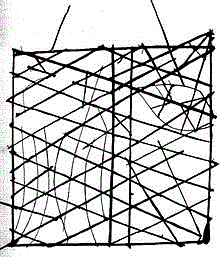
Mattang image

Colin Weatherby posted a long read on three recent reports about leadership in local government. The first looked at research into best practice leader development, the second the results of leadership at a capital city council and the third at the role of leadership in preventing corrupt or inappropriate behaviour in council works depots. I don’t think anyone would argue that we don’t need good leadership, even though we seem to survive well without it.

A colleague recently attended a lecture by Australian adventurer and leadership researcher Earl de Blonville. The focus of the talk was ‘postformal leadership’,  a new way of thinking about leadership that he has developed from thinking in postformal psychology. Continue reading

128 – Council superheroes. Some feedback from readers.

Posted by Lancing Farrell                                                                              300 words

reader feedback

Editorship has some privileges. I have enjoyed Linda Perkin’s posts on Captain Council and look forward to what will unfold in future posts. Captain Council has generated some interest, with a few people ‘connecting some dots’ and telling us about them.

Apparently western suburbs local print media shock jock Kevin Hillier has commented that councillors in his community have a ‘cloak of invisibility’. It seems they haven’t been as publicly accountable as he would like.

It was suggested that Captain Council might need this superpower. If he did, I am sure it would not be to hide from his constituents!

Another colleague pointed out a scholarly article written a few years ago about whether CEO’s in local government are superheroes or puppets. In the introduction, the author comments that:

“… CEO’s are required to operate across multiple dimensions simultaneously.”

This sounds like ‘shape shifting’ to me. A quick check on Wikipedia reveals that this superpower is more likely to be ‘dimensional travel’ (i.e. the ability to travel between two or more dimensions, realities, realms) or ‘omnipresence’ (i.e. the ability to be present anywhere and everywhere simultaneously). Secretly, I think many CEO’s do aspire to omnipotence.

I should probably take this article more seriously. It concludes with the view that:

“Successful CEOs share several common characteristics which reflect the ability to effectively manage along the three edges+. These CEO’s tend to possess transformational, charismatic, and almost superhuman qualities.”

It is all starting to sound a bit eerie to me, but my confidence was restored by a more thorough perusal of the article, which revealed that the research was strictly scholarly and involved nothing supernatural.

+ The concept of the ‘three edges’ was developed by Henry Mintzberg to describe the work of the public sector manager. The edges are the ‘operating edge’, the ‘stakeholder edge’ and the ‘political edge’.

Jones, Stephen 2011. ‘Superheroes or Puppets? Local Government Chief Executive Officers in Victoria and Queensland’, Journal of Economic and Social Policy, August.


127 – ‘A new theory of value creation for local government’. Do we need one? Part 2 – Business Model.

Posted by Lancing Farrell                                                                              750 words

walt disney theory of value creation

Image: ‘The greatest theory ever told’ – Walt Disney’s 1957 value creation map.

This is the second post in the series intended to make the case for a new theory of value creation for local government. The first post discussed business strategy. This post looks at the link between strategy and the business model.

Once the strategy has been determined, it leads directly to the selection of a business model that can deliver that strategy. I have chosen the following description of a business model from organisational theorist and academic David Teece to set the scene.

“Whenever a business enterprise is established, it either explicitly or implicitly employs a particular business model that describes the design or architecture of the value creation, delivery, and capture mechanisms it employs.

The essence of a business model is in defining the manner by which the enterprise delivers value to customers, entices customers to pay for value, and converts those payments to profit.

It thus reflects management’s hypothesis about what customers want, how they want it, and how the enterprise can organize to best meet those needs, get paid for doing so, and make a profit.”

As with strategy decisions, the difficulties for local government are again apparent. Continue reading

124 – The butcher, the baker and the candlestick maker. Our councillors?

Posted by Whistler                                                                                          800 words

butcher baker candlestick maker

Image

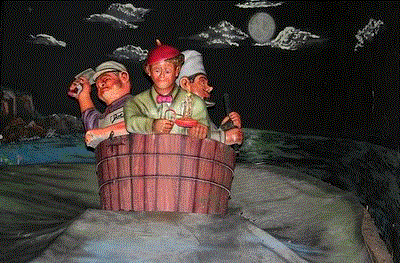
The original version of the rhyme ‘rub-a-dub-dub’ supposedly tells of three townsfolk watching a dubious sideshow at a fair. Later versions talk of them being ‘all put out to sea’, perhaps a reference to being ‘at sea’ or puzzled or bewildered (thanks Wikipedia). I think either version could work for some of our councillors today.

Councils usually have greater gender balance and occupational representation than in the rhyme. My question is, who are the people who become councillors? What attracts them to the role? Why do they do it? What do they offer? Do they really reflect the communities they represent? Continue reading

123 – Reinventing Management – Architecture and Ideology. Gary Hamel.

Posted by Colin Weatherby                                                                         1300 words

inertial incremental insipid

Gary Hamel starts his dissection of large organisations with a series of descriptors; inertial, incremental, and insipid. Reading his paper made me feel like returning to small business. I once heard the Chief Executive Officer of the Australian Industry Group talking about a poll of his members. He asked them what they would like from government and they said that they wanted government to be positive, intelligent, and credible – the antidote to the inertial, incremental and insipid.

Hamel is describing what he calls the congenital disabilities of large organisations. By inertial, Hamel means that they are ‘frequently caught out by the future and seldom change in the absence of a crisis’.

 “Deep change, when it happens, is belated and convulsive, and typically requires an overhaul of the leadership team.”

By incremental, Hamel means that despite their resource advantages, incumbents are seldom the authors of game-changing innovation.

“It’s not that veteran CEOs discount the value of innovation; rather, they’ve inherited organizational structures and processes that are inherently toxic to break-out thinking and relentless experimentation. Strangely, most CEOs seem resigned to this fact, since few, if any, have tackled the challenge of innovation with the sort of zeal and persistence they’ve devoted to the pursuit operational efficiency.”

By insipid, Hamel means they are emotionally sterile. He says that managers know how to command obedience and diligence, but initiative, imagination and passion can’t be commanded—they are gifts.

“Every day, employees choose whether to bring those gifts to work or not, and the evidence suggests they usually leave them at home. In Gallup’s latest 142-country survey on the State of the Global Workplace, only 13% of employees were truly engaged in their work. Imagine, if you will, a car engine so woefully inefficient that only 13% of the gas it consumes actually combusts. That’s the sort of waste we’re talking about. Large organisations squander more human capability than they use.”

Hamel is excoriating in his examination of the supposed ‘remedies’ advanced over the years Continue reading