165 – Decision making: How dialogue becomes action

Posted by Lancing Farrell                                                                                             960 words

emperors new clothes

Image

This last post in the series on decision making discusses the importance of design operating mechanisms that promote free flowing and productive dialogue to enable decision making. The setting in which dialogue occurs is as important as the dialogue itself.

 Ram Charan says this will be evident in the social operating mechanisms if people feel able to speak with ‘openness, candour, informality and closure’. He discusses each in turn:

  • Openness means that the outcome is not predetermined. There is a willingness to hear all sides in a safe atmosphere of ‘spirited discussion, learning and trust’.
  • Candour is willingness for people to speak the unspeakable, to expose unfulfilled commitments, to air the conflicts that undermine apparent consensus. People express their real opinions, not what they think team players are supposed to say. Candour helps eliminate the ‘silent lies and pocket vetos’ that occur when people agree to something that they have no intention of doing. It prevents reworking and revisiting decisions and reducing performance.
  • Informality encourages candour. Formality suppresses it. Informality also reduces defensiveness.
  • Closure imposes discipline. At the end of a meeting people know exactly what they are expected to do. It produces decisiveness by assigning accountability and deadlines to people in an open forum.

In local government there can be a notable lack of candour – speaking up can have consequences. Continue reading


164 – Who should push back with the councillors? The CEO, Directors or Managers?

Posted by Whistler                                                                                          600 words

chess

I think this is a good question and it is one that every manager will ask themselves at some point. It may take a bit of experience to ask it. Individual councillors regularly ask for the organisation to do things that are outside policy or they become conflicted. So who should be saying no?

In many councils there has been an organisational correction about the type of contact councillors can make with staff. Usually this happens after a councillor has attempted to influence a junior staff member to do something outside policy. When councillors complain about the staff member because they won’t do what they asked (or if the officer complains) the organisation reinforces the rule that councillors can only talk to senior officers – i.e. the CEO, Directors or Managers.

This partially solves the problem and often introduces new problems. Continue reading

163 – Decision making: Decision-focussed strategic planning in local government.

Posted by Lancing Farrell

more better faster

Image

This is the sixth post in a series.  Michael Mankins and Richard Steele propose an alternative model of strategic planning. They believe that strategic planning can’t influence organisation performance if it doesn’t drive decision making. And it can’t drive organisational decision making while it is focussed on individual business units and limited to an annual planning process. They describe some of the changes that organisations can make to their strategic planning to produce more, better and faster decisions.

They separate – but integrate – decision making and planning. Decisions are taken out of the planning process into a parallel process for developing strategy. Executives can identify the decisions that they need to make to create more value over time. The output of this process is a set of decision that management can codify into future business plans through the planning process. Continue reading

162 – What if local government was an Australian Rules football game?

Posted by Whistler                                                                          1100 words

AFL game

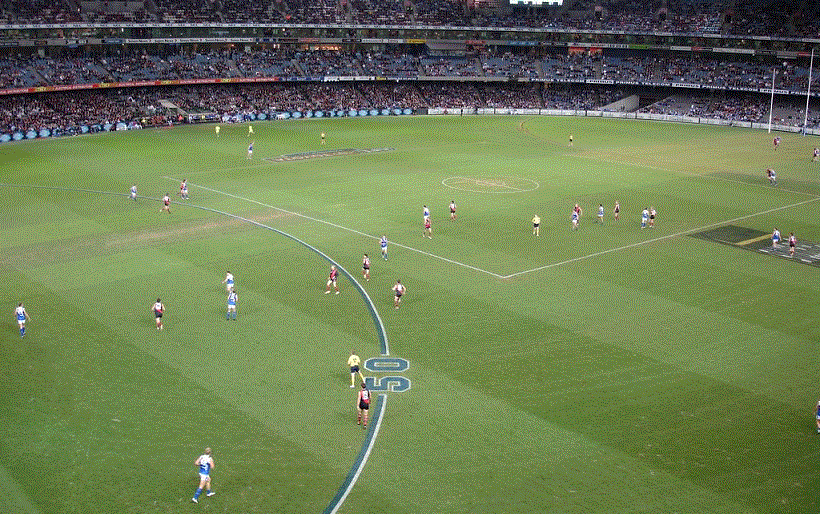
Concerns are periodically expressed about the rules in AFL football and their impact on the flow of the game and its popularity as a sporting spectacle. I understand the concern. I have some suggestions for the AFL Commission. What about changing the rules so that Australian Rules football operates the same way as local government? I think it could bring the same interest and fascination for football onlookers.

Just what sort of spectacle would it be?

For a start, the rules would need to change about the goals. Having fixed goals might enable incredible skill to be developed and displayed by players kicking from the boundary line in pockets or beyond the 50m mark, but what if the goals moved randomly?

Picture it. Continue reading

161- Decision making: Dealing with indecisiveness.

Posted by Lancing Farrell                                                                                  1100 words

dilbert indecision

This is the fifth post in a series. Some organisations, like some people, just can’t make up their minds. Ram Charan believes that leaders can eradicate indecision by changing the tone and content of the everyday conversations occurring throughout the organisation. This is difficult in local government where CEO’s and top management are often insecure and sensitive to challenge.

Breaking a culture of indecision will require leaders to challenge assumptions, share information, and bring disagreement to the surface. Charan offers the following example to highlight the signs of indecision:

A presentation is made to a meeting about a proposed project. There is silence until the CEO speaks and asks questions that show they have taken a position on the matter and made up their mind. Then others speak up to agree with the CEO, keeping their comments positive.

It appears that everyone supports the project. But, some are concerned and keeping their reservations to themselves. Over the next few months the project is slowly strangled to death.

It is not clear who killed it but it is clear that the true sentiment in the room after the presentation was the opposite of the apparent consensus.

The key issue is that the true sentiment is the opposite of the apparent consensus. Charan says that ‘silent lies and lack of closure’ can lead to a false decision that is undone by unspoken factors and inaction.

How often does this happen in local government? Continue reading

160 – Making a local government service catalogue. Part 2: What to do with it?

Posted by Colin Weatherby                                                                                      630 words

service category

In the first post I described a service catalogue and looked at where (and how) to start making one. This post discusses what to do next to refine the service catalogue and use it to improve organisational performance. I have no doubt that a service catalogue is essential to starting a discussion with the community about services required in a rate capped operating environment, however it should also drive continuous improvement by providing a focus for service reviews.

The ‘first cut’ service catalogue that defines services from the customer viewpoint and links that view to organisational structure, is really just the start.

Further analysis is required to determine the link between the service catalogue and organisational strategic plans (especially the council plan). This can be achieved by coding the spreadsheet of cost centres with the themes or key objectives or themes in the plans. This will allow further analysis by pivoting on different criteria. What is the link between council plan objectives, customer defined services and cost centres? Continue reading

159 – Making a local government service catalogue. Part 1: Where do you start?

Posted by Colin Weatherby                                                                                         740 words

service catalogue food images

Across local government in Victoria councils are starting to discuss core and non-core services and the need to make a service catalogue – in other words, list of all the services they provide. In part this interest has been sparked by rate capping and the need to better understand where revenue is going. Any council attempting to increase rates above the Essential Services Commission cap will need an argument that is supported by their community. So what is a service catalogue?

In its simplest form it is a list of all the services a council offers, and by default, anything not on the list is not offered. It doesn’t mean that other services can’t be offered but there will need to be consideration of the costs and benefits before committing to do so. The list will need to be controlled once it has been made.  Deciding what services you will and won’t offer (and who will and won’t receive them) is at the heart of strategy. Continue reading

158 – Customer perception. Why is it important in local government services?

Posted by Lancing Farrell                                                                              670 words

customer service gaps

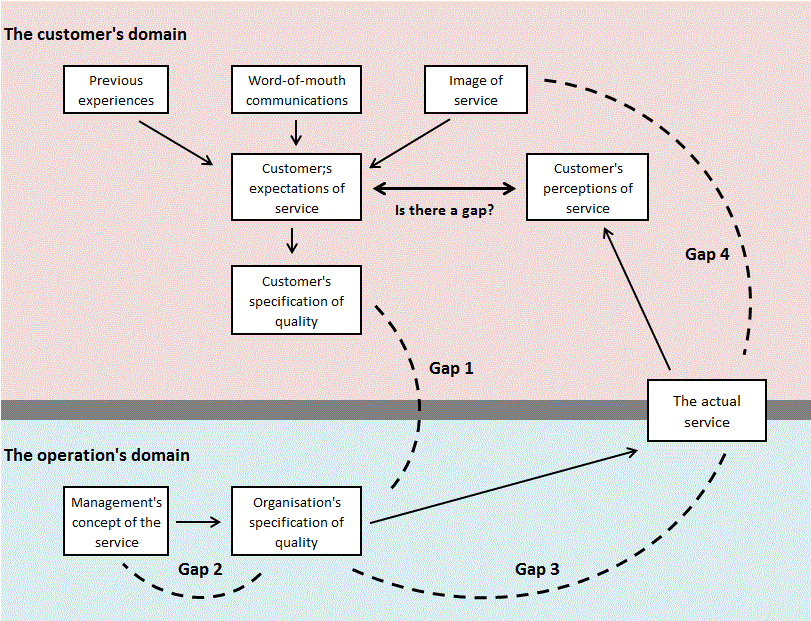
Image adapted from Slack, Chambers, Harland, Harrison, and Johnston 1998, Operations Management, 2nd Edition.

There have been a number of posts on aspects of customer service – who are our customers, customer-introduced variability, how do you listen to the ‘voice of the customer, internal customers , what Gordon Ramsay might think about council customer service, and captive customers. If there has been a thread through these posts, it has been the need to look at services from the customers’ viewpoint and to understand constitutes value for them.

The posts on value have discussed how to understand both private and public value – why do we provide the services that we do, the private-public value continuum, applying the public value scorecar , public value gap analysis, local government and commodity services, value-led management, and a series on a new theory of value creation in local government. The idea that people seek private value and councils set out to create public value is at the heart of a lot of customer service problems.

One aspect of customer service that hasn’t been discussed is the role of perception. Continue reading

157 – Captive customers. Why are they so special?

Posted by Colin Weatherby                                                                         850 words

captive

The idea that our customers (i.e. the ratepayers, residents, businesses and citizens in the community) are captive to our services is not new, however the implications are seldom discussed in local government. What does it really mean for service providers when their customers are forced to pay for services they may not use, or for service levels that may not meet their specific needs?

The idea that we will have choice in matters affecting our lives has become sacrosanct in western society, especially if we are paying. Customer service standards today are unrecognisable from those of the last century. Nobody expects to wait. If what they want isn’t available, they expect the service provider to get it – and quickly. If service falls below the normal standard they expect compensation. Social media is giving voice to unhappy customers and putting pressure of organisations.

In this environment, getting customers to pay for services in quarterly instalments and then receive standard services designed to suit ‘everyone’, leads to obvious conflicts. Continue reading

156 – Decision making: The calendar effect and local government planning.

Posted by Lancing Farrell                                                              700 words

calendar

This is the fourth post in a series. Most councils prepare their plans in a very conventional way. All of the councils where I have worked have been the same. The planning process is frequently criticised but seldom challenged. There is a better way.

Despite the effort put into strategic planning by many organisations, it can actually be a barrier to decision making. Michael Mankins and Richard Steele believe that difficulties in strategic planning are attributable to two factors:

  1. The calendar effect – it is usually an annual process.
  2. The business unit effect – it is usually focussed on individual business units.

This is completely at odds with the way executives actually make important strategic decisions. They make the decisions that really shape organisational strategy and determine the future direction of the organisation outside the formal planning process. And they often do it in an ad hoc way without rigorous analysis and debate. Continue reading