76 – Creative ways to make your capital expenditure target. Some ideas.

Posted by Whistler                                                                          570 words

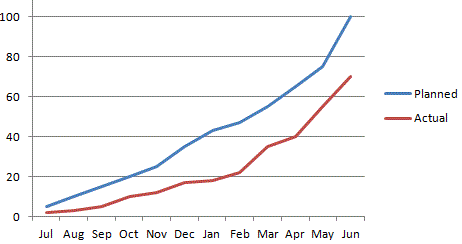
capital expenditure graph

Yes, it is that time of the year when our engineers and accountants become highly creative.   By June 30 they will need to explain whether or not the targeted amount of capital works has been completed. Often the target is expressed as simply as ‘90% capital program completed’. Usually it is a KPI for the CEO and senior managers. That makes it an important target.

So, why the need for such high levels of creativity? Continue reading

72 – Revolutionising local government. How long is it since you were last revolutionised?

Posted by Whistler                                                                          600 words

merry go round

I was talking to an experienced consultant who works with numerous councils recently and she commented about some of the councils currently undergoing ‘revolutionisation’. New CEO’s, in two cases new to the sector, were busily implementing their kitbag of management ideas. They seem to hit the ground running with a program of change. What are some of the features of revolutionisation and how effective is it?

I will start with effectiveness first. It depends on the measure. I can think of a few. Is it delivering on a promise to the councillors who appointed them to shake things up and create change? Is it is improving the performance of the organisation in meeting community needs sustainably in the longer term?

If it is the former, I would think they are mostly successful. Continue reading

70 – What does ‘meeting expectations’ really mean? A performance appraisal story.

Posted by Whistler                                                                     375 words

apple on teachers desk

Image from http://bellasvitas.blogspot.com.au

I have been reading Lancing Farrell’s posts on performance appraisal with interest. I am sure everyone has a performance appraisal story to tell. A colleague was telling me about her performance appraisal in which she ‘met expectations’. What does that really mean?

Her performance review outcomes possible were on a five point scale – does not meet, partially meets, meets, exceeds, or significantly exceeds expectations. For each outcome there was a definition. The definition for ‘meets expectations’ gives you an idea about the rest. Continue reading

64 – Ambition, culture and performance. A tale of middle management in local government.

Posted by Whistler                                                                                          750 words

cathedral

I was recently involved in a discussion where the metaphor of the three stonemasons came up. The person telling the story described the response of the three stonemasons to the question ‘what are you doing?’ You may know it.

The first stonemason said ‘I am making a stone’. The second said ‘I am making a wall’. The third said ‘I am making a cathedral’.

The purpose in telling the story was to illustrate the various motivations of people at work in local government and that, hopefully, we are all here to make a cathedral and we know it. Well, I started thinking about how many of the workers cleaning the same public toilets every day, or mowing the same parks, or emptying the same bins, think they are making a cathedral. The chances are that they are just diligently making a stone. Whether it is used to make a cathedral or not is probably not important to them and never will be.

Then my thinking moved on to thinking about myself and the other middle managers I deal with. Surely we are all making cathedrals? Continue reading

59 – Decision hats for middle management. Some suggestions.

Posted by Whistler                                                                          570 words

I recently posted on hats that councillors could wear when making decisions in their different capacities, or when making different types of decision. The hats would provide a cue to other councillors and onlookers. I received some comments from readers and since then I conducted an informal poll of colleagues to determine what head gear they think could be worn when they make decisions. Again, the idea is to signal intention to others.

Managers mostly operate in the one capacity but they make many different types of decisions. Here are some thoughts on hats that could go with them. Continue reading

57 – Some types of thinking observed in local government.

Posted by Whistler                                                                          580 words

ant on leaf

Image from http://caracaschronicles.com

Convenient thinking. I think this is a preferred way of thinking for many people. It is the easiest. What is the quickest way to deal with this matter? Is there someone else who should be doing it? What is likely to have the least impact on me? Once you start asking these questions, you are well on the way to some convenient thinking. It is most problematic when senior management regularly engage in convenient thinking.

Consequential thinking. This is related to convenient thinking but is more focussed on the possible outcomes from doing something. What could go wrong? Who could be upset? Will it move my career forward? Continue reading

54 – The four decision hats. What are your councillors wearing?

Posted by Whistler                                                                          630 words

I was in a workshop about Edward De Bono’s six thinking hats recently when it occurred to me that we could do with some decision hats in local government. Councillors could wear a different hat for each of their roles. This way they would be clear about what capacity they are acting in, and any onlookers would know as well.   Alternatively, a different hat could be worn to signal the type of decision being made. Here is how it could go.

Let’s start with hats representing the role or capacity that the councillor is acting in. Obviously, gender will influence hat selection for some councillors. I will do my best to select hats with universal appeal.

george washigtonWhen acting as politician, part of the local government to make decisions affecting constituents, a range of hats are potentially available. Continue reading

49 – Rate capping. Four workarounds we can expect to see.

Posted by Whistler                                                                          320 words

illusion

Image from http://serendip.brynmawr.edu

All the talk about rate capping and the impact on local government services has started me thinking about what happens every time there are legislated changes to the way councils operate. We find workarounds. Rather than putting our efforts into being better at providing the services that communities expect, we put our energy into workarounds to protect the status quo.

Workaround number 1. Service lives for assets will be pushed out unrealistically to reduce the annual depreciation cost. Instead of depreciating assets over 50 years they will be depreciated over 100 years, effectively halving the depreciation cost.

Workaround number 2. Staff numbers will be cut to make budget and agency staff and consultancy costs will rise significantly. A lower cost but permanent part of the workforce will be replaced with a much more expensive but temporary workforce. The over expenditure will be offset by workaround number 1.

Workaround number 3. Asset sales will be included in the budget. This will usually be land determined to be surplus to requirements (probably used as open space at the moment) or the vehicle fleet (which will then be leased). It is unlikely that the land will actually be sold and this will be explained in notes to the annual report as an unforseen problem. Never mind, put them in again next year. I worked at a council that successfully did this for a decade. Selling assets like the fleet will probably realise a loss but provide some short term cash while increasing long term costs.

Workaround number 4. CEO and Executive salaries will be frozen. No Consumer Price Index or ‘performance’ increases. This sounds fine and could be an example of leadership from the front to control wage increases across the organisation.  But keep an eye on their contract renewals. Typically this is where top management makes up for any lack of annual increase and the details are usually confidential.  No increases for several years and then a big increase on rehiring.
45 – Does your Executive suffer from altitude sickness?

Posted by Whistler                                                                400 words

jet pack

A colleague has recently started reporting to a Group Manager who is new to local government. Her observations about the workings of local government provide an insight into our behaviour that we either no longer notice or just accept. This post discusses the observations made of Executive budget deliberations.

Over several days her Executive considered the budget prepared by the organisation and they deliberated over the ‘business as usual’ budget and new initiative bids. In this time the discussion alternated between the high level and the detail. The way she described it, the Executive would say that they needed to be strategic and take a ‘helicopter view’, but each time they attempted to do so they felt discomfort at the ‘altitude’reached and choked. They would then dive straight back down into the details of the matter where they would then spend 10 or 15 minutes going over the minutiae before reminding themselves of the need to deal with matters strategically. They then headed back to higher altitude but once there the altitude sickness resumed and they would dive back to the detail. As I heard the story I imagined them each strapped to a Jetpack.

Over successive issues, the available time frittered away and a series of small decisions were made about the numerous budget bids, resulting in a draft budget that lacked any overall cohesion or strategy linking it to the big picture or the long term. Why did this happen?

After talking to others who have worked in local government for a long time, the process described so colourfully is the same process witnessed annually. Every manager has seen it. Despite their best efforts, the Executive frequently fail to take the high level, big picture, long-term view required. I think this is because they are not confident about what the big issues really are or how they should be addressed. In addition, they lack trust in managers to understand the issues.  Managers and the Executive don’t share the same experiences of working in the organisation. This is evident in culture survey results. The Executive also overestimate the currency and accuracy of their knowledge of operations. This leads them to think they are capable of dealing effectively with the detail.

Low altitude can also be a safe place for some members of Executives.


36 – What did you like and dislike about your previous managers?

Posted by Whistler                                                                                          430 words

A colleague told me recently that they had been asked, along with the other managers in their branch, to write a list of the things they had liked and disliked about their previous group managers. The intention was for the new group manager to understand how managers would prefer to work with him. The method of finding out was just a little unorthodox.

The list of likes and dislikes had to be submitted typed on plain paper in an unmarked envelope. Each manager’s anonymous list would then be re-typed onto a longer list to be tabled and discussed at a branch meeting. This whole approach made me think about my previous branch managers, so I made my own list. It was a cathartic exercise. I can recommend it. It is also a way to crystallise your own thinking about what works for you in your relationship with your manager.

Here are my lists. Continue reading