103 – Classic paper – ‘Managing Government, Governing Management’. Henry Mintzberg.

Posted by Colin Weatherby                                                                         1850 words

In 1996 Henry Mintzberg published a paper in the Harvard Business Review entitled ‘Managing Government, Governing Management’. In the paper Mintzberg covers four broad topics relevant to local government:

  1. Private, public, cooperative and non-owned organisations.
  2. The roles of people in society as customer, client, citizen and subject.
  3. The management myths that activities can be isolated, performance can be fully evaluated using objective measures, and activities can be entrusted to autonomous managers responsible for performance.
  4. The machine model, network model, performance-control model, virtual model and normative-control model available to organise government.


What relevance does it have for local government today?

94 – ‘An interview with Wanksy, Penis Doodler and Pothole Avenger’, The Atlantic CITYLAB, 1 May 2015.

Posted by Colin Weatherby                                                                                         430 words

Wanksy image

Image from CITYLAB.

The sub title to this article says it all – ‘How an English construction worker is fighting for better road infrastructure by scribbling on the streets like a third-grader’. What is it that reduces people to this behavior? Why do they feel compelled to break the rules to get something done? There have been various articles on guerilla gardening, depaving and other aspects of DIY urbanism, but this is the first ‘guerilla maintenance’ article I have seen.

According to the article, Wanksy is a surveyor and professional artist who became fed up with the numerous potholes in his hometown, so he started drawing penises around them. And it seems to be working Continue reading

88 – Classic paper – ‘Managing the public service institution’. Peter F. Drucker.

Posted by Colin Weatherby                                                                         Long read 1900 words

Editors Note: This is the first of a new type of post – the long read. Rather than split long pieces or edit out important ideas they will be a run as a long read. It is only recommended for those scoring more than 7/10 in the local government reading test!

In this insightful paper published in 1973, Peter F Drucker looks at why public service organisations are less efficient than business enterprises. In it he reaffirms public services as being ‘load-bearing members of the main structure’ of modern society – a provider of services that are essential to society. Despite this importance, he says the performance of public service organisations is unimpressive. They have large budgets and require ‘ever-growing subsidies’ but are providing poorer service. Citizens are complaining about ‘bureaucracy and mismanagement’ in the institutions that are supposed to serve them.

Why was that the case in 1973 and is it still the case in local government today?

69 – Local government and milk. What do they have in common?

Posted by Colin Weatherby                                                                         660 words

cow

I recently drove past a car sign-written with advertising for milk available direct from the farm. It promoted the virtues of buying milk from the producer. I had earlier heard a radio advertisement for milk available from an inner urban Melbourne dairy where I am sure there are no cows. The advertisement talked about local milk from local people.

There may be some difference in the milk each company is selling. And it is probably different from the milk I can buy at my supermarket. So what is happening with milk and why might it tell us something that is relevant to local government? Continue reading

61 – Public value gap analysis. Some actions.

Posted by Colin Weatherby                                                                         280 words

gaps

I posted on a tool that can help to identify gaps in public value creation. This post briefly suggests some actions for each gap.

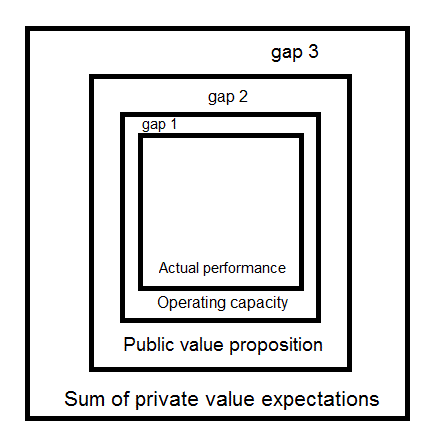
The first gap between actual performance and operating capacity, or potential performance, is best addressed though organisational processes to improve productivity. Recognising the gap is important and then it is in the hands of the organisation to justify its performance or improve it. Utilising all available operating capacity efficiently is the responsibility of organisational management.

Gap 2 requires something new to happen. It isn’t simply a matter of being more efficient and productive. Continue reading

60 – Public value gap analysis. A tool.

Posted by Colin Weatherby                                                                         790 words

private public operation actual

One of the challenges in local government is understanding public value – what it is for your community and how you can create it. It can  be difficult to separate it from private value expectations and to see the relationship with the operating capacity of the organisation. This post explores a conceptual tool to understand public value and gaps that need to be addressed in achieving it.

Many years ago when asked to be the officer leading a community advisory committee I developed a model to help the group understand what we were talking about and to focus on gaps where we could be most effective in making a difference. It worked very well. At the time I didn’t really understand why. Now I think it was because is identified the public value gap that the group could work on. Here it is. Continue reading

46 – Labor’s rate cap to hurt services and infrastructure, ratings agency warns’. The Age, 27 February 2015.

Posted by Colin Weatherby                                                         900 words

 slices of cake
Image from http://www.that-is-good-crap.com

This article follows an earlier piece in The Age,  ‘Plan to cap council rates at inflation could lead to service cuts and job losses in Victoria’ on 23 February 2015. Both articles are about the planned legislation in Victoria to restrict councils to rate increases at or below the Consumer Price Index from 2016 unless they seek an exemption from the Essential Service Commission. Some councils have already started to cut jobs to reduce expenditure ahead of rate capping. Others are forecasting cuts to their services and reduced maintenance or renewal of community infrastructure.

This is occurring at the same time that the State government is shifting more costs onto councils and national grants to councils are being frozen. I have previously posted on rate capping (see here , here and here). As you can imagine, rate capping is dominating talk within local government circles. Continue reading

42 – How do you listen to the ‘voice of the customer’ in local government? It can be done.

Posted by Lancing Farrell                                                                                              740 words

This post follows an earlier post Customer, client, citizen, resident or ratepayer. Who are we dealing with? It takes the concept of value further by proposing some tools that can be used to understand what customers expect and whether those expectations have been met.

I will start with Peter R. Scholtes and his views on the ‘customer-in mentality’, which he says is characterised by ‘thoughtfulness, responsiveness, empathy and altruism’. Customer-in thinking increases the likelihood that customers will get what they need – and need what they get. Listening to the customer is the beginning. Scholtes says we can start to do this by paying attention to what customers say when they contact us to make complaints, ask questions, or request services. Councils typically count the number of resident contacts. Some differentiate between service requests and complaints. Few actively evaluate what customers are asking about or saying to obtain qualitative data to guide service improvement.

Alternatively, or in addition, we can initiate contact with the customer to solicit information through surveys, interview or focus groups. Continue reading

39 – Applying the public value scorecard in local government services. Part 2.

Posted by Lancing Farrell                                                                                             780 words

This post continues discussion of the Public Value Scorecard by looking at the scorecards for legitimacy and support and the operational capacity.

Legitimacy and support scorecard

This scorecard links the external demands accountability in the authorising environment of the organisation, with ongoing public discourse on public value. The demands for accountability in the public sector are continuous and come from several sources. Individuals complain or join forces with others to form interest groups. The media amplifies the complaints of individuals and groups. Councillors represent their constituents and demand accountability. The Ombudsman, Auditor General and Local Government Inspector are powerful external sources of accountability. The real problem is that demands for accountability come from many different places and focus on different aspects of performance. Some are more disciplined and consistent than others. Continue reading

38 – Applying the public value scorecard in local government services. Part 1.

Posted by Lancing Farrell                                                                                              700 words

There have been a number of posts on public value (use the theme ‘public value’ to find them).  The idea that is is important and how it relates to private value has been discussed.  This post looks at how public value can be measured using the Public Value Scorecard. 

According to Mark H. Moore, public managers can improve the performance of public organisations by committing to the discipline of a public value ‘bottom line’. In the private sector, the ‘bottom line’ is a compelling and effective business concept. This post discusses the practical application of Moore’s public value scorecard in local government. Continue reading