289 – Fire fighter or architect? It is your choice.

580 words (6 minutes reading time) by Lancing Farrell

I recently completed a training course in the work of W. Edwards Deming. At the end of the course, one of the participants said they felt as though they now had the knowledge to become an architect in their work and cease being a fire fighter.

It made me think about how it is that leaders become fire fighters. It is a common complaint from executives in local government who are being exhausted on a treadmill of frantic and stressful activity.

I recently saw this piece on LinkedIn by Simon Dodds, a Health Care Engineer at SAASoft Ltd. I have reproduced it in full because it eloquently describes from a health care perspective, the same series of events that shifts managers and directors on the council treadmill from walking speed to sprinting. Here it is.

Failure demand is demand created by a failure to do something right the first time. It is extra demand caused by defects in the process, not by genuine new customer needs. For example, a patient calls their GP practice again (and again) because their need was never fully met first time. These repeated, avoidable demands would not exist if the process was designed to work right first time.

Failure demand increases workload and disrupts flow in unpredictable ways. Over time, it creates a feedback loop that fosters chronic chaos because failure demand depends on how many errors happen and this extra demand can fluctuate greatly. The unpredictability further overloads already busy staff and creates shifting bottlenecks that delay other work. When multiple steps in a process are incessantly overloaded, the service organisation loses stability.

Clinical and operational staff spend disproportionate amounts of time reacting to failure demand rather than working proactively on primary service tasks. This shifts the process from a planned, predictable workflow into a reactive mode where firefighting becomes the norm. This relentless pressure increases stress and fatigue, and stressed staff make more mistakes, which generates more failure demand. It becomes a vicious self-fuelling cycle.

The chaos obscures the underlying cause of problems and staff just focus on quick fixes, so the core process issues remain unresolved and internal demand continues to spiral. Over time, the process becomes inherently chaotic, with unpredictable queues and inconsistent service quality. Everyone becomes habituated to it and everyone loses.

From a systems point of view, failure demand is a reinforcing feedback loop:

defects => failure demand => overload => queues => risks => reactive expediting => corner cutting => more defects.

When I read this, I recognised the day to day existence of a leader in councils today. I substituted ‘managers and directors’ for clinical and operational staff’. I know this wasn’t the case 30 years ago and the change has happened gradually. Anyone who has worked in the sector for less than 20 years would think it is normal. The reality is that it is a choice. There are alternatives.

To help, Simon Dodds offers some advice to stop firefighting’

To stop chronic chaos created by failure demand we just need to:

1. Map the processes and identify where the hot spots are.

2. Measure failure demand separately from first-time demand.

3. Diagnose the root causes of the defects.

4. Redesign processes for right-first-time and give front-line staff permission to resolve issues immediately and prevent rework.

5. Monitor continuously to prevent failure demand creeping back.

6. Maintain the calm efficiency by training new staff in the Zero-Defect way.

 Become the architect of your work and design services to reduce failure demand.

From <https://www.linkedin.com/feed/update/urn:li:activity:7382850586318176256/>

287 – The council goal posts

550 words (4 minutes reading time) by Tim Whistler

Credit

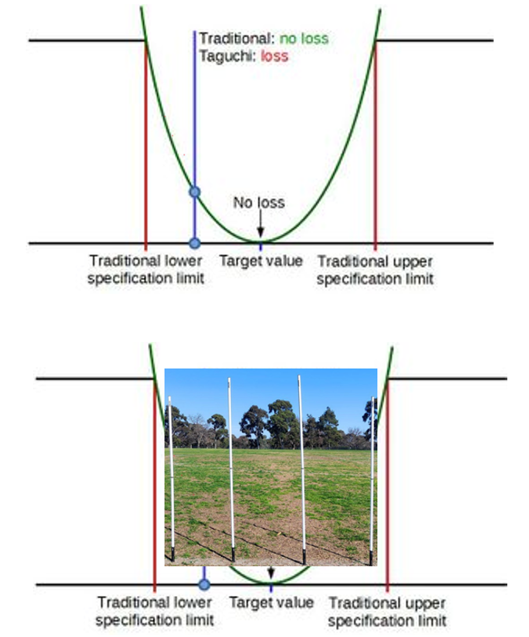
Lancing has highlighted a key problem with many council services. I used to call it the ‘lowest common denominator effect’ (i.e. performance gets reduced to the lowest level tolerated) but I think the Taguchi Loss Function makes the point in a way that helps you to fix the problem.

Imagine that the diagram Lancing used to show the target value that a customer or citizen wants as fitting between two ‘goal posts’, to instead show a set of Australian Rules football goals. For those non-Australians, I have helped you imagine that with the diagram below.

If you aren’t aren’t familiar with Australian Rules football, when the ball is kicked between the two centre posts it is a goal and scores 6 points. If it is kicked between a centre post and the post either side, it is called a behind and scores 1 point. If the ball is kicked outside all the goal posts it is out of bounds on the full and there is no score and the opposition gets to kick the ball back into play.

Continue reading