77 – Operational excellence in local government. Does it matter?

Posted by Lancing Farrell                                                                        600 words

operational capability

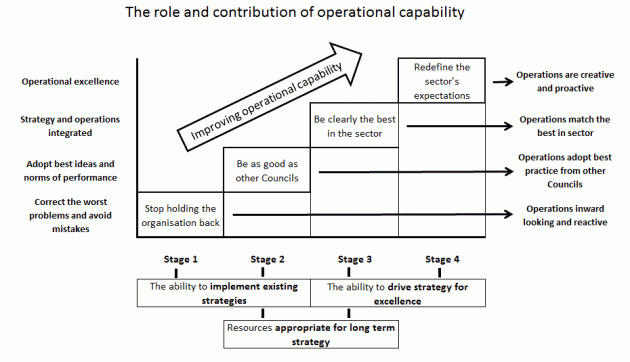
In a recent discussion with a colleague she mentioned that in her previous employment outside local government they had set organisational performance goals for leadership, finances, relationships, safety and operational excellence.   Each area of performance was rated equally. It started me thinking about how little you hear about operational excellence in local government. Is that because it doesn’t matter?

I am sure that operational performance matters. Whether councils want to be excellent or not, I am less sure. I think that the reason it is seldom discussed is that few people have a real understanding of operations management or what excellence would look like or how to achieve it. Continue reading

70 – What does ‘meeting expectations’ really mean? A performance appraisal story.

Posted by Whistler                                                                     375 words

apple on teachers desk

Image from http://bellasvitas.blogspot.com.au

I have been reading Lancing Farrell’s posts on performance appraisal with interest. I am sure everyone has a performance appraisal story to tell. A colleague was telling me about her performance appraisal in which she ‘met expectations’. What does that really mean?

Her performance review outcomes possible were on a five point scale – does not meet, partially meets, meets, exceeds, or significantly exceeds expectations. For each outcome there was a definition. The definition for ‘meets expectations’ gives you an idea about the rest. Continue reading

67 – Design a management job for high performance. Part 1 – some theory.

Posted by Lancing Farrell                                                              1250 words

sliders

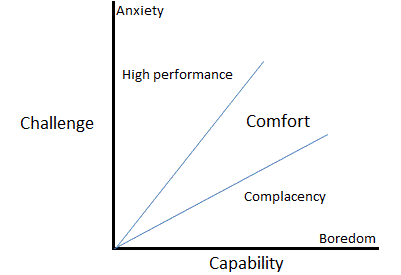
In the previous post I discussed a tool that you can use to test your current job design to see whether it has been designed for high performance. In this post I will elaborate on the theory behind the tool. This is a long post but I didn’t want to split the story. Sorry. In the next post I will attempt to apply the theory to the design of three local government management roles that I am familiar with.

Simons’ starting point in discussing the design of high performance jobs is failure to implement strategy. Why is it that organisations with clear strategy, access to resources and developed relationships still fail? He points out managers being too complacent and slow to respond, instead of being entrepreneurial. Problems coordinating activities across functions. Decision making is fragmented. Costs are excessive and eroding surpluses. When these symptoms become evident senior managers start to wonder whether they have put the wrong people in critical jobs. However, Simons says that the problem is systemic across the organisation. Continue reading

64 – Ambition, culture and performance. A tale of middle management in local government.

Posted by Whistler                                                                                          750 words

cathedral

I was recently involved in a discussion where the metaphor of the three stonemasons came up. The person telling the story described the response of the three stonemasons to the question ‘what are you doing?’ You may know it.

The first stonemason said ‘I am making a stone’. The second said ‘I am making a wall’. The third said ‘I am making a cathedral’.

The purpose in telling the story was to illustrate the various motivations of people at work in local government and that, hopefully, we are all here to make a cathedral and we know it. Well, I started thinking about how many of the workers cleaning the same public toilets every day, or mowing the same parks, or emptying the same bins, think they are making a cathedral. The chances are that they are just diligently making a stone. Whether it is used to make a cathedral or not is probably not important to them and never will be.

Then my thinking moved on to thinking about myself and the other middle managers I deal with. Surely we are all making cathedrals? Continue reading

58 – Performance appraisal in local government 4/4. What else could we do?

Posted by Lancing Farrell                                                                              650 words

optimus prime transformer

This is the last post in this series. It is also where things start to get interesting. There are alternatives to performance appraisal the way we have always done it. The difficulty is that most are quite different to the current approach and pursuing them will involve the risks that always accompany change. Are we up for it?

We could just stop using performance appraisals. As Peter R. Scholtes writes in The Leaders Handbook, this would require us to start thinking differently. In essence, this would involve adopting a ‘systems thinking’ approach to managing the organisation. This is likely to require systems to support employee development and promotion, providing feedback for improvement, determining training needs, and performance managing the poor performers.

Scholtes proposes what he calls ‘debundling’ of performance appraisal to focus on each benefit that the performance appraisal system supposedly provides. Continue reading

56 – Local government performance appraisal 3/4. What can you do in response to the issues?

Posted by Lancing Farrell                                                                                              530 words

apple and orange

Choices are necessary regarding the role of performance appraisal and how it will be done. I don’t think anyone thinks that performance should not be measured. It is a matter of how you do it.

Peter R. Scholtes points out the fundamental choice facing every organisation very clearly in The Leaders Handbook. What is most important to your organisation – controlling the behaviour of people to the satisfaction of management, or understanding, controlling and improving processes to benefit customers? Continue reading

55 – Local government performance appraisal 2/4. Why do we do it?

Posted by Lancing Farrell                                                                                   480 words

line in sand

Well, often we don’t as previously discussed. Not all organisations complete them for every employee and in some organisations it is simply a compliance exercise. Even when you do have a performance review system, it may as easily not improve performance as the team at Utopia showed this with unerring insight. I suppose the relevant question is why do we think that we need performance appraisal?

I don’t think it is because we know that it works and helps to align effort and ensure accountability in delivering on organisational objectives. I think we do it because we are bound to do so by industrial agreements and because it creates the illusion of control. Looking like we are in control is as important in local government as it is in other public services. Continue reading

52 – Local government performance appraisal 1/4. What are the issues? (or 5 reasons it doesn’t work)

Posted by Lancing Farrell                                                                             700 words

performance - rowing

This is the first in a series of four posts on performance appraisal. The central idea is that current performance appraisal systems are not effective.

To begin with, the annual performance appraisal process (sometimes called the performance development plan (PDP) or staff development scheme (SDS)) is often not carried out in local government. When it is, people have usually been compelled to do so or they are simply ‘ticking the boxes’ and being compliant. I have often thought that this is important evidence that the process is not helpful. People ‘vote with their feet’ – if they thought that performance appraisal was useful and that it added value, they would be doing it.

Continue reading

51 – An ABEF OSA. What is it and do you need one?

Posted by Colin Weatherby                                                               900 words

puzzled

The Australian Business Excellence Framework (ABEF) provides a systematic way to think about your organisation and its improvement. It identifies seven categories of organisational activity that are systematically analysed when you conduct an organisational self assessment (OSA) to determine the approach, deployment, results and improvement. This examination of approach, deployment, results and improvement is called the ADRI cycle and it is similar to PDCA and other improvement cycles except that it focuses on outcomes not actions. So, that is what it is.

Do you need one? (And, more importantly, what will you get if you have one).

Continue reading

44 – The Executive. What exactly is its role?

Posted by Colin Weatherby                                                                                         700 words

This seems to be a common question. You frequently hear people saying, ‘that decision will need to go to the Executive’, or ‘don’t do that until you have been to Exec’. If asked, the people saying this often can’t say why they have offered this advice and reviewing the terms of reference for the Executive will usually reveal that it is not a decision making body. It is individual members who have the authority to make decisions. So, what is its role? Continue reading