192 – Boundaries, interfaces and thresholds. Why do we love them so much?

Posted by Whistler                                                                                         450 words

stile over fence boundary

I was at a meeting recently where officers were discussing who is responsible for different maintenance activities. They had developed a ‘demarcation information guide’ for the managers of facilities so that they could try and work out who to contact for different maintenance tasks. It told you who looked after fences, paths, lights, floor coverings, broken windows, etc. It started me thinking about local government’s penchant for boundaries (nobody suggested that an alternative could be service integration).

I think we like to set boundaries because it lets us focus on what is special about ourselves as a point of differentiation from other local governments. I once worked at a council where the CEO said that we should act as though the world ended at the municipal boundary. We were different to everyone else. He said to imagine that if you left the municipality you would fall off the edge of the world. As a leadership ‘device’ it certainly focussed attention on the municipality. It was a simple and effective way to differentiate the council – pretend there is nowhere else!

This approach reinforces the view that each council is ‘special and different’, rather than accepting that we have more in common than we have that is different . This view is evident when councils are reluctant to share systems or services. In Victoria we resisted municipal amalgamations and many councils still complain about them. I think it is part of our culture to resist ideas from outside our sector or organisation. This creates a safe and reliable place.

We also like interfaces. If we didn’t, why would we design our organisations around town planners, engineers, social workers and accountants? The functional structure of councils creates lots of interfaces between units, departments and divisions in the processes that actually deliver services. It is these interfaces that result in service failure and the resultant ‘failure demand’ identified by John Seddon. Work flows across interfaces, not up and down within silos.

And thresholds abound. There are the tiered levels of authority delegated by the CEO. The typical council ‘command and control’ structure, so criticised by John Seddon, puts in place lots of hierarchical thresholds. We have entry levels for employment. Anyone unsuccessful in applying for a senior role will be familiar with the response ‘we had other applicants already at the required level’ when you seek feedback.   We like to employ people based on what they have done rather than what they can do. Suppliers and contractors who are new to local government struggle to get a customer. Once you have worked for a council, the others will open their doors. Getting the first council is the hard bit.

I think that the attachment to boundaries, interfaces and thresholds comes from our desire to limit things –  the extent of our responsibilities; the extent of authority; the amount of risk we will take.

191 – Essay No. 3 – Local government and systems thinking.

Posted by Lancing Farrell                                                                              1250 words
 

systems thinking checkland

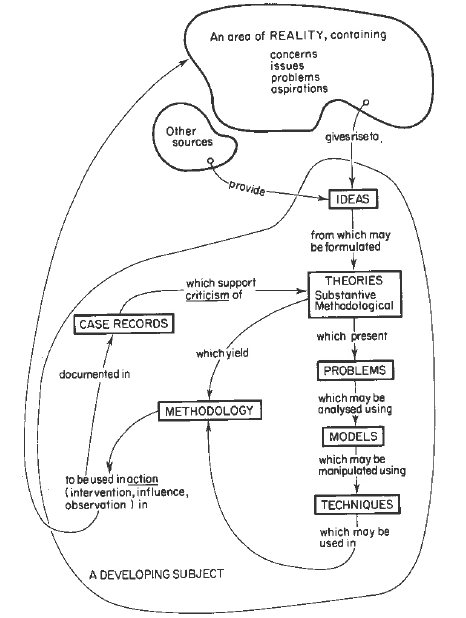
Systems Model, Peter Checkland, 1981.

Systems thinking has featured in a number of posts (see  Some types of thinking observed in local government,  Classic paper: ‘Forget your people – real leaders act on the system’. John SeddonApplying the public value concept using systems thinking in local government). As someone with an interest in systems thinking I felt it deserved some discussion in the context of local government using ideas gathered from Peter Checkland, Alistair Mant and John Seddon.

The cover of Peter Checkland’s book ‘Systems Thinking, Systems Practice’ says that it is about the ‘interaction between theory and practice of problem solving methodology’, as derived from a decade of action research. It is a seminal text on the ‘meta-discipline’ of systems thinking.

Checkland has set out to ‘develop an explicit account of the systems outlook’ and, based on that view, to ‘develop ways of using systems ideas in practical problem situations’. The book is about the ‘use of a particular set of ideas, systems ideas, in trying to understand the world’s complexity’.

“The central concept ‘system’ embodies the idea of a set of elements connected together which form a whole, this showing properties which are properties of the whole, rather than properties of its component parts.”

Systems thinking is centred on the concept of ‘wholeness’. In some ways it is a reaction to the classical scientific method, which emphasises ‘reducing the situation observed in order to increase the chance that experimentally reproducible observations will be obtained’.   Eliminating variables in order to study something to determine cause and effect is useful but ultimately limiting in complex systems where the interactions of all variables matters.

Systems thinkers have called it ‘organised complexity’ to describe the space between ‘organised simplicity’ and ‘chaotic complexity’. In some ways it is seeking to understand the simplicity that exists on the far side of complexity. In a nutshell, systems thinking is concerned with organisation and the principles underlying the existence of any whole entity.

Australian management author, Alistair Mant, describes two types of systems in his book ‘Intelligent Leadership’. He calls them the ‘frog’ and the ‘bicycle’ systems and he believes that leaders need to be able to distinguish between the two systems when applying systems thinking and directing a change and shift in systems. He sees ‘pointing systems in intelligent directions’ as one of the critical leadership responsibilities.

Frogs and bicycles are metaphors for different kinds of systems. The essential difference lies in the relationship of the parts to the whole. A bicycle can be completely disassembled and then reassembled with confidence that it will work as well as before.  This is not possible with a frog. Once you remove a single part the whole system is affected instantaneously and unpredictably. Furthermore, as you continue to remove parts the frog will make a ‘series of subtle, but still unpredictable, adjustments in order to survive’.

“This sort of system, at a level beneath consciousness, wants to survive and will continue for an astonishing length of time to achieve a rough equilibrium as bits are excised – until it can do so no longer. At that point, again quite unpredictably, the whole system will tip over into collapse. The frog is dead and it won’t help to sew the parts back on.”

This is a salient warning for those planning to intervene in a system without due care. Mant believes that most big organisational systems contain bits of frog and bicycle systems.   He says that the bicycle parts can be hived off and reattached in a new way without harming the overall system, but that the frog parts are really the core process.   In a way, he is describing systems at two different levels – the component-level (bicycle) and the system-level (frog).

Checkland says that ‘any system which serves another cannot be modelled until a definition and model of the system served is available’. This approach should prevent action on component ‘bicycle’ systems occurring before the potential implications for the whole ‘frog’ system is understood.

In common with Checkland, Mant holds the view that systems are complex and need to be considered as a whole. The systems model developed by Checkland (shown above) illustrates the process of systems thinking. He says that it starts with a ‘focus of interest’ or set of concerns that exist in the real world. This could be a problem or something about which we have aspirations. This leads to an idea. From that idea two kinds of theory can be formulated:

  1. Substantive – theories about the subject matter.
  2. Methodological – theories about how to go about investigating the subject matter.

Once theories exist, it is possible to state problems not only as they exist in the real world, but also as ‘problems within a discipline’. For example, engineering, chemistry or town planning. All of the resources of the discipline (i.e. previous problems, its paradigms, models and techniques) can then be used in an appropriate methodology to test the theory.

The results of this test, which involves action in the real world (i.e. interventions, influencing and observation), then provides case records of ‘happenings under certain conditions’.   These are the crucial source of criticisms that enable better theories, models, techniques and methodologies to be developed. It is the improvement loop.

For those proponents of the Vanguard Method this might be starting to sound familiar. John Seddon has developed an application of systems thinking in organisations that has demonstrated its value in improving organisational systems. The Vanguard Method has the following steps:

  1. Check
  • What is the purpose of this system?
  • What are the types and frequencies of customer demand?
  • How well does the system respond to demand?
  • What is the ‘flow’ of work?
  • What are the conditions that make the system behave this way?
  1. Plan
  • What needs changing to improve performance?
  • What action could be taken and what would we predict the consequences to be?
  • Against what measures should action be taken?
  1. Do
  • Take the planned action and monitor the consequence in relation to the purpose.

It features systems thinking in the need to understand a concern in the real world (what are the demands?), develop a theory or approach to improvement (what needs to change?), and then seeks to implement that action and monitor consequences (how can the approach be improved?).

“The outcome of studying the work in this way is a system picture that puts together everything that has been learned and which illustrates the dynamics of the particular service.” John Seddon.

Mant says that most complex systems containing and serving people have ‘natural properties’. Effective management aligns itself with the natural flows and processes to help them along – like a leaf floating on water running in a stream that naturally takes it to its destination. Bad or dogmatic management fails to recognise these natural properties and attempts to ‘shoehorn the system into shape’ to meet externally determined priorities. This has been identified as a problem for public sector management in a previous long read post.

Local government has spent too long looking out of the window hoping to see a ’business-like’ way of managing that will solve all of its problems, rather than having the confidence to work out what is needed from first principles. It is vulnerable to the next externally imposed management fad.

Seddon is particularly harsh in his judgement of public service reform for the past 35 years in Britain. He describes the contribution of each Prime Minister in some detail. Overall, he paints a picture of political interference and the projection of a narrative that has primarily focussed on reducing costs, yet costs have increased. This is principally because they have failed to understand the system. The complexity of systems containing and serving people has been overlooked.

Checkland, Peter, 1981. ‘Systems Thinking, Systems Practice’.

Mant, Alistair, 1997. ‘Intelligent Leadership’.

Seddon, John, 2014. ‘The Whitehall Effect’.

189 – Essay No. 2 – Local government, effectiveness and efficiency.

Posted by Lancing Farrell                                                                              3300 words

false economy cartoon

Image

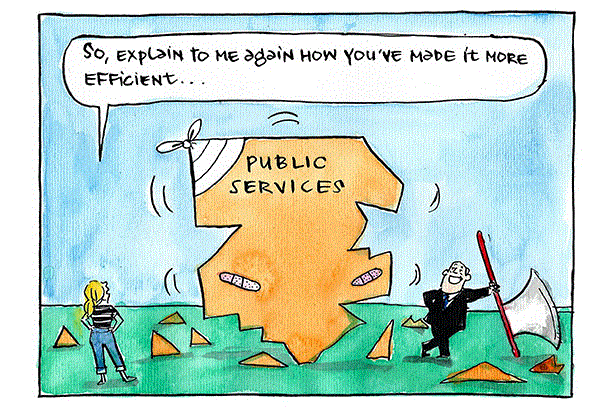
People in local government regularly discuss effectiveness and efficiency. Often this happens in relation to pressure on revenues, such as rate capping. Most of the discussion centres on efficiency rather than effectiveness, and opportunities to stop delivering those services that are seen as ‘cost shifting’ from other government. The efficiency discussion is often not well informed. Frequently it focuses on inputs while ignoring outcomes and public value. Any savings are usually equated with cost cutting, not creating the same value at lower cost.

Australian researcher and writer Christopher Stone has published several papers on ‘false economies’. Each addresses a different aspect of productivity and efficiency in the public sector.

“Everyone has the right to know that money is not being wasted; that it is being spent as efficiently as is possible.” Christopher Stone, Decoding Efficiency, April 2013.

So, what is efficiency and how does it differ from effectiveness? Continue reading

182 – Public management, or management in public?

Posted by Whistler                                                          220 words

scaredy cat

I was reminded today of a practice that seems to have crept into local government with the increasing insecurity and risk aversion of top management. It is similar to the concept of ‘risk farming’.

The practice involves your manager avoiding responsibility by setting up meetings for anything that is happening that they sense could have a down side. In the past, a discussion with your manager at your one-on-one meetings would have sufficed. You could let them know what is happening and undertake to keep them informed.

Now, they are likely to ask you to set up a series of meetings involving them and anyone else they can think of who may have an interest in the matter. The purpose is to ‘keep an eye’ on the issue and ‘support’ you in seeing it through. At the meetings you become publicly accountable for your management of the matter.

In the event that the matter blows up, your manager will implicate everyone else involved and they will be witnesses to your failure. Your manager will no longer be held accountable for your performance – after all, there was a whole group of people ‘supporting’ you.

I am old enough to remember when a manager would provide support by encouraging and advising, and by standing by your side when things were getting tough. They don’t seem to be able to get out of the way fast enough now.

As someone said to me recently, when people don’t know something they get sacred and when they get scared their aversion to risk goes up.

181 – Applying the public value concept in local government using systems thinking

Posted by Colin Weatherby                                                                                         1100 words

dominoes

Image

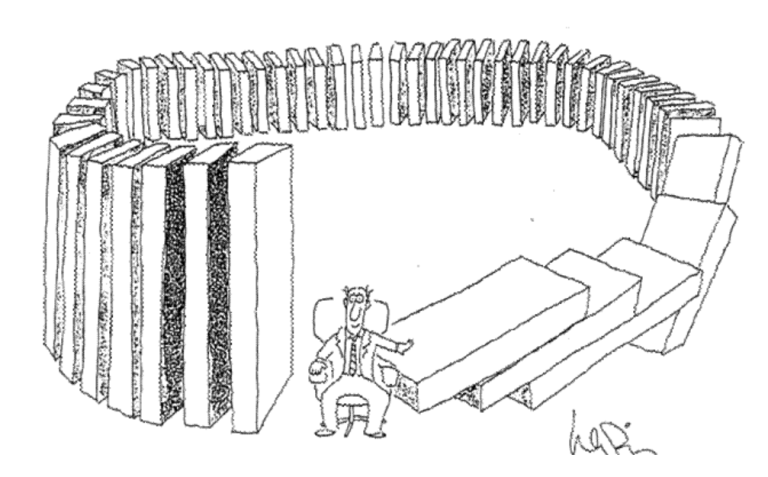
Systems thinking is potentially a great lever for improvements in the design and delivery of local government services. However, it will require a major shift in thinking about how work is designed and managed because the systems thinker is focussed on the purpose of a service from the customer’s point of view.   This is a change from the needs of the organisation and the people working in it driving the design of work and delivery of services. Here are some thoughts building on the earlier post by Parkinson.

Local government needs to work harder to put the needs of customers first despite the realities of multiple and conflicting accountabilities, limited potential for increased income from rates, difficulty defining who the customer is, and increasing expectations of service levels, reliability and speed.

The principal focus of systems thinking is designing and managing the organisation with the customer mind. Continue reading

180 – Long Read: Managers as designers in local government.

Posted by Lancing Farrell                                                                              300 words

design thinking wordle

This is a long read compilation of the series of posts on the manager as designer in local government. For those who prefer to get the whole story in one go, here it is.

Some years ago I read a book called ‘Managers as Designers in the Public Services’ by David Wastell (Professor of Information Systems at Nottingham University Business School). It made a lasting impression on me. It is a book worth reading for its treatment of systems thinking in public service management.

More recently, I read two articles from the September 2015 issue of Harvard Business Review; ‘Design Thinking Comes of Age’ by Jon Kolko and ‘Design for Action’ by Tim Brown and Roger Martin. Each article extends the idea of the manager as designer with specific application to improve corporate processes and culture.

Jon Kolko discusses the application of design to the way people work. He says that people need help to make sense out of the complexity that exists in their interactions with technologies and complex systems, and that design-thinking can make this ‘simple, intuitive and pleasurable’.

“ … design thinking principles have the potential to be … powerful when applied to managing the intangible challenges involved in getting people to engage with and adapt innovative new ideas and experiences.”

The principles he is referring to are empathy with users, the discipline of prototyping and tolerance of failure.

Roger Martin and Tim Brown provide a related but different view of design in organisations. They see it as helping stakeholders and organisations work better together as a system. The focus of their article is the ‘intervention’ required for stakeholders to accept a new design artefact – whether ‘product, user experience, strategy or complex system’.

They argue that the design of the ‘intervention’ (i.e. the way a new product or service is introduced to users and its integration into the status quo) is even more critical to success than the design of the product or service itself.

In effect, there are two parallel design processes; the artefact (i.e. a new service) and the intervention for its implementation (i.e. the change management).

So, how is this all relevant to local government? Read on …

179 – Some thoughts on local government and public value.

Posted by Parkinson                                                                       1400 words

common good

A number of posts written have been written about public value by others (see Why do we provide the services that we do in local government?, Customer, client, citizen, resident or ratepayer. Who are we dealing with?, Applying the public value scorecard in local government services. Part 1. , Applying the public value scorecard in local government services. Part 2., Public value gap analysis. A tool., Public value gap analysis. Some actions., Making high performance happen through value-led management., and Value-led management in local government. Some further thoughts). This post is an attempt to provide a context for further thinking about public value in local government.

Common good and public value

The political philosopher Michael Sandel has identified that rising social inequality is leading to a separation in ways of life between the rich and the poor. He believes that when this happens there is no longer a common way of life because “they don’t use the same public institutions, don’t inhabit the same civic spaces, and don’t avail themselves of the same public services”. As a result, Sandel believes that we can cease to think that we are ‘in it together’ enough to even deliberate together as members of a political community to determine common good.

The gap between the rich and poor is growing in Australia. According to the Oxfam report ‘Still the Lucky Country?’, the wealthiest Australian are disproportionately influential and the poor are at risk of being marginalised and unheard. Extreme wealth provides the power to influence government policies that favour those with wealth, regardless of what would work best for the whole of society.

The common good is the ‘large’ form of public value. Continue reading

176 – In-vehicle GPS – Part 2: How every council can have it.

Posted by Lancing Farrell                                                                              550 words

hurdles

In part one I discussed the features and benefits of in-vehicle GPS. Because councils deliver services at locations dispersed across a large geographic area and vehicle ownership is expensive and utilization is often low, in-vehicle GPS has the potential to provide significant benefits. It links the planning undertaken in asset maintenance systems to in-field work planning and delivery to ensure that resources are used efficiently to complete the planned work. The key barrier has been how to get in-vehicle GPS installed in all vehicles.

I think the trick to implementing in-vehicle GPS is the strategy and policy sitting behind it. Here are some tips. Continue reading