61 – Public value gap analysis. Some actions.

Posted by Colin Weatherby                                                                         280 words

gaps

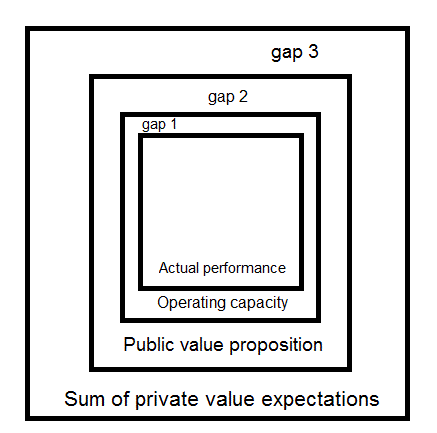
I posted on a tool that can help to identify gaps in public value creation. This post briefly suggests some actions for each gap.

The first gap between actual performance and operating capacity, or potential performance, is best addressed though organisational processes to improve productivity. Recognising the gap is important and then it is in the hands of the organisation to justify its performance or improve it. Utilising all available operating capacity efficiently is the responsibility of organisational management.

Gap 2 requires something new to happen. It isn’t simply a matter of being more efficient and productive. Continue reading

60 – Public value gap analysis. A tool.

Posted by Colin Weatherby                                                                         790 words

private public operation actual

One of the challenges in local government is understanding public value – what it is for your community and how you can create it. It can  be difficult to separate it from private value expectations and to see the relationship with the operating capacity of the organisation. This post explores a conceptual tool to understand public value and gaps that need to be addressed in achieving it.

Many years ago when asked to be the officer leading a community advisory committee I developed a model to help the group understand what we were talking about and to focus on gaps where we could be most effective in making a difference. It worked very well. At the time I didn’t really understand why. Now I think it was because is identified the public value gap that the group could work on. Here it is. Continue reading

45 – Does your Executive suffer from altitude sickness?

Posted by Whistler                                                                400 words

jet pack

A colleague has recently started reporting to a Group Manager who is new to local government. Her observations about the workings of local government provide an insight into our behaviour that we either no longer notice or just accept. This post discusses the observations made of Executive budget deliberations.

Over several days her Executive considered the budget prepared by the organisation and they deliberated over the ‘business as usual’ budget and new initiative bids. In this time the discussion alternated between the high level and the detail. The way she described it, the Executive would say that they needed to be strategic and take a ‘helicopter view’, but each time they attempted to do so they felt discomfort at the ‘altitude’reached and choked. They would then dive straight back down into the details of the matter where they would then spend 10 or 15 minutes going over the minutiae before reminding themselves of the need to deal with matters strategically. They then headed back to higher altitude but once there the altitude sickness resumed and they would dive back to the detail. As I heard the story I imagined them each strapped to a Jetpack.

Over successive issues, the available time frittered away and a series of small decisions were made about the numerous budget bids, resulting in a draft budget that lacked any overall cohesion or strategy linking it to the big picture or the long term. Why did this happen?

After talking to others who have worked in local government for a long time, the process described so colourfully is the same process witnessed annually. Every manager has seen it. Despite their best efforts, the Executive frequently fail to take the high level, big picture, long-term view required. I think this is because they are not confident about what the big issues really are or how they should be addressed. In addition, they lack trust in managers to understand the issues.  Managers and the Executive don’t share the same experiences of working in the organisation. This is evident in culture survey results. The Executive also overestimate the currency and accuracy of their knowledge of operations. This leads them to think they are capable of dealing effectively with the detail.

Low altitude can also be a safe place for some members of Executives.


44 – The Executive. What exactly is its role?

Posted by Colin Weatherby                                                                                         700 words

This seems to be a common question. You frequently hear people saying, ‘that decision will need to go to the Executive’, or ‘don’t do that until you have been to Exec’. If asked, the people saying this often can’t say why they have offered this advice and reviewing the terms of reference for the Executive will usually reveal that it is not a decision making body. It is individual members who have the authority to make decisions. So, what is its role? Continue reading

40 – Unskilled, unaware, or both? The Dunning–Kruger effect at work.

Posted by Colin Weatherby                                                                                         800 words

One of my favourite sayings is that ‘anything is possible when you don’t know what you are talking about’. I have often wondered why I feel the need to use it so often at work. After a colleague sent me link on the Dunning-Kruger effect I am starting to understand why.

The Dunning–Kruger effect is named after David Dunning and Justin Kruger of Cornell University. They published ‘Unskilled and Unaware of It: How difficulties in Recognising One’s Own Incompetence Lead to Inflated Self-Assessments’ in 1999. The title gives you a good idea about the contents. The focus of the paper is;

We argue that when people are incompetent in the strategies they adopt to achieve success and satisfaction, they suffer a dual burden: Not only do they reach erroneous conclusions and make unfortunate choices, but their incompetence robs them of the ability to realise it.

Continue reading

36 – What did you like and dislike about your previous managers?

Posted by Whistler                                                                                          430 words

A colleague told me recently that they had been asked, along with the other managers in their branch, to write a list of the things they had liked and disliked about their previous group managers. The intention was for the new group manager to understand how managers would prefer to work with him. The method of finding out was just a little unorthodox.

The list of likes and dislikes had to be submitted typed on plain paper in an unmarked envelope. Each manager’s anonymous list would then be re-typed onto a longer list to be tabled and discussed at a branch meeting. This whole approach made me think about my previous branch managers, so I made my own list. It was a cathartic exercise. I can recommend it. It is also a way to crystallise your own thinking about what works for you in your relationship with your manager.

Here are my lists. Continue reading

33 – Developing an organisational performance measurement system. Some ideas.

Posted by Lancing Farrell                                                                                     820 words

I have been thumbing through ‘Improving Performance – How to Manage the White Space on the Organisation Chart’ by Geary A. Rummler and Alan P. Brache, in particular the chapter about performance measurement. In it they describe measurement is the single greatest determinant of an organisation’s effectiveness as a system, and as the primary tool for ‘communicating direction, establishing accountability, defining roles, allocating resources, monitoring/evaluating performance, and taking improvement action’.

I haven’t seen a local government that has actively used performance measurement this way. Instead, it tends to be driven by external accountability requirements. We use the performance measurement that we do to convince others that we are doing what we should. Continue reading

27 – Risk farming or good governance? How some executives avoid accountability.

Posted by Whistler                                                                                          400 words

What do I mean by ‘risk farming’? It is the practice of spreading risk around so that your responsibilities become so diffused amongst various individuals and groups that you can’t be held accountable for them. There will always be someone else sharing accountability. So, how is it done?

You start by taking every matter before the Executive. Continue reading

17 – Interested in local government management? Four books you should read and why. Part 2

This post continues my discussion about the books that I discovered in 2014 that I think should influence management in local government.

3. Improving Performance – How to Manage the White Space on the Organisation Chart by Geary A. Rummler and Alan P. Brache. Published in 1995, this book is quite different to the other two books recommended. It is not about the public sector and it is a hard core management book. The authors have developed a way of thinking about organisations and their performance that is very relevant to local government. Topics covered include managing processes and organisations as systems, linking performance to strategy, redesigning processes, and designing a performance measurement system.

Rummler and Brache apply their systems view by discussing the interdependence of nine performance variables shown in the diagram below.

the 9 performance variables

The levels of performance and the performance needs are described:

  • Organisation level – the organisational strategy, goals, and organisational structure.
  • Process level – how work flows across functions in the organisational structure.
  • Job/performer level – the people doing the work in processes.
  • Goals – the customer’s expectations of service quality, quantity, timeliness or cost, etc.
  • Design – of the organisation, processes and jobs to achieve the goals.
  • Management – the practices in place to ensure goals are current and being achieved.

It is a simple and powerful way to think about organisations vertically and horizontally. In a diverse organisation like local government, understanding the performance variables is critical to improving cross-functional services and reducing the ‘silo effect’ in which functional goals are put ahead of the goals of processes that deliver services to customers.  Read it if you are interested in cross functional processes and improving service delivery.

4. The Leaders Handbook by Peter R. Scholtes. Published in 1998, this book is also a serious management text. Written in an engaging way with lots of diagrams and case studies to illustrate points, it is accessible and easily read. So, don’t be put off. For someone who believes in systems thinking, it contains gems, such as this one below written in the context of performance appraisal and why Scholtes believes it isn’t effective;

“Successful work requires having a consistent and reliable set of systems, processes, and methods by which you and your people design, develop, and deliver what the customers need when and how the customers need it. Systems are created, sustained, and improved by insightful and interactive work on the system, not by using carrots and sticks. Measurable goals do not improve systems. Improving systems improves systems (p.303).”

Chapters cover a wide range of topics including, systems thinking; giving meaning, purpose, direction and focus to work; leading by asking good questions; and performance without appraisal. It is clear that Scholtes (a colleague of W. Edwards Deming) values systems and statistical thinking, relations with people, and learning to master improvement. He sees organisations as ‘complex systems of social networks and technical processes in which simplistic approaches will not help resolve complex problems’. He identifies 6 leadership competencies:

  1. Systems thinking – understanding the difference between systems and structure or policy; and seeking systemic causes, not culprits.
  2. Variability at work – knowing the difference between common cause and special causes of variation.
  3. Learning – understanding when a statement is theory or opinion versus fact, and acting accordingly; and knowing the difference between change and improvement.
  4. Psychology and human behaviour – understanding and applying the concepts of internal versus external motivation and demotivation.
  5. Interactions – seeing the interdependencies between systems thinking, variation, learning and human behaviour.
  6. Vision, meaning, direction and focus – providing clarity of purpose and developing and continuously communicating a clear sense of direction and focus.

Scholtes sets out a new paradigm for leadership for complex socio-technical systems.  Local government, with its political and organisational challenges, is nothing if not complex (as discussed in post 3).

I challenge you to read these books and then decide whether you think about your organisation as a system and if it is really focussed on creating public value by fulfilling customer-defined purpose through effective and efficient processes where variation is understood and performance is measured.

Lancing Farrell