293 – IT investment: Dangerous Enthusiasm or Due Diligence? Use evidence to decide.

2200 words (20 minutes reading time) by Carole Parkinson

Podcast option:
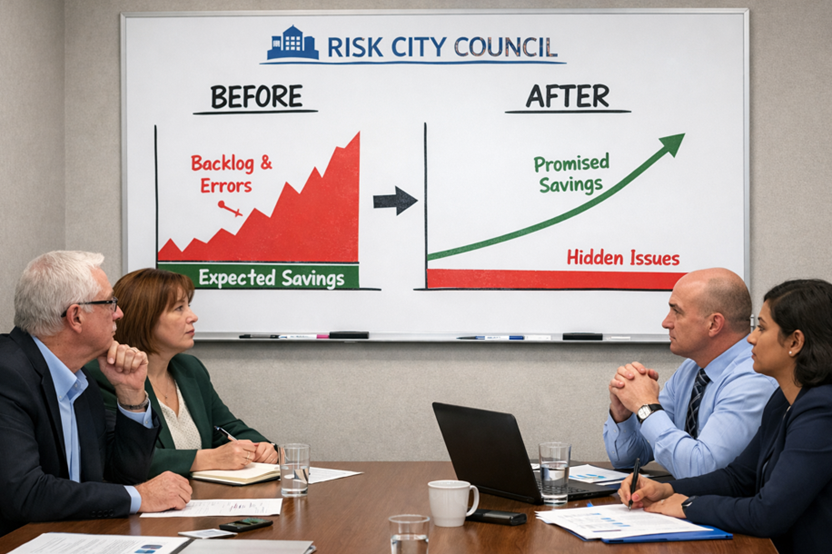
Credit: ChatGPT

In a nutshell…

This post explores the risks and pitfalls associated with large-scale IT investments in local government. It argues that councils often rely on technology and automation to fix financial deficits or service inefficiencies without first optimising their underlying processes. Drawing on expert theories, the post suggests that these ambitious projects frequently over-promise and under-deliver by ignoring the complexities of human-technical systems. To avoid failure, Parkinson recommends that leaders adopt a skeptical mindset, demand evidence-based service studies, and implement incremental project stages. Ultimately, Parkinson emphasizes that improving service design from a resident’s perspective is more effective than simply digitising outdated methods.

Introduction

“I voted for the IT project because the business case promised the budget would balance by year four. But no one told us what we’d do if the savings didn’t arrive. In the end, we automated our inefficient services instead of fixing them. It has now cost us more money than we have saved!

We should have demanded a service study to improve services first, limited the project scope, put a ‘kill-switch’ in place, and made sure the CEO had an effective early warning system in place for failure.”  

Councillor

The lesson?

Big IT doesn’t fix services; it just automates them. You can make governance improvements to reduce the odds of an expensive disappointment.

Why councils are betting on IT

I have been reading the plans Victorian councils are releasing for the next 10 years. These plans are all a bit different. In essence they cover how a council will serve its community, define the services and projects the council will deliver, and show how the councils strategic direction will be funded.

IT investment is positioned as an enabler of efficient service delivery, better decisions, streamlined operations, and improved customer experience, while also promoting transparency and accessibility. It is justified as necessary to meet online-service expectations, modernise old systems, and sustain previous investments.

In a nutshell, they are relying on IT investment to improve how council work gets done so services are delivered more efficiently and conveniently. More importantly, they are relying on them to balance budgets through efficiency dividends from process automation and use of artificial intelligence.

How that bet goes wrong (in real life, not in the plan)

In these plans, some councils provide detailed action plans for IT investment. They describe how the investment in enterprise IT/digital/artificial intelligence (AI) will pay dividends through increased efficiency and better decision making. Few include quantifiable measures, like hours of customer/staff time saved, time or money saved from improved service performance, or number of blocked cyber threats.

Most make more general statements, such as IT investment improving ‘integration, efficiency, service responsiveness, analytics, and data protection’. They tend to flag things like AI and emerging tech as ‘disruptive’, and say they will need continued ‘exploration, upskilling and adoption’ to capture opportunities and maintain service effectiveness.

In all cases, there are lots of red flags. Savings are assumed to come from unspecified efficiencies, even when the way services are delivered hasn’t been optimised. Many benefits depend on behaviour change by people across the organisation, not just installing new software. None consider the cost shifting that happens when you reduce visible headcount but increase hidden work in data cleansing, workarounds, exception handling, and vendor dependency. Finally, they underestimate the cost of learning, backfilling, training, retrospective process redesign, change fatigue, and the productivity dip experienced after go-live.

A major IT investment isn’t simply a technology purchase. It’s a high-risk intervention in a complex socio-technical system. If you don’t understand the system first, IT will amplify the waste, workarounds, delays, and blame that is already there.

Here is how it can play out…

At the planning counter, the new system looked slick—until the first week of lodgements. Applications bounced back for “missing information” that had already been provided, just in the wrong field. Staff spent mornings ringing applicants to re-collect the same details, then re-attaching the same documents. Phone calls doubled, mostly “Can you just tell me where it’s up to?” The dashboard said turnaround times were “on track” because the clock stopped during “awaiting customer” loops.

Meanwhile in local laws, officers found the system couldn’t handle the real-world exceptions. So, they started writing “manual notes” in notebooks and emailing themselves reminders. A shared spreadsheet reappeared to track cases the workflow couldn’t represent. At go-live, the backlog quietly grew: more clicks, more steps, more handoffs. Complaints rose—missed follow-ups, inconsistent decisions, people repeating their story. The weekly report stayed green, while the work moved off-system to get done.”

So, what can councils do?

The good news is that there are people trying to help councils to get major IT investments right.

Three due diligence tests before approving a major IT investment

Be pessimistic on purpose

This is the advice from Professor Robin Gauld and Professor Shaun Goldfinch in their book ‘Dangerous Enthusiasms: E-government, computer failure and information system development’. Across their work on public-sector IT investment failures, the recurring message is that large, ambitious, long-horizon projects routinely over-promise and under-deliver, especially when leaders get swept up in ‘e-government‘ enthusiasm and underestimate complexity and control problems.

It is noteworthy that the Victorian Auditor-General’s IT better-practice guidance explicitly points readers to ‘Dangerous Enthusiasms’ as a key reference.

Gauld and Goldfinch’s advice is blunt:

Assume forecasts are biased (i.e. the cost, time, and benefits) and treat the business case as a claim to be tested, not a plan to be accepted and implemented.

Keep aims modest and measurable, and avoid ‘everything at once’ transformations.

Prefer modular, incremental projects with real-world checkpoints and the ability to stop without catastrophe (no ‘big bang’ that can’t be unwound).

Governance must surface bad news early (i.e. not just traffic lights, milestones, and spend-to-date). When control is mostly through reports and committees, failure can occur quietly.

Knowledge first, IT last

Professor John Seddon has supported service improvement in public and private organisations for over three decades. He advises ‘fix the method (i.e. way of delivering a service) before digitising it’ (i.e. configuring or coding IT software to support delivering the service). His consistent warning is that public services go wrong when leaders manage by targets, budgets and functional silos instead of studying demand and improving end-to-end service delivery. In those circumstances, digitisation often codifies the wrong work (including avoidable and capacity-stealing failure demand) and makes it harder to change later.

Before making a major IT investment, Seddon says:

Study real demand (i.e what matters to residents, what triggers customer contacts, rework, complaints, and escalations/follow-ups).

Redesign the service against purpose (i.e. ‘outside-in from the viewpoint of the customer) and variety in demand first; only then decide what IT software supports delivery of the improved service.

Be suspicious of ‘standardisation’ being sold as creating efficiency when the actual demand is variable and contextual (i.e. planning, local laws, assets, customer requests, aged services interfaces).

Measure capability and flow, not just activity like the calls handled, jobs closed, or milestones met.

Design for work-as-done, not work-as-imagined

Sidney Dekker’s core field is human factors/safety science: how people and technology interact in real work, why ‘human error’ is usually a symptom of deeper system conditions, and how complex organisations drift into failure over time. A major IT investment is a socio-technical change: it rewires workflows, decision rights, handoffs, and defines what ‘good work’ looks like. Dekker has studied the exact failure modes that show up and he specialises in better governance processes.

If you apply Dekker’s thinking to a council IT investment, the practical takeaway is:

Start with ‘work-as-done’ before procurement. Shadow frontline staff, map handoffs, exceptions, and the ‘real’ rules people follow to keep services moving, especially services with high variety like planning, local laws, customer requests, and asset maintenance. Then design the system and its supporting IT around that reality.

Expect workarounds and treat them as intelligence (i.e. signals of a mismatch), not as misconduct. Workarounds usually signal the system doesn’t match the reality for workers.

Look for drift signals: rising exceptions, backlog, duplicate handling, staff ‘shadow’ systems, increased complaints – even when (perhaps, especially when) if the project dashboard is green.

Build a learning response: safe pilots, parallel runs, rollback plans, strong user support, and time for training/practice. Otherwise, time and budget pressure will force risky shortcuts.

Make governance ‘just’ and inquiry-based: when things go wrong, ask “how did this make sense at the time?” so you uncover the system conditions that create failure (rather than hunting a culprit).

What are useful questions to ask before approving a major IT investment?

Based on the advice of Gauld and Goldfinch, Seddon and Dekker, there are three sets of questions to ask:

Set 1 – Method (Seddon): Ask for evidence – the demand study, failure demand estimate, and before and after measures. Make sure you have answers to these questions – What service study have we done? What demand did we observe? What did we change in the service design before identifying the potential new IT software?

Set 2 – Ambition (Gauld/Goldfinch): Ask for evidence – staged scope, kill switch criteria, and the independent audit/review arrangements. Make sure you have answers to these questions – Exactly what have we done to reduce project complexity? Have we looked at modular scope, short horizons, staged implementation, and independent reality checks?

Set 3 – Drift (Dekker): Ask for evidence – what are the rollback and continuity plans, and how will we detect “drift” early? Make sure you have answers to these questions – Are we looking for, and planning to respond to, staff workarounds, increasing exceptions, backlog growth, manual rekeying, and community complaints?

How can you help yourself?

The sets of questions (really, just due diligence tests) are useful, and I have identified three authoritative sources. There are many more sources of advice. If you are curious and want to know more, try asking ChatGPT or Copilot (or your favourite Ai) this question:

 “Find credible, citable evidence (auditor-general reports, VAGO/GAO/NAO/ANAO, peer-reviewed studies, and major post-mortems) of enterprise ERP/CRM/asset IT failures in the public sector. For each case, summarise: what was promised, what happened, root causes, early warning signs, quantified impacts (cost/time/service), and 10 governance actions a council can take to reduce risk. Include citations and links.”

If you really want to tighten up your search, add:

“Prioritise sources from audit offices and primary documents; avoid vendor marketing; include publication dates and direct quotes under 25 words.”

Some final words…

Councils are looking for ways to respond to the challenges of population growth, changing community expectations, and the rate cap. In their long-term plans they are relying on major IT investments to deliver reductions in expenditure through increased productivity, better decisions, and improved customer service. It is a big bet. Firstly, because major IT projects are difficult and exceed the capability of councils to implement. Secondly, they are difficult to govern and there is a real risk of over optimism and drift that gets the council into difficulty before it is recognised. Lastly, unless services have been reviewed and optimised, the implementation of an enterprise IT system will only cement in place inefficiencies and waste.

Before deciding, ask the right questions about what is proposed and why.

A cautious councillor can ask for the IT supplier to carry more risk for their technology. This happens with aquatic facility construction where councils now ask the architect and builder to carry risk for Greenstar compliance and they reduce contract payments if the target Greenstar rating is not achieved. You can also ask for evidence of the success of previous IT installations. This could be at your own council for any major IT change in the last 10 years – ask: What were the reasons for the investment and were the benefits realized? How do you know? The vendor should be able to provide detailed analysis of their success in previous installations, including lessons learned and post-implementation reviews giving quantified achievement of benefits.

Before deciding, gather evidence on your organisations capability and performance of the software.

It is noteworthy that councillors are only given choices about the IT investment needed to improve organisational efficiency, make savings, and improve services. CEOs have decided that the only solution to the councils challenges will come in a cellophane wrapped box from someone else. They are channeling the council down this path and have excluded the alternative that they organise for the people managing the organisation to examine the services they deliver and improve them by focusing on what customers need and expect. It is easier to place a bet on someone else’s solution to your problem than to develop your own.

Before deciding, know what you are betting on.

References

It’s the System, Stupid! Radically Rethinking Advice, AdviceUK, 2008.

Pessimism, Computer Failure, and Information Systems Development in the Public Sector, Shaun Goldfinch, 2007.

Drifting into failure: theorising the dynamics of disaster incubation, Sidney Dekker and Shawn Pruchnicki, 2013.

Note: the podcast was created using NotebookLM.

280 – Reframing the challenge to councils

2000 words (20 minutes reading time) by Lancing Farrell

Introduction

Is the challenge that councils face insufficient revenue to cover costs? Or is it that they are providing services outside their remit? Or is it waste and inefficiency in their operations? Is it all of the above? And, if it is, where do you start to address it?

When you look at the different things councils are doing to respond to the rate cap – arguing for its removal or modification to enable higher rate increases, cutting services and service levels, shaving 10% off every budget to force savings, or implementing an ‘efficiency dividend’ through successive budgets – you could be forgiven for wondering if councils are trying to solve the same problem.

Having a common view of the problem to be solved is a start to genuine and effective action across the sector.

I have been thinking about a simple re-framing of the problem councils need to solve in a rate capped environment.

So, what is the problem?

Continue reading

274 – The Wigan Deal and Value for Money

1500 words (17 minutes reading time) by Carole Parkinson

The Wigan Value for Money Statement

Lancing Farrell’s post on Wigan and the Deal 2030 explains how a council has successfully decided to make a radical change in the relationship with its community in response to austerity measures imposed by central government. By all accounts the Deal 2030 has been successful in reducing the resources needed for the council to deliver its services, in large part by reducing demand for those services by helping people to do things for themselves or to access services provided by the VCFSE (voluntary, community, faith and social enterprise) and private sectors.

It is 10 years since the Deal 2030 was launched. As with any big organisational change, it is hard to evaluate its success from the outside. To help us, there have been several reviews of the Deal 2030 since it was implemented, including the King’s Fund (2019), the Centre for Policy Impact (2019), and a Corporate Peer Challenge (2017). All have reported favourably on both the success in implementing actions in the Deal, and the impact of those actions on the Wigan community. Therefore, it was with some interest that I saw Wigan Council has recently released a Value for Money Statement.

Perhaps everything is not what it appears?

Continue reading

235 – My experience of management thinking in local government – Part 3: The frustrating years.

1000 words (9 minutes reading time)                                                        by Lancing Farrell

management experience pt 3

This is the last post on my experience of management thinking in local government. Writing about it makes it seem like a long haul. With hindsight, there have been lots of interesting ideas, many with potential value to improve services, but few with any practical method to make them useful. And less with a way to implement them across a diverse organisation like a council.

Sometime around 2017 I went back to seriously read more of John Seddon’s writing about the Vanguard Method. At this time, Vanguard had a launch for their Australian office in Melbourne, and I went along. Several Australian organisations, public and private, talked about their experience using the Vanguard Method. I wanted to know more. In 2018 I had the opportunity to fly to London and attend a masterclass on digital transformation being held by Vanguard. I met John Seddon and other senior staff from Vanguard. I also spoke with people from local government in the UK who had experience with the Vanguard Method.

This was fortuitous in the development of my thinking. After three decades I had arrived at an understanding of local government and the way it works that made me think systems thinking was the best way to improve the performance of services. The Vanguard Method provides a way to implement systems thinking that has been tested and proven in local government. It provides the method lacking in Public Value. It works with the culture prevalent at many councils. Continue reading

234 – My experience of management thinking in local government – Part 2: The wasted years.

1200 words (10 minutes reading time)                                                      by Lancing Farrell

management experience pt 2

This second post continues my management journey back into local government. This time into the wasted years – time spent trying different management ideas without success.

Some 10 years later I re-entered local government in a management role. Now we had new management ideas, some even described to me as ‘fads’. In the time I had been out of the sector, the idea of management had gained more currency. I came across Evidenced-Based Decision Making, although as some colleagues pointed out, in practice it was more commonly ‘decision-based evidence making’.

Evidence-based management is an emerging movement to explicitly use the current, best evidence in management and decision-making. It is part of the larger movement towards evidence-based practices.

I found a very interesting sounding book at this time called The Knowing Doing Gap by Jeffrey Pfeffer and Robert Sutton. The title seemed to say it all – why don’t organisations put their knowledge into action? I would like to say this book changed my life, but unfortunately it didn’t. Before I could read it thoroughly, I lent it to a colleague who never returned it. That closed a knowing doing gap for me – don’t lend other people your new books! I did learn that knowing what needs to change, doesn’t mean it will change.

I found that Employee Surveys had now become common place. Councils were now being managed by CEOs who ‘took the temperature’ of organisational culture and then developed plans to improve it. I was never too clear on the connection between culture scores and value for customers or the community.

Employee surveys are tools used by organizational leadership to gain feedback on and measure employee engagement, employee morale, and performance.

These surveys tended to show very little change from one survey to the next, even over a decade. It suggested to me that it wasn’t helping (or relevant) but we still did it. Once I looked at a book produced by one of the big culture survey firms and I noticed that our organisational culture resembled the culture of every industry they surveyed in Australia (except industries with lots of international firms). The differences between industries were at the margins. It seems Australian culture dominates in all Australian workplaces.

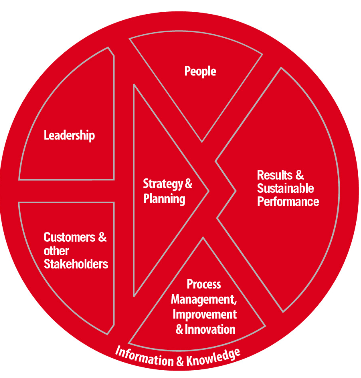
After a while, I started working at a council that was implementing the Australian Business Excellence Framework (ABEF). As someone who by now was quite interested in what local government thought was good, or even better, excellent management, this seemed like a useful idea. There were lots of other councils using it (some were Gold medallists) and it was an idea developed in the private sector, which had appeal to me after returning from working in my own business. So, I joined the strategy and planning group. The CEO had decided ABEF implementation would start with that category.

abef

The EBEF framework and categories.

I found this interesting because I would have started with Leadership, simply because of its potential to effect change and improvement. Since then I have learned that you can start with any of the seven categories. My question today would be why not start with the customer?  In this time I was able to travel and meet with officers at award winning Australian councils and spent hours studying organisational strategy.

Examining how council strategy and planning works only highlighted for me the dysfunction in council strategy development, with various types of plans in a hierarchy (you guessed it, a triangle) with different plans or strategies created at different times and in different ways. None of it was connected in the way the triangle suggested, and, in a surprise to everyone, the group worked out that one of the key plans linking political and organisational actions, didn’t actually exist except in the triangle picture used by the CEO to explain how it worked.

The Australian Business Excellence Framework (ABEF) is an integrated leadership and management system that describes the elements essential to organisations sustaining high levels of performance. It can be used to assess and improve any aspect of an organisation, including leadership, strategy and planning, people, information and knowledge, safety, service delivery, product quality and bottom-line results.

I then discovered Lean and found that it was the new version of TQM or BPR. It seemed to embody similar thinking ideas. I never bought a book on Lean but I started working at a council with a Lean practitioner. He (and many others) spent a lot of time analysing services that weren’t working. Hours were spent collecting data and mapping processes. Days trying to understand what the data was saying and where change might make it better. In the end, while chnages were made, the problems remained unsolved.

My involvement with cross-organisational business processes led me to Karen Martin’s book The Outstanding Organisation, and then her next book Value Stream Mapping. It seemed simple, we just had to learn to understand services as a value stream and then articulate and deliver the value proposition!

A value stream depicts the stakeholders initiating and involved in the value stream, the stages that create specific value items, and the value proposition derived from the value stream. The value stream is depicted as an end-to-end collection of value-adding activities that create an overall result for a customer, stakeholder, or end-user.

Around this time there seemed to be a ‘wave’ of people-based change programs. Leading Teams and The Colloquium are examples. CEOs were clearly searching for ways to act on culture and improve survey results. No doubt these programs were useful, but building people skills wasn’t making the difference CEOs expected. I participated in one of these programs and learned a lot. It was extremely useful to me as a person responsible for managing other people. However, it didn’t help me or my organisation to produce better services.

As an aside to my management journey, in 1995 I had discovered Public Value (yes, I bought Mark Moore’s book Creating Public Value) and the idea appealed to me enormously. Of course, council services are intended to produce the value agreed by people in the community, after all, they are the ones who are paying. In 2013 I bought Mark Moore’s second book (Recognising Public Value) where he illustrates the creation of public value using case studies and describes a way of measuring it (the Public Value Scorecard (PVS)). There is no arguing with the logic of Moore’s strategic triangle, but I couldn’t work out how to use it. Even the PVS was a lagging measure – you would only know if you had succeeded or failed, when you had either succeeded or failed.

I will mention one last management fad that swept local government here recently – User-Centred Design (UCD – there always seems to be an acronym). The council I was working at made a commitment to ‘customer first’ and commenced the analysis and re-design of services using the UCD methodology. We developed personas, customer apps, online forms. It really should have been called ‘digital first’. The problem that emerged was lack of integration between these new and easier ways for customers to deal with us and the actual service delivery systems. It had become easier for customers to make their needs known to us, and to place a demand on one of our service systems, but we were just as slow to respond, and just as likely to fail to satisfy their need.

The upshot of all my thinking and doing was a level of dissatisfaction with the way things are and a determination to find a way to deliver better services. I felt a compulsion to do this as rate capping was reducing our revenues and making it harder to make ends meet. A better way was needed.

Another pattern had emerged – I was now interested both in services as a cross-organisational process, and how you help an organisation to change and improve services.

It was at this time that I recalled some earlier reading I had done on systems thinking and the application of systems thinking in organisations. It started with Alistair Mant and his excellent book, Intelligent Leadership, that I had purchased in the late 90s. I also bought and read David Wastell’s book Managers as Designers in the Public Sector, and through that book came across John Seddon’s book, also from the Triarchy Press stable, on Systems Thinking in the Public Sector. The idea that systems thinking could provide a solution to service improvement became clear in my mind.

I also became convinced that Command and Control thinking (a term used by John Seddon) was a barrier to service improvement. Councils are highly siloed organisations. We like functional specialisation. Each discipline focuses on their work and excelling at what they do. Hierarchy is critical for decision making and it is often the only way that the silos become linked. Senior management have the ‘umbrella’ jobs that integrate work across silos, or at least that is where it can and must happen in a Command and Control hierarchy.

I started looking for more information about systems thinking. At some stage I came across David Stroh’s book Systems Thinking for Social Change. By then I was hooked. There had to be a way of applying systems thinking to improve local government performance in delivering services that provides public value. The challenge was to find a method to do it. The ideas were interesting and well-articulated, but how do you use them to do the work differently?

By now I had begun blogging to communicate with others experiencing the same frustrations as me. It helped me to learn.

227 – Frogs or bikes – I’d love to see that.

600 words (3 minutes reading time)                                                                   Tim Whistler

frog on road

I read Colin Weatherby’s post on the Vanguard Method and systems thinking with some interest. There have been a number of posts on systems thinking on this blog. It is not a new idea. I am intrigued by what makes the Vanguard Method any different to other applications of systems thinking. I am also interested in how it relates to concepts like public value. How does the Vanguard Method achieve better or different results?

As previously posted, I have some interest in the Vanguard Method. I suppose, I am sceptical about the likelihood of any method being taken up in local government if it relies on ‘counter-intuitive’ truths and if there is no detailed plan to say what will be achieved and when. It is always hard to justify expenditure of public funds without a written plan with measurable outcomes – even if everyone suspects the plan is ill-founded or optimistic. If you aim for the stars, if you fail you will at least land on the moon. A plan gives you something to measure the effort against and hold people accountable. After all, isn’t public accountability the aim?

Continue reading

226 – Frog or bicycle? The Vanguard Method at work.

2250 words (8 minutes reading time)                                                   Colin Weatherby

frog on bike

Some time ago Tim Whistler wrote a brief post on the Vanguard Method in Australia. Since then I have been talking to a colleague who has been using the Vanguard Method. Their experience has highlighted aspects of the Vanguard Method that are different to other system thinking approaches. The originator of the Vanguard Method, John Seddon, has also written a new book (‘Beyond Command and Control’) that discusses some of the differences between the Vanguard Method and other popular approaches to organisational change. This is rather a long post but worth the effort to read it if you are interested in systems thinking and the Vanguard Method.

Continue reading

205 – ‘We don’t need to be clever – just less stupid’, The Age 23 February 2016.

Posted by Colin Weatherby                                                                         700 words

Dont need to be clever just less stupid image

Image

I read this article and though it was fortunate that the writer, author and polymath Satyajit Das, hadn’t been dealing with his council. No doubt a greater attempt would have been made to feign ‘one stop’ service but if it was anything but a simple matter, he would have come across the same dysfunction. His acuity is evident in his analysis.

Das’s dealings with his bank highlighted how the quest for efficiency and lower costs has achieved the opposite result. This is a recurring theme in the writings of John Seddon about the public sector. Das lists six sources of ‘unproductive and inefficient’ failures that he believes are now common in many organisations.

  1. Tasks have been fragmented across different locations and the simplest activity is now complicated.
  2. There is no continuity. ‘One person is not accountable for the complete activity. Workers lack any idea of how what they are doing, or not doing, affects the whole process overall’.
  3. Staff lack the skills and knowledge required.
  4. Performance measurement has lowered, rather than improved, performance. Staff actions detract from results instead of helping achieve them.
  5. Leadership is lacking in ‘domain knowledge’ (i.e. valid knowledge in a particular area).
  6. There is a tendency to see history as old and irrelevant. The latest technological wizardry is the best solution to any problem. Valuable lessons from the past are routinely ignored.

There have been a number of posts on these very topics. Continue reading

198 – Essay No. 5 – Local government and leadership.

Posted by Colin Weatherby                                                                         1300 words

Mark H Moore strategic triangle

Mark H. Moore’s ‘strategic triangle’ – the basis for value-led public sector management

I have been thinking about leadership a lot recently. It has been a recurring theme in posts on this site. Reading Jeffrey Pfeffer’s book has challenged my thinking about how leaders work and what motivates them. It has reinforced some of my scepticism about leaders and why they do what they do. I tend to agree with Peter Drucker’s questioning of the distinction between leadership and management. Ultimately, organisations, particularly in the public sector, have to be managed. The idea that somehow managers aren’t leaders or that leaders aren’t managing doesn’t make sense.

Having said that, I can think of organisational leaders I have known who couldn’t manage. At some point they just ticked the leadership box and assumed the position! Pfeffer explains how and why everyone then goes along with it. Once you are a leader it seems you can get to stay there without any real scrutiny and accountability for your performance. That has definitely been my experience in local government.

I keep imagining myself working in an organisation with an effective leader who manages the organisation for high performance (not career advancement). One that provides clear strategy, direction and goals.  One who coordinates effort to  across the organisation to achieve those goals. In particular, I have been thinking about how they could do that in local government. Continue reading

194 – Essay No. 4 – Local government and customer service.

Posted by Lancing Farrell                                                                              4500 words

basil fawlty

Customer service is, and should be, a major concern for local government. After all, councils are service organisations. Sometimes there is confusion about exactly what customer service means, how it relates to public service delivery, and what aspects of service are most important to get right in local government.

This essay focuses on three hypotheses:

  1. That ‘customers’ in local government are different to the customers described in most customer service literature and encountered by most service organisations.
  2. There are six main opportunities for local government to improve service to customers.
  3. There are simple tools available that can assist councils in getting service delivery and customer service right.

Continue reading