145 – The deep web and local government recruitment.

Posted by Colin Weatherby                                                                                         1100 words

deep web

Local government executive recruitment is a game. Often recruitment is not genuinely based on competence and ability. In many cases, relationships are far more important. I have heard it described as the ‘deep web’ – what you see isn’t all there is. So, how does it work?

Councils recruiting a new CEO tend to go for ‘tried and true’ or ‘shiny and new’.  I think analysis will show an alternating pattern from one to another. It is almost as though councilors become bored with their CEO, or, more likely, the CEO refuses to do what they tell them to do. Once a CEO stands up and says ‘no’, they are likely to be on the way out.

Councilors know that they can demand that a CEO does what they want – whether or not it is in their or the community’s best interests. I think that once a council has dismissed a CEO and they have a ‘taste of blood’ they are more likely to do it again and a cycle of CEO non-reappointments and appointments begins (with all the disruption this brings).

When councils are recruiting a CEO, they rely on assistance from the recruiters – companies that specialise in helping councils to recruit executives. These companies can be highly influential. Continue reading

144 -The local government coracle.

Posted by Whistler                                                                          200 words

coracle paddling

I read Colin Weatherby’s post on what he would do as the CEO in response to Lancing Farrell’s question with some delight. I too have often made the connection between local government and boats, but in a different way.

Celtic monks gained a certain amount of fame for setting off in coracles to see where God, by way of currents, led them. Some of them set off without even an oar. Monks are famous for this kind of faith and their willingness to take risks.

Despite the propensity of coracle sailors to take risks, it somehow seems an apt craft for local government. The idea that many councils are like little round boats that go where wind and tide takes them is fitting. Having no front or back, it doesn’t matter which direction they go in. Having no method of propulsion leaves them at the mercy of external forces. Even a skilled navigator would struggle to take one in the direction they wanted to go.

I am not suggesting that every council is a coracle or that CEO’s and senior management must sit idle while the organisation goes in whatever direction greater forces take it. But sometimes it feels like it.

142 – A question. If I was the CEO what would I do? Answer: Focus the change effort.

Posted by Colin Weatherby                                                                                            740 words

boat builder CEO

I am sure being a CEO isn’t easy. The political environment in Australia is difficult and even more so in local government where the politicians are unpaid and not supported by political parties. There are many other pressures from the external environment – i.e. changing State government legislated responsibilities and increasing oversight of council operations; contentious urban growth and renewal planning decisions; inadequate State services for transport, education and health; and changing community expectations of service. So, if it was me, what would I do?

To begin I would not let the limitations and problems of the political and external environments dominate my management of the organisation. They are both urgent and sometimes important. However, they are not easily influenced and can take all of top management’s time and energy for little return. By all means be engaged and influence where you can but my approach would be to put my effort where no one else can and where I will get the best return.

By doing this, I think there would also be an improvement in the political environment and a stronger position to tackle the external pressures.

What do I mean? I would get my house in order. I would ensure that the resources at my disposal are used to create the maximum value for the community that has provided them. My goal would be for every ratepayer and resident to love living in my municipality. They would love it so much that they would tell all of their friends about it. They would offer to pay more for the services that they or their neighbours need. Every day social media would have stories of the great experiences people have had dealing with the council and the surprisingly good value they received.

Expectations would be met for basic service and exceeded where the value is visible and appreciated. This is the value capture that Sayan Chatterjee  talks about – councils don’t want people to value the services they provide and to offer to pay more so that the council can make a profit. Councils are not in that business. Instead, councils want them to be loyal customers who enjoy the value they get from paying their taxes. That enjoyment and loyalty is the value capture.

I wouldn’t ignore the outside world but I would want to be leading an organisation that redefines community expectations and delivers outstanding value. Here is how I would do that in order.

  1. Provide a more inclusive and less autocratic management style that suits local government culture and organisations expected to work that way with their customers.
  2. Set clear strategy – who are/are not customers; what service will/will not be provided to them; and how will it be done efficiently using available resources.
  3. Improve the customer focus by putting customers first (I mean really putting them first, not just saying it) through understanding the value they expect and designing services to provide it within available resources, now and in the long-term.
  4. Create better processes to make decisions and delegate more decision making and empower staff throughout the organisation so that more decisions are made and faster.
  5. Establish greater accountability by setting expectations and measuring performance so that feedback is provided to support achievement and create a performance-orientated culture.
  6. Focus innovation on areas of the organisation where significant change is required and set up systems to so that everyone continuously improves.
  7. Simplify the complexity inherent in local government by identifying and eliminating process constraints that have developed over time.
  8. Focus on productivity by ‘unlocking’ the capacity of people and resources to ensure that the required services are being provided as efficiently as possible.

I have been told (by a CEO) that a world where ratepayers and residents enjoy the value they get for the taxes is unrealistic and unachievable.  If that is what our leaders think, what hope is there?

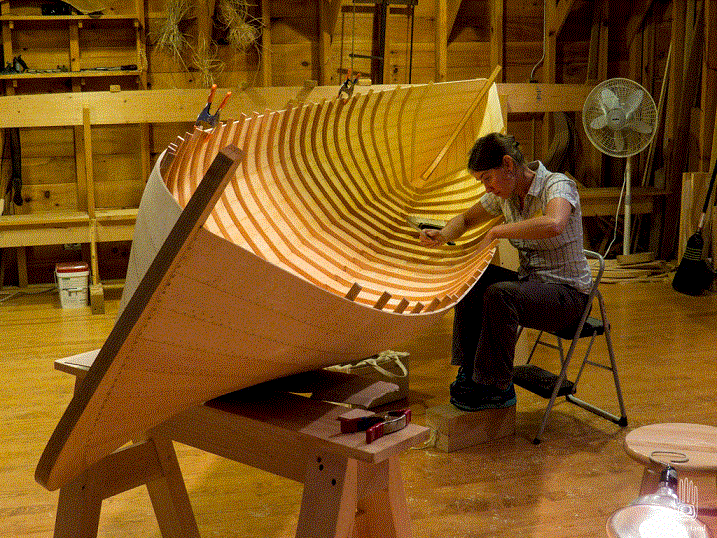
I have used an image of a boat builder for a reason. I have a relative who owns and builds wooden sailing boats. After talking to him, I think that leading an organisation is a lot like building a boat. You need to design the boat to optimise the performance required – does it have to be safe in all conditions, will it have to make fast passages, or will it carry burdensome loads? One boat can’t do them all.

Then materials must be selected and the builder needs to understand the properties of those materials – how they are worked to make the boat, how they will perform under load, how they will fail, and how they can be repaired.

A boat must be made with care. There is a right and a wrong way to do it, and doing it the wrong way could lead to failure and loss of life. Finally, the boat needs to be beautiful.

This is an important point for local government.  In the same way that there is no joy in building or owning an ugly boat, success in local government must also include a sense of pride and achievement in having contributed to something worthwhile.

Chatterjee, Sayan 2013. Simple Rules for Designing Business Models, California Management Review, Winter.

141 – If local government was a car, what sort of car would it be? Part 3 – the Volvo 240 series.

Posted by Whistler                                                                                          600 words

volvo 240

Some time ago I started thinking that if a council was a car, what it would be. This is the third post in a series of five. The first review was for the Hyundai Excel Sprint council and the second was the Leyland P76.

Third is the Volvo 240 series. Immortalised by Dudley Moore as being ‘boxy but good’, the 240 has carted many families around in relative safety for decades (yes decades – they last forever). No glamour here, just rock solid, dependable performance and the best safety standard available at the time. Continue reading

139 – A question. If I was the CEO what would I do? Answer: Nothing.

Posted by Whistler                                                                          230 words

heart rate

This is my response to the question posed by Lancing Farrell.  I think the CEO has found local government the way we like it. I am not sure what their problem is. A strong and autocratic style from the CEO reassures us that there is someone at the top calling the shots and keeping the councillors in line. With no one prepared to make difficult decisions it keeps things stable and predictable. This suits the low level of organisational achievement and absence of time consciousness. What more could you ask for?

With people running the place who have been rewarded for their allegiances and length of service, this would be a predictable and easily understood workplace. Recruitment would be straightforward and safe. Anyone with experience in the sector would easily fit in and, so long as they got along with those in charge, could be quite successful.

Why the need for change? After all, why change something when you don’t have a clear idea of what you could or should change it to? Maintaining the status quo is a time honoured way to manage, especially in the face of uncertainty. Doing nothing could be the best thing to do and it is the lowest risk for those in charge.

Fear of change has been a hallmark of local government and an approach that has served it well. It has kept everything in its place. Consistency is important in service delivery and local government has been extremely consistent over many years. Everyone knows what to expect.

138 – Three books with management concepts relevant to local government that might appeal to the reluctant reader.

Posted by Whistler                                                                                                          1100 words

dr seuss

I posted on the local government reading test a while ago and a few colleagues have commented that many management books are written as simple parables, almost like children’s books, to help convey complex information. One of my children reminded me of some of their early ‘management’ reading and I thought I would post on it.

  1. ‘The Lorax’ by Dr Seuss (61 pages)

I will start with the longest of the books, though none of them is by any measure a challenging read. Even though they were written by a doctor, he has included lots of pictures to ease the journey for the weary reader. Continue reading

137 – EPM, PMO or JACI. What are our CEO’s talking about now?

Posted by Colin Weatherby                                                                         1180 words

project flow diagram

I recently attended a presentation on enterprise portfolio management or project management offices in Victorian local government. It seems to be the latest idea that has caught the attention of CEO’s in their search for solutions to problems they can see.

I must have been working in local government for too long. I have seen management by objectives, evidence-based decision making (or decision-based evidence making as I like to more accurately describe it), total quality management, reengineering, and more recently, lean and high performance teams. It is as though we look out our window and see someone doing something that looks like what we think we should be doing and we just copy them.

In two of the long reads (here and here) the shortcomings of copying the private sector are dissected by Peter Drucker and Henry Mintzberg. Continue reading

136 – If local government was a car, what sort of car would it be? Part 2 – the Leyland P76.

Posted by Whistler                                                                                          480 words

leyland p76

Some time ago I started thinking that if a council was a car, what it would be. This is the second post in a series of five. The first review was for the Hyundai Excel Sprint council.

The second is the legendary Leyland P76. The Targa Florio, no less. They promised so much and delivered so little. Launched with much fanfare and designed for ‘Australian conditions’, the P76 didn’t live up to expectations. It could fit a 44 gallon drum in the boot and under the bonnet it sported a V8 engine. Continue reading

135 – A question: What would you do if you were the CEO?

Posted by Colin Weatherby                                                                         180 words

woman

A colleague working at a council with a new CEO sent me a list of the organisation’s woes as identified by that CEO with their summary of the situation. It started me thinking, ‘what would I do if I was the CEO?’

Here is the list:

  • Strong autocratic and bureaucratic style on the part of the previous CEO.
  • People fearful to make decisions and comfortable not making them.
  • Strong avoidance of accountability.
  • A very conventional approach – ‘we have always done it like this’.
  • Low level of achievement – ‘if we don’t get it done today, there is always tomorrow’.
  • A low level of self actualisation and self worth.
  • Younger staff desperate for change.
  • Older staff scared of change.
  • A number of senior staff complacent in believing that all is perfect.

All of this led to a realisation that as a council with a demanding community and limited resources, the current culture would not support the future.

What would you do?

Please comment below or send your response to localgovernmentutopia@gmail.com

134 – ‘A new theory of value creation for local government’. Do we need one? Part 4 – Integrating the thinking.

Posted by Lancing Farrell                                                                              1600 words

cutting diamond

This last post in this series (see here, here and here for previous posts) is an attempt to synthesise a new theory of value creation for local government using the ideas discussed in the previous posts.

First, a quick recap on strategy, business models and operations stratgey.

  • The strategy is the position that an organisation takes in relation its market, the value it decides to create, and how it decides to create that value and operate at a surplus.
  • Every organisation explicitly or implicitly employs a business model that describes the design or architecture of the value creation, delivery, and capture mechanisms it will use.
  • The operating strategy then guides decisions about vertical integration, capacity planning, facilities planning, services technologies, and process technologies.

A new theory of value creation for local government will need to integrate these concepts into a cohesive and repeatable approach. Continue reading