95 – Making high performance happen through value-led management.

Posted by Lancing Farrell                                                                              850 words

tug of war

Some time ago I posted on Frank Ostroff and the barriers that he believes prevent change in government . Ostroff makes a lot of sense – formulate a vision, be mindful of your present situation, seek the support of stakeholders, set a clear path, understand the complexity in what you are doing, and hold people accountable. However, I have found that sometimes you need a simple tool to take those ideas into practice. I was once asked by a CEO.

‘How do you get people to fundamentally re-think what they are doing instead of making incremental improvements to optimise what they are currently doing?

Maybe this is the answer. Continue reading
78 – Organisational comfort zones in local government. Where is yours?

Posted by Colin Weatherby                                                                         730 words

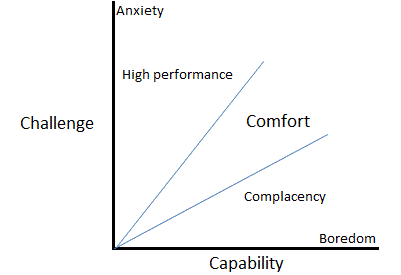
Challenge capability diagram
The idea that people are often in their comfort zones and that learning and improvement occurs when you move out of it has currency in local government today. The concern is that when people find their comfort zone they settle in and thereafter resist change, even beneficial change. Individuals are regularly being asked to leave their comfort zone and accept challenges. Does an organisation also have a comfort zone?

I think many organisations do – and they stay in them. It will usually be the zone that the organisational leaders, the council or the CEO and Executive, allow it to be in. Frequently, it is a place that they understand and there will be a level of challenge and change activity that the leaders are comfortable to support. The question is what is that level at your organisation? Continue reading

77 – Operational excellence in local government. Does it matter?

Posted by Lancing Farrell                                                                        600 words

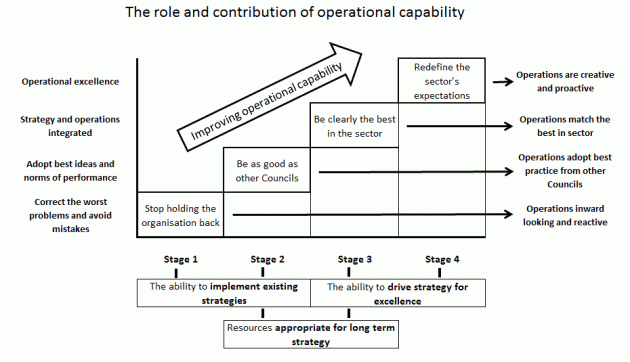
operational capability

In a recent discussion with a colleague she mentioned that in her previous employment outside local government they had set organisational performance goals for leadership, finances, relationships, safety and operational excellence.   Each area of performance was rated equally. It started me thinking about how little you hear about operational excellence in local government. Is that because it doesn’t matter?

I am sure that operational performance matters. Whether councils want to be excellent or not, I am less sure. I think that the reason it is seldom discussed is that few people have a real understanding of operations management or what excellence would look like or how to achieve it. Continue reading

69 – Local government and milk. What do they have in common?

Posted by Colin Weatherby                                                                         660 words

cow

I recently drove past a car sign-written with advertising for milk available direct from the farm. It promoted the virtues of buying milk from the producer. I had earlier heard a radio advertisement for milk available from an inner urban Melbourne dairy where I am sure there are no cows. The advertisement talked about local milk from local people.

There may be some difference in the milk each company is selling. And it is probably different from the milk I can buy at my supermarket. So what is happening with milk and why might it tell us something that is relevant to local government? Continue reading

62 – “The way to make it in local government is to forget ambition and pigeon hole yourself before someone else does”.

Posted by S. Dogood                                                               1000 words

pigeon hole

This was the advice I received during a discussion with a colleague this week.  Pigeon hole yourself he advised and local government becomes a good place to work.  In some ways he is right.  The discussion started me thinking about why that is the case and how it could be different.

The ambitious face a number of challenges.  First and foremost they can’t be threatening to the Executive.  Secondly, they need to be realistic about their skills and value.  Lastly, regardless of their own role breadth or experience, they run the recruitment gamut as there is always a hierarchy of preferred candidates for any role.  Hiring traditionally take the following hierarchy seeking to recruit someone who Continue reading

61 – Public value gap analysis. Some actions.

Posted by Colin Weatherby                                                                         280 words

gaps

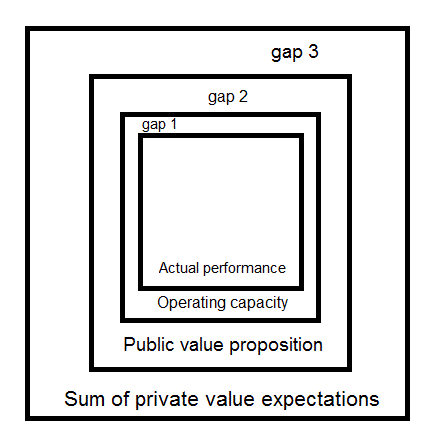
I posted on a tool that can help to identify gaps in public value creation. This post briefly suggests some actions for each gap.

The first gap between actual performance and operating capacity, or potential performance, is best addressed though organisational processes to improve productivity. Recognising the gap is important and then it is in the hands of the organisation to justify its performance or improve it. Utilising all available operating capacity efficiently is the responsibility of organisational management.

Gap 2 requires something new to happen. It isn’t simply a matter of being more efficient and productive. Continue reading

60 – Public value gap analysis. A tool.

Posted by Colin Weatherby                                                                         790 words

private public operation actual

One of the challenges in local government is understanding public value – what it is for your community and how you can create it. It can  be difficult to separate it from private value expectations and to see the relationship with the operating capacity of the organisation. This post explores a conceptual tool to understand public value and gaps that need to be addressed in achieving it.

Many years ago when asked to be the officer leading a community advisory committee I developed a model to help the group understand what we were talking about and to focus on gaps where we could be most effective in making a difference. It worked very well. At the time I didn’t really understand why. Now I think it was because is identified the public value gap that the group could work on. Here it is. Continue reading

53 – Coffee, basketball and privatisation. What significance could they have for Australian local government?

Posted by Colin Weatherby                                                                                    1000 words

the barista economy

Image from The Age, 11 March 2015

On the 11 March 2015 there were three articles in the Melbourne Age newspaper on different topics that each held a message of potential relevance for local government.

The first was ‘Welcome to the barista economy. The article is based on a speech by Christopher Kent from the Reserve Bank of Australia (RBA) who looked at changes in household expenditure patterns over the past 30 years.

One thing is clear: we are spending a lot more on ‘services’ than we are on ‘stuff’. The share of household spending on services is up from 53 per cent to 65 per cent of household consumption.

The RBA explains the increased spending on services as a result of cheaper goods because of better productivity and more goods coming from ‘emerging economies’. The world has become better at producing goods and people now have more money to buy services, which in effect is buying time. We can afford to employ someone to perform tasks when our time is better spent on other activities, we don’t have the skills, or it improves our quality of life (e.g. leisure).

The barista connection highlights the growth in service industry jobs. Coffee shops are everywhere. Having a coffee has become part of every outing.

I think that the significance for local government is twofold. Continue reading

46 – Labor’s rate cap to hurt services and infrastructure, ratings agency warns’. The Age, 27 February 2015.

Posted by Colin Weatherby                                                         900 words

 slices of cake
Image from http://www.that-is-good-crap.com

This article follows an earlier piece in The Age,  ‘Plan to cap council rates at inflation could lead to service cuts and job losses in Victoria’ on 23 February 2015. Both articles are about the planned legislation in Victoria to restrict councils to rate increases at or below the Consumer Price Index from 2016 unless they seek an exemption from the Essential Service Commission. Some councils have already started to cut jobs to reduce expenditure ahead of rate capping. Others are forecasting cuts to their services and reduced maintenance or renewal of community infrastructure.

This is occurring at the same time that the State government is shifting more costs onto councils and national grants to councils are being frozen. I have previously posted on rate capping (see here , here and here). As you can imagine, rate capping is dominating talk within local government circles. Continue reading

44 – The Executive. What exactly is its role?

Posted by Colin Weatherby                                                                                         700 words

This seems to be a common question. You frequently hear people saying, ‘that decision will need to go to the Executive’, or ‘don’t do that until you have been to Exec’. If asked, the people saying this often can’t say why they have offered this advice and reviewing the terms of reference for the Executive will usually reveal that it is not a decision making body. It is individual members who have the authority to make decisions. So, what is its role? Continue reading